Wikileaks saved Afghan asylum seekers from deportation

Wikileaks logo

If you look at the criticism leveled at Wikileaks in the wake of “Cablegate” as well as the earlier leaks of the Iraq and Afghan warlogs, it usually boils down to two points, often made at the same time: the leaks don’t tell us anything we didn’t know before and at the same time, they endanger (American) lives. Both are of course fairly opportunistic claims, usually made in bad faith but effective enough they’ve been repeated over and over again with each new round of leaks. So it’s good to learn about a counterexample that disproves both, as it turns out the revelations in the leaked Afghan warlords have made several Dutch judges decided to disallow the expulsion of Afghan asylum seekers.

Normally when judges decided whether or not a given country is safe enough to send asylum seekers back there, they depend on statements given by the ministry of foreign affairs. In the case of Afghanistan however no less than five judges found that Wikileaks’ Afghan warlogs proved that the country was not secure enough to force people to return there. When this became known, it lead to questions in parliament today, as government party CDA found it “remarkable” that judges would sooner trust Wikileaks than their own government, while opposition party PvdA wanted the ministry to start using the Wikileaks revelations in their statements, something the minister said was already going to happen…

So there you have it: positive proof Wikileaks is important.

QotW: Alex on stupid, stupid security schemes

Casting a geek eye on l’affaire Wikileaks, Alex finds time to rant about Mastercard SecureCode:

hat a horrible idea Mastercard SecureCode (and its pal Verified by Visa) is. I already hated it before this – it’s a password, that should be a strong password because it’s financial, but that I don’t use that often and therefore can’t remember, and it trains you to accept the idea of typing confidential information into a random web site you didn’t ask for. Essentially all phishing requires you to type your bank details into something that you didn’t ask for. Forcing the public to type their bank details into some random website they didn’t ask for is howling insane. Right?

I like the Dutch IDEAL (sic) payment method better: pay through your own internet banking account rather than fart about with credit cards and stupid password schemes. Especially because the schemes Alex mentions allows you to actually create a new password/account everytime you use it, as long as you know your credit card details (name, card number, secure code on the back of the card). Which means it’s not actually any safer than using a credit card without Mastercard SecureCode. It’s security theatre that provides you with a false sense of security while actually not being any safer and worse, teaches you bad habits.

A tale of two kinds of victims

Charles and Camilla shocked at public anger aimed at them

A report about the attack by rioters on the car carrying Prince Charles and the Duchess of Cornwall will be completed by Friday, the home secretary has said.

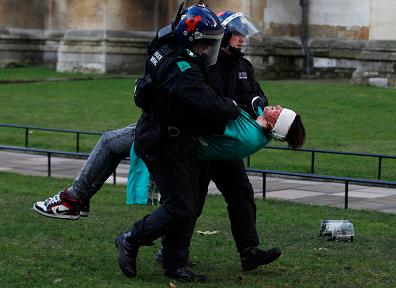
A victim of police brutality carried away by two London cops

No report on the attack by police on peaceful protesters will be completed by Friday, nor is any promised by the home secretary. The home secretary is however of the opinion that organised thugs infiltrated the protests.

In either case the violence perpetruated by the ruling classes on students and young people — ending of EMA grants, the raise in tuition fees — remains invisible, part of the “peaceful democratic process”.

Unsuccesful minor writer in literature snobbery shock

One Edward “my surname is not a Microsoft trademark” Docx gets the opportunity in The Guardian today to moan about those horrid, horrid bestselling genre writers taking away readers that belong to proper literaty writers. Ho-hum. It’s nothing you haven’t seen before and done better, an insipid bit of literary trolling a cynical man might think was done to get the Guardian some hits and our Docx friend some publicity just in time for the publication of his next novel. Pointless to respond to it, to either defend genre writing or to show where he stacked the deck, that would just take him much more seriously than he deserves.

Remains just to note that the p.r. blurb for his latest work does make it sound awfully like a genre novel:

Dr Forle is a scientist living on a river station deep in the South American jungle. Founded by his mysterious mentor, Quinn, his is the last manned post before the impassable interior. Forle’s small band of colleagues are an international crew, working with locals to study the eerie forest glades – created by poison ants – that the Indians call ‘devil’s gardens’. When a strange canoe docks at the jetty one afternoon and offloads not just their usual supplies but an unannounced Colonel and a sinister Judge, life on the station is thrown into chaos. These men claim to be registering the local Indian tribes to vote. But on the night of their arrival, Forle witnesses a terrible act of torture. Unable to ignore what he has seen and yet unwilling to abandon his work, he is drawn deeper and deeper into a world of brutality and corruption: a small war involving remote tribes, the army, cocaine growers and even Sole, the half-Indian woman whom he had come to love. When one of his assistants is murdered, Forle is forced to abandon his life’s work and take sides. But what kind of a man is he? In the tradition of such classics as “The Heart of Darkness” and “The Lord of the Flies”, “The Devil’s Garden” is a contemporary and mesmeric study of power and corruption from one of our rising literary stars.