In honour of the last migration we just went through at work this Saturday, here’s Doe Maar with the last song of their last concert back in 1984.
Neither Britain nor Holland needs an army
Simon Jenkins says what I’ve been saying for a while now: countries like Britain do not need armies anymore:
Six months ago I proposed in the Guardian that if Britain was short of money it should cut defence. I did not mean reduce defence, or trim defence. I meant cut it altogether. We are desperately short of money and absolutely no one is threatening to attack us now or in the foreseeable, indeed conceivable, future. Besides, as we have seen this past week, other ways of ensuring security make more pressing claims on us. We just do not need an army, navy or air force. So why are we paying £45bn for them?
[…]
The argument can take amazing forms. Come now, say the high priests. Just suppose another Hitler rose again, built a new Luftwaffe and U-boats, and bombed London and sank all our coastal trade. We would need a carrier. Suppose Russia falls under the sway of an oligarch with a grudge against Harrods and a business rival in Kensington Palace Gardens. Suppose he decides to nuke them. Supposed 100 suicide bombers block-booked themselves on Eurostar and went to every Premier League match. You would look pretty silly, Jenkins, wouldn’t you?
I would look pretty silly, and probably I wouldn’t be the only one. But for the time being, I regard such unrealities used to justify massive spending as no less silly. We can only meet realistic threats. We do not build 1,000 NHS hospitals and leave them to await the return of bubonic plague.
If Britain does not need an army nor cannot actually afford one, what about Holland? We’re spending about eight billion euros a year on “defence”, yet still had to cannibalise our army, sell off equipment that had barely entered service just to pay for our “missions” in Iraq and Afghanistan, fighting people that had never threatened nor harmed us. That we could do, but against a real enemy our army is just too small to be a credible defence and anyway, who is going to attack us anyway, Belgium?
New mushroom species discovered in Holland
You’d think that in such a densely populated, crowded and completely manicured country like the Netherlands the only new species to be found to be single celled, but you’d be wrong. Because late last month an entirely new mushroom species (Dutch) was found in Schouwen-duiveland, an island in my home province of Zeeland.

The new species was discovered during a research week organised by the Nederlandse Mycologische Vereniging (Dutch Mycological Society), who regularly organises this sort of trips to less well researched parts of the country. the new species wasn’t the only surprise, as they also found several species new to the Netherlands.
It seems that despite the fact that it’s almost impossible to think of any part of the Netherlands as being nature, rather than nature park, we can still be surprised by new or rare species.
Fear the demon teenager
Imagine if newspapers consistently stereotyped any other group this way:
The portrayal of teenage boys as “yobs” in the media has made the boys wary of other teenagers, according to new research.
Figures show more than half of the stories about teenage boys in national and regional newspapers in the past year (4,374 out of 8,629) were about crime. The word most commonly used to describe them was “yobs” (591 times), followed by “thugs” (254 times), “sick” (119 times) and “feral” (96 times).
Other terms often used included “hoodie”, “louts”, “heartless”, “evil” “frightening”, “scum”, “monsters”, “inhuman” and “threatening”.
The research – commissioned by Women in Journalism – showed the best chance a teenager had of receiving sympathetic coverage was if they died.
“We found some news coverage where teen boys were described in glowing terms – ‘model student’, ‘angel’, ‘altar boy’ or ‘every mother’s perfect son’,” the research concluded, “but sadly these were reserved for teenage boys who met a violent and untimely death.”
At the same time a survey of nearly 1,000 teenage boys found 85 per cent believed newspapers portray them in a bad light.
Media demonisation of youths is not new of course; it’s an old and venerable tradition with British tabloids. Mods/rockers, punks, hip-hop gangstas: every new subculture has been demonised in turn. But there’s also our media created obsession with safety: we cocoon our kids until they hit puberyt and then suddenly they’re all purse snatching knife criming yobbos: two sides of the same coin. Fear the other kids, keep our own safe at home. I’d hate to be a teenager right now, to be harassed and hassled everywhere I went just for being a teenager, having to be controlled all the time.
And teenagers are nearly powerless in our society as well. There is no Teenage Defense League after all, no real political consciousness of teenagers as an interest group. Most of them can’t even vote, so there’s nothing in it for politicians to cater for them. As the article goes on to mention:
The research found that – for all the coverage of teenage issues – the boys’ voices themselves were rarely heard in newspapers. Fewer than one in 10 articles about young people actually quoted young people or included their perspectives in the debate.
Fiona Bawden, the WiJ committee member who presented the research at the British Library, said: “When a photo of a group of perfectly ordinary lads standing around wearing hooded tops has become visual shorthand for urban menace, or even the breakdown of society, it’s clear teenage boys have a serious image problem.
It’s not surprising that teenagers have no voice in the newspapers: they don’t buy the papers, the papers’ advertisers are not interested in their business and therefore they are safe to be demonised. The market in action.
One small victory for the squatters movement
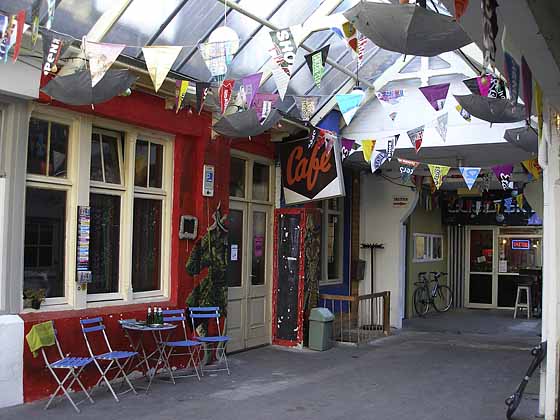
Earlier this year squatting was made illegal in the Netherlands. This ban had been threatened for a long time, but only found a majority in parliament now, just one symptom of the rightward trend in politics here. A depressing development that showed how weak and irrelevant the squatting movement had become. At one time the movement, in all its forms had been hugely powerful and been widely supported, despite (or perhaps, because) having huge running battles with the police during the late seventies and early eighties. A longterm shortage of affordable housing in the major cities, a situation that existed ever since the war, combined with conspicously empty but perfectly good buildings deliberately kept empty by private speculators as well as city councils, especially in Amsterdam meant squatters had a lot of sympathy amongst ordinary people. Squats were — and are — also nuclei of alternative culture, a cheap or even free space for all sorts of cultural activities less likely to find a place elsewhere. But with the easing of the housing shortage and the gentrification of the inner cities, the squatting movement has lost much of its attraction and support. It has shrunk considerably, down to a hardcore of idealists and a few more tourists and ironically has also become much less violent than it used to be. (Said violence of course mostly used in self defence against the much more violent opposition of police and the slumlords’ bully boys.)
With squatting seemingly no longer necessary and the movement largely moribund, it was no wonder rightwing parties finally could muster enough votes to make it completely illegal. This despite a long established jurisprudence that had established that the act of squatting itself could not be illegal. It was a symbolic act as much as anything, a way to stick the knife into an old enemy. At first it even seemed most city councils confronted with squatters were going to ignore the law, dealing with them as they had always done, on a case by case basis. But since then it seems the tide has turned and even a squatting friendly city like Amsterdam has become more active with squat clearings.
Until now.
Because yesterday the court in Den Haag decided that new law or not, the city council cannot clear out a squat without at the very least giving the people living there a chance to put their case to the court. It argued that the European laws and jurisprudence on human rights had established that the right to a home life meant that people cannot be chucked out of their homes without a court order. Because of this judgement, several planned clearances here in Amsterdam had to be postponed, as the city council had to study the judgement to see if it applied to them or not, the first good news the squatting movement has recieved in the last few years. What’s more, if the judgement is upheld and not overthrown by a higher court, it means that each new clearance has to be publicised by the officier van justitie (D.A.), giving squatters the opportunity to appeal to the courts for each case, delaying or even stopping individual clearances and in general making the whole process much more costly.
It’s only a partial victory, squatting is still illegal, and it’s typical of the weakness of the squatters and their allies that it comes from the courts rather than the streets, but it it’s a hopeful sign. The ruling shows that the new anti-squatting law has its limitations and it might just be in conflict with European law as well.