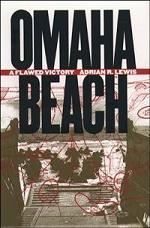
Omaha Beach: a Flawed Victory – Adrian R. Lewis

Omaha Beach: a Flawed Victory


Omaha Beach: a Flawed Victory
Adrian R. Lewis
381 pages including index and notes
published in 2001

Omaha Beach: A Flawed Victory was not quite the book I expected it to be or wanted to read. What I thought I was getting out of the library was a book describing the landings itself, looking in detail at how the battle for Omaha Beach evolved, similar to a book on Kursk I got at the same time. What I got instead was an analysis of the strategic choices made for the landings and how that led to near-disaster at Omaha. The actual battle is dealt with in the first chapter, the rest of the book deals with the reasons why the battle happened as it did.

Any disappointment I felt was shortlived. The book I got was easily as interesting as the book I wanted to get. What it managed to do was to make me question the “official” reasons why the Americans at Omaha Beach did so much worse than their colleagues at Utah or the British/Commonwealth forces at their landings. What I’ve always read was that the American commanders at Omaha had both underestimated the German resistance and the German fortification and had rejected the use of all the various special enginering tanks the British had developed to tackle these fortifications, the socalled “Hobart’s Funnies“. What Adrian R. Lewis argues instead was that the real problem was that the Normandy Landings were planned according to the wrong doctrine, that the experience build up in earlier landings in the Pacific and the Mediterranean was ignored in favour of finding new solutions to the same problems because the commanders in charge of Operation Overlord overestimated the uniqueness of the operation.

Read more…

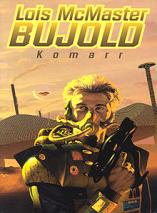
Komarr – Lois McMaster Bujold

Cover of Komarr


Komarr
Lois McMaster Bujold
311 pages
published in 1998

Komarr was the first Miles Vorkosigan book I’d ever read, back in 1998. At the time it was the latest in the series to have been published and deliberately written as a jump on point for new readers like me. I didn’t jump in completely ignorant however, as the Vorkosigan series was one of the favourite series of rec.arts.sf.written, which each new novel thoroughly dissected and discussed. It was these discussions that prompted me to finally pick up one of the series and luckily, it was the perfect starting point.

What I missed about Komarr the first time around was how feminist it is in its own right. It’s not an overtly political book, but the heart of the story is how one woman manages to escape from a bad marriage and the gender assumptions, traditions and expectations she grew up with. It’s her story that makes Komarr special, in what otherwise would’ve been a fun but unremarkable adventure science fiction story. As I’ve realised since, Lois Bujold has always been good at infusing even her slightest science fiction with subtle sociological backgrounds, imagining what effects the usual genre props might actually have on a society. So for example, the coming of Galactic gender assignment technologies to backward Barrayar has lead to a glut of males, as tradition values male heirs more than costly daughters and every family scrambled to make sure they got their quota of males. It’s something that has happened in the real world as well, not that outrageous a prediction to be sure, but Bujold pulls that sort of thing all the time, hidden in plain view in the background to Miles’ adventures.

Read more…

Your (rolling) papers, please

Amsterdam coffeeshop

With a new rightwing government in power in the Netherlands it was just a question of time before the coffeeshops would be targeted again. Attitudes towards cannabis and coffeeshop culture have been hardening on the right in the past decade or so, at least amongst national politicians and there’s less and less support for continuing the policy of tolerance towards cannabis users. The latest argument in this battle is the nuisance coffee shops supposedly cause, especially those aimed at foreigners.

Normally we do everything to lure visitors to the Netherlands, but as soon as they come here to toke up without risking jail, it’s a nuisance. Sure, there’s no denying that some coffeeshops do annoy their neighbours and the mega popular ones down by the Dutch-Belgian and Dutch-German borders are not places you would like to live next to, but on average coffee shops cause much less disturbance than e.g. pubs routinely do. People who’ve enjoyed slightly too much hash are more likely to fall asleep than cause trouble after all, unlike your average lager lout.

So the government has come up with the brilliant idea to introduce a “wietpas“, a membership scheme for coffeeshops, where you have to get a pass to be able to buy cannabis. Only Dutch people would be able to get such a pass so no filthy foreigners will get their hands on our weed.

You can guess what that would mean for tourism in Amsterdam. One of the few things that makes the city something more than a secondrate Vienna is the ability to score cheap, safe weed and enjoy it without harassement. As the Amsterdam bureau for tourism has calculated (Dutch), of the four and a half million tourists who visit Amsterdam each year, roughly a quarter visits a coffeeshop during their stay. That’s more than a million people, who each stay on average two days and spent around 100 euros — and not just on cannabis either. How many of those will continue to come to Amsterdam if they can’t get their fix anymore?

Books read October

I was going to read more this month, but my Essentials project got in the way. Unlike some bloggers, I don’t count comics towards my book reading. It just feels like cheating. So only four books this month, all science fiction or fantasy.

The Restoration Game — Ken MacLeod
Ken’s latest novel is as good as always, but somewhat of a departure from his last few, more philosophical perhaps.

Brass Man — Neal Asher
Another almost indecypherable Polity novel depending for its impact on a lot of prior knowledge on the part of the reader, knowledge I don’t have. It reminds me of first getting to grips with the Marvel Universe, the same hints about earlier stories being dropped, the same characters with unexplained backstories. I like that sort of thing, you may not.

The Ship of Ishtar — A. Merritt
A classic pulp fantasy story from 1924, long before Tolkien codified our expectations of that genre. Interesting to read, but every now and again needs effort to continue.

Komarr — Lois McMaster Bujold
The first book in a campaign to make up for my deficiencies in reading science fiction and fantasy written by women. A reread of the first Miles Vorkosigan novel I’d ever read. What struck me this time was how quietly feminist this book is, something I need to write about in greater detail.

Smug gits

What Would Optimus Prime Do?

It took this photoseries to crystalise for me what was nagging me about Jon Steward’s Rally To Restore Sanity And/Or Fear. The signs featured are clever, geeky, ironic, somewhat smug, but apolitical. It’s protesting as performance art, bloodless and meaningless. Well intentioned, I’m sure, but meaningless. Seeing the rally on the news and reading about it on the internet I could not help but think that this was what all those well meaning, smart centrists and war apologists wanted the anti-war demonstrations to be back in 2001-2003. Polite, cheerful and ineffective.