Fifty Essentials in Fifty Days 46: Essential Silver Surfer Vol. 02

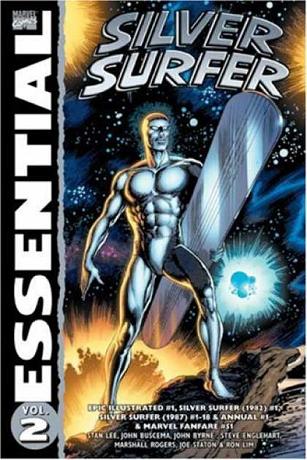
cover of Essential Silver Surfer Vol. 02


Essential Silver Surfer Vol. 02
Steve Englehart, Marshall Rogers, Joe Staton, Ron Lim and friends
Reprints: Silver Surfer Vol. 2 #1, Silver Surfer v3 #1-18, Annual 1
Get this for: the Silver Surfer is back in space — three stars

From one classic Steve Englehart series to another, not quite as classic one. The Silver Surver’s second series would be quite different from the original Stan Lee & John Buscema one, if only because Englehart freed him from his imprisonment at Earth in the very first issue. But the main difference was best summed up in an Amazing Heroes observation, that whenever in his original series the Surfer would wax philosophically about man’s inhumanity to man, in his new series he waxes hornily about Shalla Ball, Nova or Mantis…. Englehart made the Surfer more lighthearted, more cosmic than he had been in his old series, while, as the mention of Mantis suggests, also revisiting his own personal obsessions. Joined by his old Batman partner Marshall Rogers on the art, the 1987 Silver Surfer series is quite different from its 1968 predecessor and to me much more interesting.

But Essential Silver Surfer Vol. 02 does not quite start there. While sensibly not including the myriad guest appearances of the Surfer over the years, this volume does start with two stories featuring the old Surfer: a short story from Epic Illustrated and the Stan Lee scripted, John Byrne plotted and pencilled 1982 Silver Surfer one shot. The latter saw Reed Richards freeing the Surfer from his cosmic imprisonement on Earth, return to Zenn-La and his old love Shalla Ball, only to discover his planet almost destroyed and Shalla Ball a prisoner of Mephisto. He manages to free Shalla Ball and revitalise Zenn-La, but at the cost of his freedom, yet again. It’s a good story, but typical of everything that made the original series a failure in the end: the Surfer doesn’t work on Earth.

Englehart understood that and also understood the potential of having a proper space based series, something not really seen at Marvel before. In issue one he got the Surfer off Earth and free of Galactus, in issue two he cut his ties to Zenn-La and Shalla Ball and by issue three he had reintroduced Mantis, seen for the first time since she became the Celestial Madonna, as well as set up the storylines that would drive the series for its first year and beyond. Building on the loss of the Skrulls’ shape-shifting power established in the 1985 Avengers and Fantastic Four annuals, Englehart has the Skrull empire descend in chaos, with one of the pretenders of the throne launching the second Kree-Skrull War. Meanwhile the Elders of the Universe are gunning for the Surfer, wanting to keep him from helping Galactus, who they wanted to kill.

Why they wanted to kill him does not become clear until a few more issues along, as Englehart also draws in the Supreme Intelligence of the Kree and the Infinity Gems, here still called the Soul Gems, into the Elders’ plot. This seems to have run out of steam with #109, as Galactus eats five of the Elders while the other three are drawn into a black hole, but this turns out to be premature. In issue fifteen Ron Lim replaces Marshall Rogers and Joe Staton on the art, while Sue and Reed Richards are recruited by the Surfer to help Galactus recover from his “cosmic indigestion” caused by the Elders of the Universe he ate…

Ron Lim is well suited to the Silver Surfer, which was his breakthrough series as well. He has a good style for cosmic battles and I’ve always liked his art, buff as it is. Not that Marshall Rogers was bad, with his more gracious, elegant style. Inbetween them is Joe Staton, who cut his cosmic teeth on Green Lantern, including a long run with Englehart. I like his art, but not here.

Essential Silver Surfer Vol. 02 ends with a curiosity, an issue of Marvel Fanfare that published what was going to be the first issue of a twelve issue, double sized Silver Surfer limited series, before that metamorphed into a ongoing series. That limited series was also going to be written by Englehart, but with art by John Buscema and with the Surfer left stranded on Earth, but still meeting with Mantis and getting drawn in cosmic developments. It’s an interesting view of what could have been, but fortunately never came to pass.

Fifty Essentials in Fifty Days 45: Essential Avengers Vol. 06

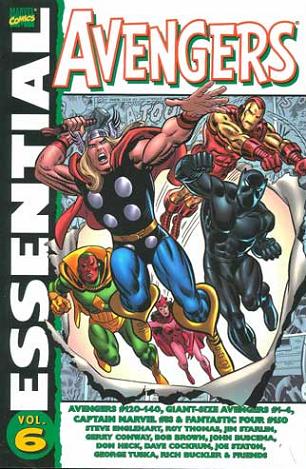
cover of Essential Avengers Vol. 06


Essential Avengers Vol. 06
Steve Englehart, Sal Buscema, David Cockrum and friends
Reprints: AVengers #120-140, Giant-Size #1-4, Fantastic Four #150 Captain Marvel #33 (February 1974- October 1975)
Get this for: the Celestial Madonna — four stars

It’s probably a bit dim of me to only notice it now, but The Avengers after Lee had left was really a writer’s comic, wasn’t it? Sure, we remember Neal Adams doing the Kree-Skrull wars, or those couple of issues Barry Smith did, or John Buscema’s work, but if you look at it honestly The Avengers for long stretches at a time made do with good enough artists, all its pizzaz in its stories. In this volume, you got people like Rick Buckler, Bob Brown and Sal Buscema on the art, all doing a reasonable job, but never doing anything that stops you in your tracks. The writing on the other hand, which is all Steve Englehart (with some influence from Roy Thomas as editor), is doing its utmost to amaze and dazzle you. If it doesn’t quite succeed, this is not entirely its own fault, but as much due to the years that have passed since these stories were originally published. The style in which they were written has dated, not badly, but enough that they lose some of their impact. It feels overwritten, which was always Englehart’s weakness anyway, as it was of that whole generation of Stan Lee and Roy Thomas influenced Marvel writers.

Steve Englehart already got started on the epic stories in the previous collection, but here he goes all-out. Issue 129 to 135 and including Giant-Size Avengers #3-4 are one continuing story, the seeds of which were already sown half a dozen issues before. It is of course the saga of the Celestial Madonna, starring the Englehart created Mantis and featuring the Avengers, Kang, Rama Tut, Immortus, a host of long dead heroes and villains as the Legion of the Unliving, the Kree and their origin, the origin of the Vision and how he was related to the original Human Torch, why the Kree-Skrull war got started, the death of the Swordsman and the return of Hawkeye, who build the Blue Area on the Moon, the menace of Dormammu and the weddings of Mantis and the Swordsman, reanimated by an alien plantlike intelligence as well as the wedding of the Vision and the Scarlet Witch.

It’s a mess of a story, with a great many disparate elements dragged into it, but Englehart ties it all together beautifully. I had never read it before, knew about it, but never realised how much of what Englehart did here would influence The Avengers for decades to come. Englehart created the definitive Kang, clarified his relationship with Rama Tut and tied in old Avengers villain Immortus as well. He also provided a proper origin for the Vision, which must have been influenced by Roy Thomas considering its use of the original Human Torch, tying up a lot of old plot threads from The Fantastic Four and The Avengers and creating a new mess for others to “improve on”, or not. He also tied in the Avengers with wider Marvel mythology, with his use of the Kree and Skrulls as well as that mysterious blue area on the Moon that the Fantastic Four had found years ago.

On the whole The Avengers had never been so much at the heart of the Marvel Universe as under Englehart, participating in the Thanos War in a crossover with Captain Marvel, then crossing over with The Fantastic Four for the wedding of Crystal and Quicksilver. There’s also, in the last few issues collected here, the coming of the Beast to the Avengers, fresh from his own solo adventures and with plotlines continued from there. It’s the sort of continuity I grew up with from Marvel and the sort I like best, where there is always evidence of a wider universe beyond The Avengers, but out and out crossovers are rare and don’t last more than one or two issues.

As said, the art here is servicable to good, but you need to read this for the writing. Englehart would go on to do better work on other titles since he wrote the Celestial Madonna Saga, but this is perhaps his first great work.

Dutch football to Wilders: F-off

amateur football

Sometimes rightwing populism backfires, as Geert Wilders’ party the PVV found out last week. A PVV member of the Den Haag city council proposed an “allochtonenstop” in amateur football, in response to the supposed “flood of problems” football clubs with too many non-western immigrant members were having. According to Richard de Mos (also a PVV member of parliament), such people don’t volunteer for their clubs, are disrespectful and responsible for daily violence on the football pitch. To combat this behaviour clubs should stop accepting new non-western immigrants as members.

Deliberately controversial, this sort of proposal is what helped make the PVV into the third biggest party in the Netherlands. You just make up a lot of stupid but tough sounding shit about Muslims or “non-western immigrants” that reinforce already existing stereotypes in your base, let the experts explain why you’re wrong but emerge as the party of common sense, in touch with the public mood, unlike the elitist eggheads who refuse to see deportation of all muslims to Texel is the right answer to Holland’s crime problems.

This time, it failed spectacularly. Because this time the PVV talked nonsense on a subject their voters actually knew something about. Too many people voluntarily spent their weekend running around wet and cold football pitches to believe this nonsense about foreigners running amateur football. this time therefore the backlash came not just from the experts, but from the very same people the PVV normally has on their side. Richard de Vos forgot that if you want to bullshit people, best not attempt that on subjects they actually know something about…

In short: the PVV got roundly thrashed on this proposal, with everybody from the Dutch football union on down ridiculing it.

Sint!


movie poster for Dutch horror movie Sint

Above is the trailer for the new Dick Maas horror movie, Sint, in which Sinterklaas (the original Santa Claus) goes bad and starts killing children instead of giving them presents. Not an entirely original idea and I’m sure there are some Santa Claus horror movies too, but Dick Maas has a good track record for horror movies, with De Lift and Amsterdamned, the latter of which scared me stiff when I first saw it as a fourteen year old. His new movie has been the subject of a mild controversy, as some of the posters used to advertise it are thought to be a little bit too scary by the usual numbnuts. An official complaint to the advertisement standards agency was made, but failed. And so it should.

The posters aren’t that scary, we do not need to “childproof” our cities and the people making these complaints are the sort of creepoids who’d want nothing better than to move Holland back to the fifties with brussel sprouts for dinner every evening. If you don’t like the movie, don’t watch it.

Meanwhile the real horrorshow happened in Eindhoven, as evil, hated outside of Brabant PSV defeated my poor old Feijenoord 10-0. It’s isn’t fair. And yes, I am a Feijenoord supporter living in Amsterdam — guess how much fun I’m going to have at work tomorrow…


Fifty Essentials in Fifty Days 44: Essential Spider-Man Vol. 06

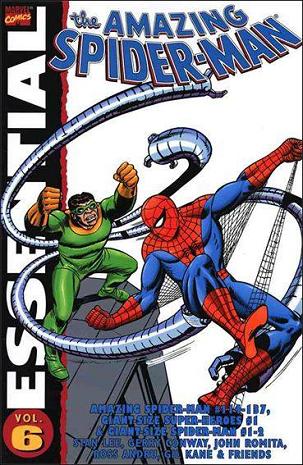
cover of Spider-Man Vol. 06


Essential Spider-Man Vol. 06
Gerry Conway, John Romita, Ross Andru, Gil Kane and friends
Reprints: Amazing Spider-Man #114-137 and more (November 1972- October 1974)
Get this for: the death of Gwen Stacy — four stars

Yes, just as happened with Essential X-Men and Essential Fantastic Four, I missed out on volume five of Essential Spider-Man. Annoying, since volume four ended on a cliffhanger as Doctor Octopus seemed to have the upper hand on Spider-Man. And how does volume six start? With a battle between Spidey, new villain Hammerhead and Doc Ock. You can see why I got a bit confused in the shop…

Anyway, this volume sees Gerry Conway firmly established as Spidey’s writer, though Stan Lee does return for a few issues halfway through. Conway used to be an incredibly prolific writer in the seventies and eighties, working for both Marvel and DC on all their headline acts, including a forty plus issue run on Amazing Spider-Man partially collected here. He may as much as anybody else be responsible for Marvel’s Bronze Age house style, that mix of superhero adventure and soap opera, with stories usually lasting one or two issues but subplots carried forward for much longer, a style he would also export to DC. Despite this he has never really been a fan favourite, has he, unlike a contemporary like Len Wein, let alone Steve Gerber. This may be because his writing was so familiar, so omnipresent that it could never surprise you like Wein or Gerber could. You won’t get anything experimental with Conway at the helmet.

For Spider-Man Conway is the ideal writer, as this volume shows. He has a good grasp of what makes Spider-Man tick, does well with the soap opera and while not as creative as his predecessors on the title, here still creates two classic Spider-Man villains: Hammerhead and Tarantula, not to mention the Punisher. But what he will be mostly remembered for is something else entirely: the Death of Gwen Stacy.

Gwen Stacy was of course Peter Parker/Spider-Man’s great love, not quite his first, but his first serious relationship. Gwen’s death was as much a turning point for him as Uncle Ben’s death was for making him Spider-Man in the first place. It cast a shadow over the rest of his life, though this is not always noticable even in this volume. Before her death, Spider-Man could always be certain that his powers could save himself and his loved ones from any danger. After it, he would always worry whether he would’ve to go through it a second time. For superhero comics as a whole Gwen Stacy’s death is a turning point as well, the first time (if I remember correctly) that such a prominent supporting cast member was killed off. As Kurt Busiek has argued, Gwen’s death could be seen as the end of the Silver Age, so great was its impact.

It’s interesting to see the differences in how Conway treats Gwen’s death with how it would be dealt with in modern comics. There is literally no lead-up. In the previous issue Spidey is still in Canada fighting the Hulk, he returns to New York, Norman Osborn remembers his past as the Green Goblin as well Spider-Man’s secret identity, kidnaps Gwen and lures Peter to the top of the George Washington bridge. They fight, the Goblin throws Gwen off the bridge, Spidey catches her with his web, but is too late: she’s already dead. It’s over and done with in one issue, while Norman Osborn himself dies in the next. Had it been written today, it would’ve needed a six issue story arc at least.

The art in this volume is by John Romita, Gil Kane and Ross Andru, in that order. These are all artists working in a roughly similar style, especially Romita and Andru, who also use many of the same inkers: Jim Mooney, Romita himself, Frank Giacoia. Of the three I prefer Kane, who has just that little bit more bite to his art. Ross Andru on the other hand I’ve always found a bit bland…

Many of the stories here I’ve read before, especially those leading up to the death of Gwen Stacy and those dealing with its aftermath, not in the least in the old Dutch Spider-Man Klassiek series, which provided a sort of “extended highlights”. To read them in context has been interesting: Gwen may death, but Spidey still has to fight a new villain month in month out. Various subplots continue to develop and come to fruition, the soap opera continues and one month doesn’t differ that much from another. There’s never been a period in Spidey’s where this relentless grind was so clearly visible..