Fifty Essentials in Fifty Days 39: Essential Howard the Duck Vol. 01

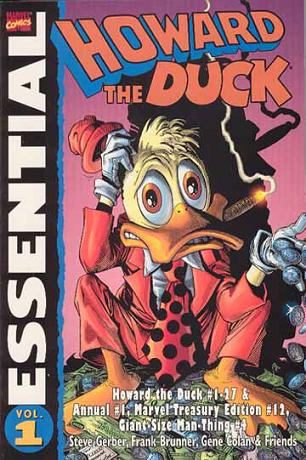
cover of Howard the Duck Vol. 01


Essential Howard the Duck Vol. 01
Steve Gerber, Gene Colan and friends
Reprints: Howard the Duck #1-27, annual 1, Marvel Treasury #12 and more (January 1976 – September 1978)
Get this for: Gerber’s best work for Marvel — five stars

Get down America! Essential Howard the Duck Vol. 1 collects the complete original run of Steve Gerber’s Howard the Duck, the greatest cult hero of seventies Marvel, the one comic that captured the spirit of the seventies. Whether that still makes it interesting thirty years onwards is another question entirely. A question everybody needs to answer themselves, but for me I found these stories still surprisingly relevant and good.

As you probably know, Howard got his start with a cameo appearance in an early issue of Gerber’s Man-Thing, just one casualty in a reality war, taken from his own Earth and trapped in a world he never made. He was an instant hit, got two solo adventures in Giant-Size Man-Thing (no sniggering please), then his own series. Steve Gerber wrote all his appearances, including a teamup with The Defenders in Marvel Treasury Edition #12. The series took off, became a cult hit and more than that, one of the few real breakout titles Marvel had in the late seventies, popular enough to get a newspaper strip and much later a not very good movie. But that was after Gerber had left, as Marvel’s higher management fucked him over. All his writing on Howard was of course work for hire and hence continued by other hands after he quit, but none of it was any good. Howard the Duck only worked for Gerber, because he was Gerber.

It looks so easy, the Howard the Duck formula. Create some absurd villain, add a dash of parody, mix in a bit of social commentary and don’t forget the cynicism, add an ill humoured duck (or drake rather) and his girlfriend, then serve it all up with standard Marvel superhero soap opera plots. Yet only for Gerber would this work. Most other writers would just overdo the parody elements, making the Duck into a secondrate Mad imitator or got too absurd and Howard stopped to make sense. It’s the easiest trap to fall into as a writer, to think satire and humour are easy, that you can use a formula to produce it, that all it takes is some obvious parodies and some dime a dozen absurdity to make a Howard the Duck story.

It’s the same as with the old Batman television series, often imitated but never equalled by both other tv shows or comics, because none of those imitators ever got their heads round the idea that the secret was to treat Batman and his world seriously, that there are rules. In Howard’s case the menaces might be even more absurd but Howard still has to deal with them: a nine foot ginger bread man can still kill him if he doesn’t eat him first. Gerber wrote Howard the Duck exactly as he would a more “serious” superhero series and Howard’s villains like Space Turnip Man might be dumb or crazy, but they make sense in their own context. More importantly, Howard always is more than just a comic fowl (sorry), but a true tragic figure, a reverse Ben Grimm, a human trapped in a world of monstrous talking hairless apes.

What made Gerber’s Howard the Duck more than just the lazy parody his successors turned it into is that it was the story of his own struggle of living in seventies America. He can be incredibly blatant in this, (e.g. the Reverend Yucc and his Yuccies) and there is a lot of angst about politicians and Madison Avenue brainwashing and all that, but these are just the most obvious ways in which Gerber’s own emotions seep in the stories. The infamous issue sixteen, a fill-in issue needed because Gerber was blowing his deadlines, is the best example. Instead of the usual reprint or inventory issue, Gerber instead offers a stream of consciousness illustrated essay on his own hangups about Howard, a dialogue between the writer and his creation. It’s the highlight of the series.

Though Gerber was the driving force behind Howard the Duck Gene Colan should be mentioned as well. He portrayed all absurdities with the same ease as he would’ve illustrated a Daredevil or Tomb of Dracula story, without drawing undue attention to the wackiness. It doesn’t hurt that the man could draw either.

Howard the Duck was perhaps the best Marvel put out in the seventies. You need to have this volume.
Tuesday is 2-Tone Day

It’s an embarassement if you don’t know them.


Well, that’s my mood in a nutshell, but…


And as always it’s just gone noon half past monsoon:


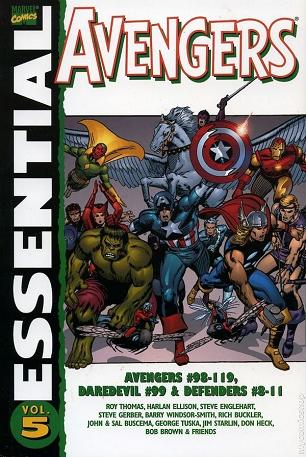
Fifty Essentials in Fifty Days 38: Essential Avengers Vol. 05

cover of Essential Avengers Vol. 05


Essential Avengers Vol. 05
Roy Thomas, Steve Englehart, Barry Smith and friends
Reprints: Avengers #98-119, Defenders #8-11, Daredevil #99 (April 1972 – January 1974)
Get this for: The end of Roy Thomas’ and the start of Englehart’s run — four stars

The fourth volume of Essential Avengers ended with the best Avengers story Roy Thomas ever did: the Kree-Skrull War. How can the fifth volume ever improve on this? Well, how about a three issue epic with the Avengers search for their missing member Hawkeye turning up both Hawkeye and ex-member Hercules, pits them against the Olympian god of war Ares as well as the Asgardian goddess the Enchantress and culminating into an epic battle reuniting every Avenger past and present, including the Hulk and the Swordsman?

It’s a good start, especially when the art on these three issues is done by Barry Smith. It’s the best the Avengers look this volume, even though such good artists like John and Sal Buscema, Rick Buckler, Bob Brown and Don Heck are responsible for the art in the rest of the book. they’re good, but Barry Windsor Smith even back then was in a class of his own. You wish he could’ve done the art for longer, but of course he never was the fastest artist in the world and beside, his tourist visum had expired and he was deported…

After the ten issue epic that was the Kree-Skrull War, both Roy Thomas and his succesor Steve Englehart limit themselves to shorter stories for a while. Thomas has the Avengers traveling to Olympus, then plots the return of the Grim Reaper before unleashing the Sentinels again. The X-Men had just been cancelled and so their old villains were fair game for the Avengers, something Englehart would also make use of by letting Magneto attack the Avengers. Englehart also plunders storylines from other series, tying in Captain America’s fight together with Rick Jones against Madame Hydra, in which the latter died, with his own Space Phantom & Grim Reaper teamup, by revealing the former had stood in for the actual Madame Hydra in that earlier Captain America story, hence the real Madame Hydra was still alive. It’s an early example of how complex Marvel continuity could become in the seventies and eighties, with writers building not only on the work done before in their own series, but bringing in loose ends from their own earlier ventures, as well as adding to stories originally done by others.

Though Englehart and Thomas do limit themselves to shorter stories, both let these stories flow more naturally into each other. They’re much less self contained as those Stan Lee wrote originally for The Avengers. This means there’s more room for interpersonal conflict and soap opera and Englehart makes good use of this. Roy Thomas had dropped the first hints that the Scarlet Witch and the Vision might have been attracked to each other; under Englehart their romance, after may false starts, came out in the open. This romance is one of the mainstays of his run here. Another constant in Englehart’s run is Hawkeye’s, well dickishness towards the other Avengers. Always a bit of a hothead, here he’s just obnoxious at times, throwing a hissy fit when the Scarlet Witch choses the Vision rather than him, later getting into an actual fight with Daredevil over the Black Widow, in a Steve Gerber penned issue of Daredevil also collected here. It may not have read that way originally, but here it seems the sexism fairy has visited Hawkeye.

Like the previous volume, this one too ends with a multi issue epic, as Englehart loses his inhibition and starts a story on par with Roy Thomas’ Kree-Skrull War. But this time this epic is not contained in one series, but involves The Defenders as well, which was also written by Englehart at the time. Dormammu and Loki manage to trick the Defenders into finding the six pieces of the Evil Eye, last seen in a Fantastic Four issue in order to cure the Black Knight, but in reality to give Dormammu the power to rule the universe. Loki gets cold feet and involves the Avengers by tricking them into believing the Defenders actually want to rule the world. Chaos, as they say, ensues. The Avengers – Defenders War is the ancestor of all those crossover epics that would excite and bore us later in the eighties and nineties and it already includes that page showing every hero in the world fighting the main villain’s evil hordes all over the world — or at least New York.

This is neither Thomas’ nor Englehart’s finest hour, but this is still a great volume to see how one great writer hands over the baton to another one.

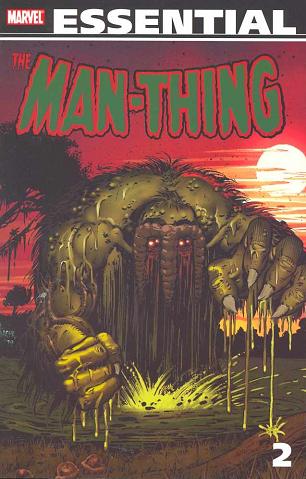
Fifty Essentials in Fifty Days 37: Essential Man-Thing Vol. 02

cover of Essential Man-Thing Vol. 02


Essential Man-Thing Vol. 02
Steve Gerber, Michael Fleisher, Chris Claremont and friends
Reprints: Man-Thing #15-22, Giant-Size #3-5, Man-Thing v2 #1-11 (March 1975 – July 1981)
Get this for: The second part of Gerber’s run — four stars

The Marvel Essentials series is meant to sell you characters, rather than creators — buy a volume and you get a big slab of Spider-Man’s adventures, or the Fantastic Four’s — but with some series this approach just doesn’t work. Man-Thing is one such series. Only one writer ever got a handle on the muck monster and nobody before or after him really knew what to do with him. That writer was Steve Gerber of course, whose work dominated the first volume of Essential Man-Thing. The second volume collects the remainder of his run on the first Man-Thing, but also the complete second, 1979 series, written by Michael Fleisher and Chris Claremont. It’s clear neither of them got the Man-Thing as Gerber got him.

Man-Thing is after all a difficult character to write. He’s completely passive, with no motives of his own, solely responding to the emotions of the people around him. You can’t have the usual Marvel soap opera with Man-Thing, it’s difficult to get him to fight recurring villains and really the best thing you can do with him is to use him in morality tales. Which both Gerber and his successors did, with the difference that Gerber had his finger on the pulse of the seventies and the talent to make use of it. He was also able to see the absurdity in his stories, which helps a lot when reading much dated relevant stories. But he also moved people with his stories, especially “the Kid’s Night Out” from Giant-Size Man-Thing #4, as witnessed in this remembrance by Fred Hembeck. In it Man-Thing is the avenger of a fat kid who died of exhaustion during gym class, while the people that tormented him mouth platitudes at his funeral, lashing out in anger when his one friend challenges their lies. It’s dated yes and I’ve read hundreds of such stories, but I can see the power it must have had on people like Hembeck back then

For an example of how not to do a Man-Thing story, we need look no further than Giant-Size Man-Thing #5 and a Len Wein story. Wein, who created Manny’s counterpart at DC, Swamp Thing, should’ve been able to handle him, but his story of two young lovers running away into the swamp to get away from their feuding parents is a) cliche and b) very very dull, a sort of third rate EC Comics shock story. That’s the mistake in many of the non-Gerber stories, taken it all too seriously and going for shock rather than creativity, upping the death count along the way. It doesn’t make them any better.

On the art side, most of it is by dependable Marvel veterans like Jim Mooney, Ed Hannigan and Don Perlin. None of them are bad and some like Hannigan do their best work here, but it’s not as good as the art in the previous volume, which of course boasted Mike Ploog, who is hard to improve on. It’s the standard seventies Marvel house style on display here, when Manny really needs something special.

Not a bad volume and Chris Claremont at least tries to do what Gerber does seemingly effortlessly, but in the end it shows that some characters can only be handled by one specific writer.

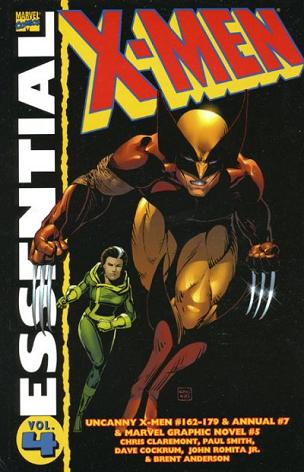
Fifty Essentials in Fifty Days 36: Essential X-Men Vol. 04

cover of Essential X-Men vol 4


Essential X-Men Vol. 4
Chris Claremont, Dave Cockrum, Paul Smith, John Romita Jr and friends
Reprints: Uncanny X-Men #162-179, Annual #7, Marvel Graphic Novel #5 (October 1982 – March 1984)
Get this for: full blown mutant paranoia with the X-Men — four stars

The fourth volume of Essential X-Men starts with the tail end of Dave Cockrum’s second run on the title, and the Brood Saga. At the end of the previous volume the X-Men had been kidnapped into space, this volume opens with Wolverine discovering where they were: on the home planet of the Brood, Marvel’s very own Alien knockoff. On the run from them, lost and alone in a very hostile alien jungle Wolvie discovers things are even worse than he thought, as it turns out he and the other X-Men have been impregnated by the Brood Queen and are carrying an alien embryo. They’ll die giving birth to new queens but not before they might be able to hurt the Brood. It’s another X-Men space epic, but a much more depressive one than the previous ones.

It sets the tone for the rest of this volume, as the X-Men’s world gets progressively darker. After the Brood Saga and its aftermath, the next story is from Marvel Graphic Novel #5, “X-Men: God Loves, Man Kills”, which after “Days of Future Past” is the first story explicitely about mutant hatred. It’s not a good story, with the subtely of a sledgehammer and very eighties with its televangelist villain, but it’s a prelude of what’s to come. Though this had supposedly always been the theme of The X-Men, for the most part the classic X-Men had been a regular superhero title and mutant hatred even with Claremont at the helm it took to “Days of Future Past” in #141-142 that it became explicit. But while that story showed the nightmare future the X-Men fought again, it still wasn’t a big part of the series afterwards. With the graphic novel Claremont put mutant phobia in the spotlights again and in the regular title as well it became more prominent, as the X-Men became more and more mistrusted by the world they had saved so often

For example, even in the lighthearted story from Annual 7 this mistrust is shown. The Impossible Man, an old Fantastic Four villain, is on a scavenger hunt taking trophies from all his favourite superheros: the X-Men’s mansion, Nick Fury’s eye patch and the Wasp’s entire collection of costumes, with the X-Men chasing after him. When Rogue and Colossus follow him to the Avengers’ Mansion, they’re attacked by She-Hulk and Iron Man who mistake them for the thieves. It’s one small example of the mistrust between our favourite muties and the rest of the superhero community.

Another big change for the X-Men is that they’re no longer the only mutant team: while they were kidnapped by the Brood, Charles Xavier had assembled a team of New Mutants. It showed how popular the X-Men had become that there was now a second mutant title. It’s not immediately notable in the X-Men’s own title, except for the inevitable confrontation when they return from outer space.

Apart from the ongoing mutant paranoia, Claremont also heaps more personal troubles on his heroes. The X-Men and especially Storm start to change again during the Brood Saga, as they have to fight for their lives and kill as well. On Earth too they have to become harder, lose some of their idealism to survive. With Storm, always portrayed as an innocent abroad, this change hits hardest: in issue 170 she actually strikes to kill an opponent, Callisto of the Morlocks who had kidnapped the Angel to be her consort. She fights a knife duel with Callisto, the latter seems to have her on the ropes, but Storm manages to tangle Callisto’s arm in her cape and stabs her full in the heart. This moment is shown in a great six panel sequence by Paul Smith, the upper left panel showing Storm and Callisto as Storm prepares to strike, then a close up from behind Storm’s shoulder showing the expression on Callisto’s face as she’s stabbed in the chest. The third panel then shows them standing, Callisto starting to collapse. The bottom three panels has Storm walking to the camera, past Callisto falling down and with the Morlock crowd in the background. A great sequence and a example of Paul Smith’s talent.

Storm’s change into somebody much more harder, less naive (as symbolised by her new, street tough costume in #173) is not the only angst the X-Men go through. Wolverine sees his marriage to Lady Mariko Yashida fall through at the last moment, Mariko being manipulated by Mastermind, who’s back for vengeance. Even after this is cleared up Wolvie doesn’t get to marry his great love, as Mariko’s family is entangled with the Yakuza again and she feels her duty compels her to clean this up first. But all this is just collatoral damage in Mastermind’s real plot: to convince the X-Men Dark Phoenix is back and get them to kill an innocent woman.

Because on the last page of #168 Madeleine Pryor is introduced to Scott Summers and she is a dead ringer (no pun intended) for Jean Grey, his one true love who had killed herself rather than give in to the temptation to become Dark Phoenix again. Scott falls hard for Madeleine, with the next issue finding them slow dancing together, even though he had spent most of #168 being intimate with his previous girlfriend, Lee Forrester. Madeleine and Scott seem made for each other, but he cannot help but wonder… He finally asks the question he dreads, whether she is Phoenix and is answered by an energy blast. Issue 175 finds the X-Men fighting for their lives against a reborn Phoenix, or so things seem, but Scott finally figures things out and then has to fight for his life against the rest of the X-Men who are now convinced he‘s Phoenix… It all works out in the end, with a wedding for Maddy and Scott, but it was a long hard slog.

The third angst generator is the coming of Rogue, their old adversary from the Brotherhood of Evil Mutants, who was the one who robbed Carol Danvers from her powers, memories and almost her life. She joins the X-Men out of desperation, with her powers out of control and confused about who she is thanks to Carol’s personality being entangled with her own. Xavier lets her joint against the wishes of most X-Men, who slowly have to learn to live with her. It’s a good example of Claremont’s great skill at soap opera and how he can manipulate his readers. It makes perfect sense for the X-Men to take in Rogue, with their mission of rehabilitation, but I’m sure many readers would’ve been as outraged as Carol at the unfariness of it all when she learned of it…

A quick word about the art to finish this off. As said, this volume starts with Dave Cockrum doing his usual excellent job, who is replaced by Paul Smith, then a complete unknown but who is just as good as Cockrum from the start. He has a smooth, semi-realistic style that’s sort of reminds me of Alan Davis, but not quite and he’s great at depicting subtle emotions with just a few lines. Smith in turn is replaced by John Romita Jr., who continues in his style but puts a slightly scratchier edge on it. All three artists work well with Claremont, who adapts himself in turn to each of them. A great volume again.