Fifty Essentials in Fifty Days 35: Essential Ghost Rider Vol. 2

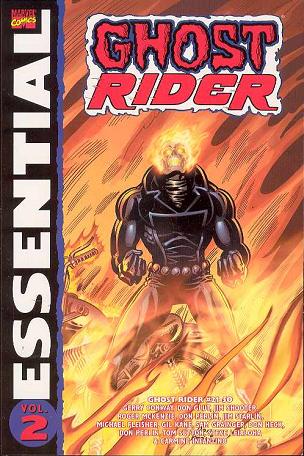
cover of Essential Ghost Rider Vol. 2


Essential Ghost Rider Vol. 2
Gerry Conway, Jim Shooter, Roger McKenzie, Michael Fleisher, Don Perlin and friends
Reprints: Ghost Rider #21-50 (December 1976 – November 1980)
Get this for: a series in search of a rationale — three stars

I wasn’t much impressed by the first volume of the Essential Ghost Rider, not in the least because the Ghost Rider, Johnny Blaze was kind of a dick. Things started to improve at the end of that volume, as Tony Isabella built up a setting and supporting cast for him and got him the trappings of a proper superhero, but one based in L.A. as opposed to New York which most of the rest of Marvel calls home. With this volume Gerry Conway is the writer and he builds on Isabella’s foundations, as does Jim Shooter who succeeds Conway after only three issues. Not for long however: with #26 Shooter sends Blaze packing, after he reveals his demonic nature to all his friends, forced into this by Doctor Druid, in an early example of his dickery.

As originally concieved, Blaze would become Ghost Rider automatically every night, which was changed by Isabella into whenever danger threatened and further refined by Conway and Shooter into something Blaze more or less controlled. Once Shooter abandons the L.A. setting however and puts Ghostie on a road trip with no specific goal, Blaze and the Ghost Rider more and more become separate identities. Roger McKenzie is the next writer having a shot at the title and he continues this trend. Under McKenzie Ghost Rider has to survive a quest for vengeance by one of his first villains, the Orb, then a Dormannu manipulated showdown with Dr Strange, followed by a hell spawned bounty hunter not so very different from himself and finally the wraith of a centuries old mutant child and his robotic motor cycle killers.

By now Ghost Rider has moved away from plain superheroics again into more occult/horror flavoured stories. With the last writer in this volume, Michael Fleisher (ignoring a fillin issue by Jim Starlin between McKenzie and Fleisher) the superheroics are entirely left behind, as the Ghost Rider becomes a pure spirit of vengeance. Each story has Blaze coming into a different town, city or village, getting involved with whatever menace is waiting for it, defeats it, then leaves. The villains he fights are either small time punks and hoods, or the local supernatural phenomenon, or both. There’s no real supporting cast, just the people Blaze meets and helps on his travels, usually involving at least one not too bad looking girl. Reading these stories in short succession you can’t help but notice how formulaic they are, though Fleisher is a good enough writer to hold your interest anyway.

The art for most of this volume is in the capable if pedestrian hands of Don Perlin, who was quite prolific in the late seventies and early eighties. His art was never spectacular or had much of his own style, but he was one of those pencilers who could be depended on to do a good job month in month out. It tells the story and that’s good enough. It’s a bit of a shame really that it was Gil Kane who opened this volume: after him almost everybody else is a disappointment. Having his art in an otherwise lackluster Essential collection is always a bonus.

Essential Ghost Rider Vol. 2 shows where the horror boom at Marvel from the early seventies ended up eventually, as just another variation on the superhero formula. There’s nothing really interesting or novel to the comics collected here.
Women writing Fantasy!

Following on from that list of science fiction by female authors I’ve read in the last ten years, here’s the same for fantasy:

  • The Interior Life — Katherine Blake
  • Tam Lin — Pamela Dean
  • The Paladin — C. J. Cherryh
  • God Stalk — P. C. Hodgell
  • Dark of the Moon — P. C. Hodgell
  • A Wizard of Earthsea — Ursula K. Le Guin
  • The Tombs of Atuan — Ursula K. Le Guin
  • The Farthest Shore — Ursula K. Le Guin
  • Shadow Magic — Patricia C. Wrede
  • Daughter of Witches — Patricia C. Wrede
  • The Harp of Imach Thyssel — Patricia C. Wrede
  • Harry Potter and the Philosopher’s Stone — J. K. Rowling
  • Harry Potter and the Chamber of Secrets — J. K. Rowling
  • Harry Potter and the Prisoner of Azkaban — J. K. Rowling
  • Harry Potter and the Goblet of Fire — J. K. Rowling
  • Jonathan Strange and Mr Norrell — Susanna Clarke
  • Deep Secret — Diane Wynne Jones
  • A College of Magics — Caroline Stevermer
  • The Prize in the Game — Jo Walton
  • Gate of Ivrel — C. J. Cherryh
  • The Year of Our War — Steph Swainson
  • War for the Oaks — Emma Bull
  • Grunts — Mary Gentle

And per comparison, the complete list: 231 books read of which 24 were written by women. Not a great score either, if percentage wise slightly better than in science fiction. (Compare also with detectives: 34 out of 87 books read.) For me personally at least it’s untrue that women are more represented in fantasy than in science fiction; this may be true, but I’m still reading more male than female authors. there really isn’t something about a specific genre that makes male authors more appealing than female ones or vice versa.

My naive assumption is that in an ideal world, the gender balance between authors in any given subgenre will be roughly equal. The idea that innate gender differences are to blame for the relative lack of female space opera/hard sf authors or the same lack of male dark fantasy vampire shaggers, as suggested several times in the original Torque Control discussion is just wrong. That we can even have this discussion some thirty years after the second wave of feminism hit science fiction is awful, but somehow we’re still in a situation that female sf/fantasy writers are more easily ignored by publishers, reviewers and readers, including myself. I’m not interested in debating why this is (at least not here and now), but this is not a situation that’s healthy for sf/fantasy to ignore.

(More on women and science fiction at Torque control.)

Fifty Essentials in Fifty Days 34: Essential Fantastic Four Vol. 04

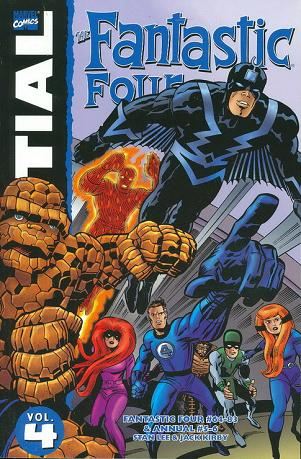
cover of Essential Fantastic Four Vol. 04


Essential Fantastic Four Vol. 04
Stan Lee, Jack Kirby and friends
Reprints: Fantastic Four #64-83 and Annual 5-6 (July 1967 – February 1969)
Get this for: Lee and Kirby at the peak of their game still — Five stars

I’m sorry, but I have to repeat the praise from last time: gods, Stan Lee and Jack Kirby were good together on The Fantastic Four. With the start of this volume they’ve already had more than sixty issues behind their belts and you’d expect that, especially after the creative burst of the last ten-fifteen issues that the pace would slacken a bit, but nothing is further from the truth. They keep on expanding the Marvel Universe, first with the coming of the Kree, including the Kree Sentry and Ronan the Accuser, then with the origin of what would later become Adam Warlock, finally with the discovery of Subatomica. Not to mention the birth of Sue and Reed’s son…

But there are also adventures with old friends, like the Inhumans and the Black Panther and old villains like the Mad Thinker and the Wizard return too. Apart from the Kree Sentry and Ronan, the only real new villain is Psychoman, introduced in Annual #5. There’s plenty of action and conflict here, but the focus does not lie on fighting supervillains, something which the Fantastic Four at any rate has never been about. The FF is at its best confronting some cosmic menace or going on a voyage of discovery, not handling the same villains that could also be menacing Iron Man next week.

There’s not much to say about the stories here, to be honest, that I haven’t said before. Lee and Kirby know these characters inside out, they know how they will respond in any situation they put them in. There’s always a bit of argument of who did what on these series and it’s no great secret that it was largely Kirby’s imagination that made The Fantastic Four so special. He gets to go wild again with Subatomica and the story introducing Him, who would later become Adam Warlock. His design work and sense of grandeur remain unsurpassed.

As does the rest of his art. It’s the cosmic decors and bizarre creatures and villains everybody remembers from Kirby, but his quiet moments are great too. He can get so much emotion from a few subtle lines in a character’s face, especially with the Thing, who wears his heart on his sleeve. You will never mistake one Kirby character for another. His story layout is excellent too, great sense of pacing and with everything he does in service to the story.

One thing that did annoy me about this volume was the neglect of the Invisible Girl, who had married Mr Fantastic the previous volume and who was now kept out of the action by her over anxious husband. It reflects the mores of the time that Sue, as a married woman, would need to be protected and kept away from danger but it comes over as incredibly sexist in retrospect. Things get worse when she’s pregnant. Obviously then she cannot join them on missions anymore, but the other three members keep her completely out of the loop for a time. There’s also Crystal, Johnny’s Inhuman girlfriend whose powers are arguably greater than any of the Fantastic Four, yet is completely wasted in most of the stories here…

That quibble aside, this is another perfect volume.

Fifty Essentials in Fifty Days 33: Essential Defenders Vol. 02

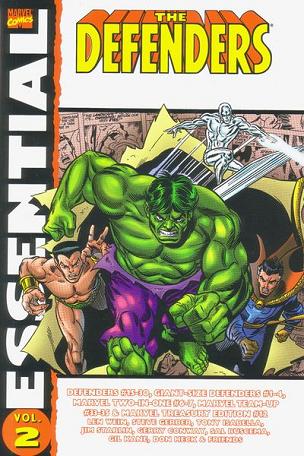
cover of Essential Defenders Vol. 02


Essential Defenders Vol. 02
Steve Gerber, Sal Buscema and friends
Reprints: Defenders #15-30, Giant-Size Defenders #1-5 and much more (July 1974 – December 1975)
Get this for: Gerber and Marvel’s only non-team team — four stars

The Defenders is one of the …odder… ideas for a title Marvel ever had. Take four heroes never known for being easy to work with, with nothing in common and make them into a “non-team”. Sure, the Silver Surfer, Hulk, Doctor Strange and Namor the Submariner all are “big guns”, but putting them together in one series, especially the Hulk? Hadn’t Marvel learned that lesson with The Avengers? And yet… It worked sort of, worked enough to get them their own series after a trial out in Marvel Feature but at least to me it never really gelled until a certain Steve Gerber joined the title…

Essential Defenders Vol. 2 contains the first half of Gerber’s run on The Defenders, but it starts with Len Wein on writing duties. Wein treats the Defenders as a fairly standard superhero team, having them e.g. fight Magneto and the Wrecking Crew. Once Gerber takes over things get weirder, more offbeat, slightly more existentialist. By this time only the Hulk and Doctor Strange remained of the original team, with Valkyrie and Nighthawk as new members, plus various co-stars, including Yellowjacket, Daredevil, Luke Cage and the Son of Satan. That core group of the Hulk, Doctor Strange, Valkyrie and Nighthawk works well together, especially with the Hulk softened up a bit to make him more of a teamplayer.

Now The Defenders used to be my favourite Marvel team back when I first started to read superhero comics and the Gerber stories collected here were one of the reasons why. Two stories in particular stand out. The first is the Defenders clash with the Sons of the Serpents, Marvel’s go-to club of dimwitted but dangerous racist tools. Here once again the twist at the end of the story is that the guy using them is *gasp* Black and only using them for their own personal gains, as it was more or less in their earlier Avengers appearances. What Gerber does differently is to pay more attention to the damage done by the Serpents, has more of an eye for the reality of America in the Seventies than earlier writers using the Serpents had.

The other story is the Guardians of the Galaxy story that ran from Giant-Size Defenders #5 to Defenders #29, which turned me into a fan of them as well. Especially interesting there is issue 26, which has a recap of how the far future of the Guardians came into being, complete with trademark Gerber social commentary — “we valued dry armpits and the three billion dollar aerosol industry over our flowers, our food and ultimately our health” — as the depletion of the ozone layer leads to the widespread use of bionics by the mid-eighties…. Gerber also manages to tie-in the old Killraven series into this future history by the way.

The volume ends with Gerber’s most famous creation, Howard the Duck teaming up with the Defenders in Marvel Treasury Edition #12, which I found to be a bit meh. Howard is an acquired taste and for the most part has aged badly, apart from in a few classic stories. He’s just too seventies. Gerber does much better with the Defender’s characters: more so than any other team you feel that the core members are friends just hanging out rather than coming together to fight crime, which I’ve always found appealing.

The art throughout the volume, with some exceptions including a great issue by Gil Kane, is by Sal Buscema, who is not at his best here. It’s serviceable, rather than good. His pedestrian art undermines some of the pizazz of Gerber’s writing; you’d want a more interesting artist to interpret his plots like on Man-Thing or Howard the Duck. On the other hand there is the fact that Sal Buscema’s style is easy to understand, clean and clear and for a somewhat more mainstream title like The Defenders this may be a more suitable style.

The best of Gerber’s Defenders is still to come and not in this volume, but it’s a great starting point for the series. Most of the bugs have been taken out of the series here and you get the start of what made The Defenders tick for so long.

Women writing science fiction!

What Martin said. But. Here’s my own record on reading female science fiction writers during the last ten years (2001-2010):

  • Serpent’s Reach — C. J. Cherryh
  • Pride of Chanur — C. J. Cherryh
  • To Say Nothing of the Dog — Connie Willis
  • The Sparrow — Mary Doria Russell
  • Frankenstein, or the Modern Prometheus — Mary Shelley
  • Shards of Honor — Lois McMaster Bujold
  • Tea from an Empty Cup — Pat Cadigan
  • Sideshow — Sheri S. Tepper
  • Picnic on Paradise — Joanna Russ
  • Dervish is Digital — Pat Cadigan
  • Sign of the Labrys — Margaret St. Clair
  • In the Garden of Iden — Kage Baker
  • Sky Coyote — Kage Baker
  • Diplomatic Immunity — Lois McMaster Bujold
  • Nine Layers of Sky — Liz Williams
  • Heavy Time — C. J. Cherryh
  • Hellburner — C. J. Cherryh
  • Mendoza in Hollywood — Kage Baker
  • Ammonite — Nicola Griffith
  • 1610: a Sundial in a Grave — Mary Gentle
  • Farthing — Jo Walton
  • The Secret of Sinharat — Leigh Brackett
  • People of the Talisman — Leigh Brackett
  • The Best of C. L. Moore — C. L. Moore
  • Cetaganda — Lois McMaster Bujold
  • Ha’Penny — Jo Walton

For comparison, the complete list of science fiction read in that time. that’s twentysix books by female authors out of a total of roughly 300 books, or less than ten percent. In other words, it would be a bit cheeky to join in the discussion about the real or percieved rarity of female science fiction writers and the lack of recognition they get considering how bad my own record is. There are reasons for this gender imbalance in my reading of course: most of my favourite writers just happen to be male, I at any rate tend to cluster my reading, with some writers (like Charlie Stross or Poul Anderson) getting a lot of repeat custom, which doesn’t help either. It’s not therefore that I deliberately avoid female science fiction writers, more that my unstructured reading for pleasure means my reading is biased unconsciously towards male authors.

If I want to do something about this, I have to consciously balance out that bias, by forcing myself to seek out women writers rather than just reading what I want. I don’t have to do that of course, but if I am worried about this gender imbalance in my favourite genre of fiction, I need to walk the walk as well as talk the talk.

So… Any suggestions?