Yankee with a heart of gold — Wind Breaker — First Impressions

No better protagonist for a yankee anime than a guy who has no problem beating up half a dozen thugs only to get blushy and tsundere when their victims thanks him:
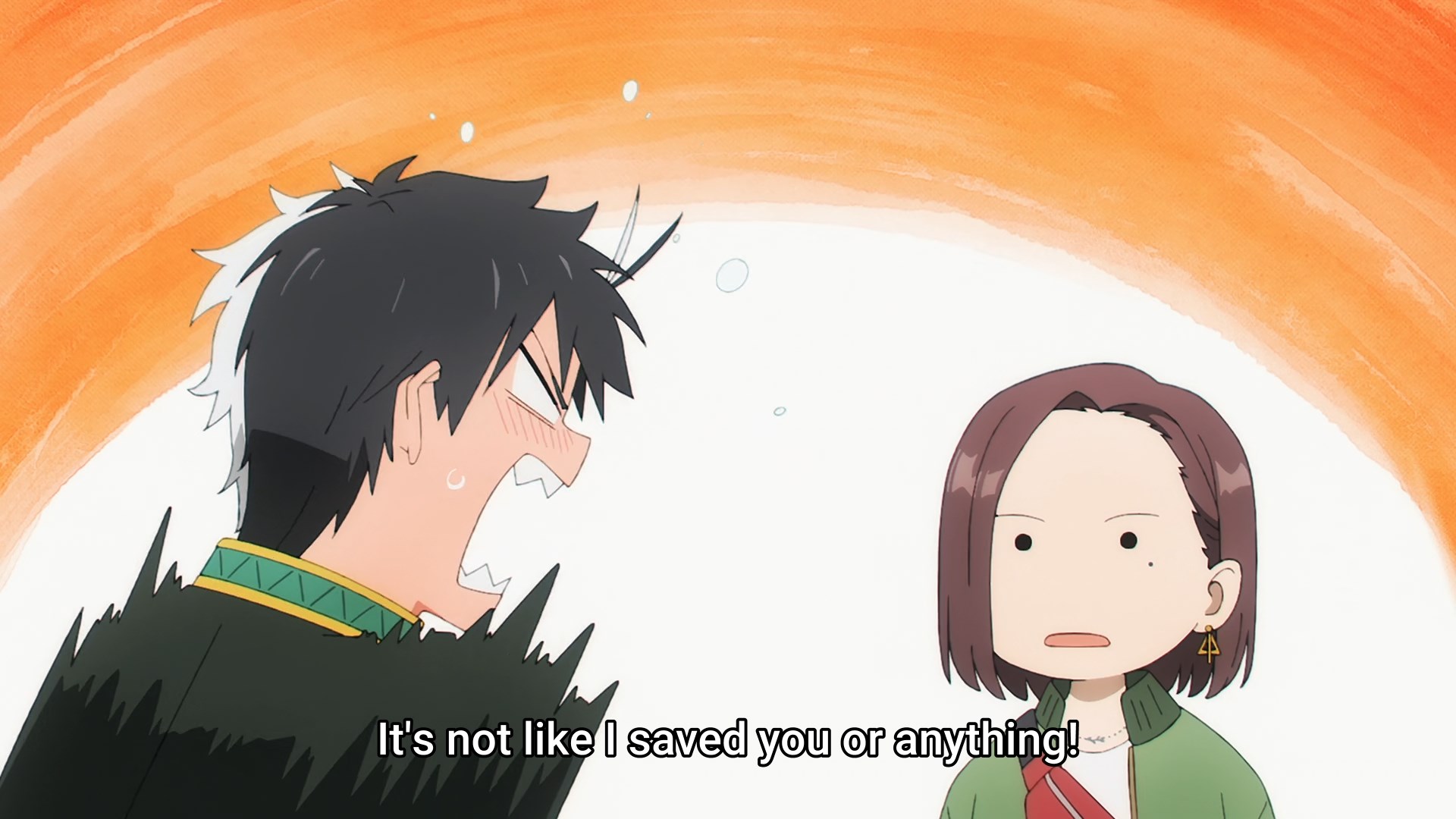
It's not like I saved you or anything!

Yankees are what Japan calls a certain kind of teenage criminal: violent, engaged in petty crime, but usually with some code of honour guiding them, thought his of course is more usual in fiction than real life. Managa and anime have always had a soft spot for these people, so aggressively doing their own thing in a society that values conformity above almnost anything else. Sakura is the perfect protagonist for this sort of series. Slightly dumb, overtly focused on violence as a solution to all his problems. Not sadistic, just obsessed with proving he is the strongest as the only way he can get any respect. Having always been judged a criminal, up to no good because of the way he looks, he felt he had no choice but to fight to earn his place int he world.

A crowd of shadowy figures is looking at the camera calling the protagonist gross

All of which is revealed or implied in the very effective first minute and a half of the episode, where Sakura is walking a metaphorical tightrope as he recalls the disgust and anger of his class mates, teachers and family. No wonder he wanted to transfer to the worst school in Japan, a school with a reputation as yankee heaven, where he can fight as much as he pleases to become the strongest. Reality turns out to be slightly different however, because somebody already had gone through this story two years ago and they reformed the school to the point where the juvenile deliquents now guard the peace in the city. As the women he rescues tells him, this means that he will never reach the top, as he’s alone. But alone is what he has always been, so he doesn’t understand what she’s trying to say at all.

Sakura is carrying around enough psychological baggage to make for a satisfying protagonist and that other necessary element for a yankee series, the extreme but stylish violence is also tackled. The fights here operate on the kung fu movie principle, where mobs of adversaries politely wait their turn to be beaten one by one by the hero. There is however some element of realism in these fights: when a sneak attack gets Sakura cut on the ankle, the wound does debilitate him enough that he momentarily cannot defend himself.

I really liked this first episode; I always love a good yankee series and this looks to be an excellent one.


Maybe check his hard drive?

Why is Greg Smallwood taking a principled stance for the rights of abusers not to have their careers harmed by their own actions:

I’m done pretending that an apology or atonement gets you anywhere with these people. Tell me, Liam – did an apology change Warren Ellis’s circumstances? How about Jason Latour’s? Cameron Stewart? Brian Wood? There is no path and you know it.

Has Ed Piskor’s suicide unhinged him that much? Why does he feels so much sympathy for abusers but not their victims? Ellis abused, hurt and damaged the careers of literally dozens of people, many of whom had to leave comics because of it. Smallwood never mentions them, but he is very upset that people “bullied” Ed Piskor. Where the ‘bullying’ consisted of two women accusing him of secual harassment. Piskor committed suicide a week later and left a suicide note in which he blamed various cartoonists including one of the women who accused him for it.

Which on its own is a tragedy, but is also incredibly spiteful, to use your last action in this world to try and start a lynch mob, handing an excuse to people like Smallwood to start a harassment campaign. Maybe Piskor did have mental health issues that drove to suicide, but that doesn’t excuse this, nor does it make his accusers into retroactive bullies. In the end he turned to be somebody who couldn’t hack it that his own actions had maybe destroyed his career.

Smallwood is worse though, using Piskor’s suicide as an excuse to rehabilitate some of comics’ worst abusersm, trying to frame it as an antibullying campgain. You’d expect that from the comics gaters, the usual frothing rightwing assholes eager to attack women and people of colour and who indeed have joined in harassing the people mentioned in Piskor’s suicide note. Way to out yourself as being the same, when you could’ve just kept your mouth shut. The eagerness with which Smallwood insists people like Brian Wood or Warren Ellis should be able to “return to comics”, that somehow they still deserve a career despite ruining those of their victims, but that mean bullies won’t let them no matter how sorry they are, is vile. If anything it shows he’s not a safe person to be around.

One for the shotacons? — First Impressions

It’s good to see that [deep breath] Tensei shitara Dainana Ouji Datta node, Kimama ni Majutsu wo Kiwamemasu the anime is as horny for its protagonist as the manga version is:

Prince Lloyd is a black haired ten year old boy with big blue eyes and a shiny tights, dressed in short shorts

As the seventh prince and much younger then his brothers, prince Lloyd is not in line for the throne, which is a good thing because it means he can read and study magic. It turns out he’s the reincarnation of a commoner who tried to dabble in magic and got burned to death by a nobleman for his efforts and now as a prince he has all the time in the world to practise. He even didn’t mind being burned to death as his love for magic was so strong. Reborn, he now he has unlimited magical power, so much power even the demon sealed in the castle’s forbidden library is no match for him.

Prince Lloyd in baths urrounded by maids

Very much another ‘reincarnated protagonist gains ultimate power from his past life’ series, with some minor tweaks. The most obvious being the whole shotacon thing here. All the maids for one are almost as horny for him as the series itself is. From the manga it’s all treated as comedy rather than anything more serious, but if you dislike series that are iffy on informed consent, this may cross the line too much. As an adaptation it’s well done, with some actually good looking animation in places, including the sword fight between Lloyd and the head maid, as well as the bath scene when he’s squirming to get out of her grip.

The World’s Most Moral Army ™

As Yuval Abraham reveals in an article for 972+ Magazine, it turns out Israel deliberately targets ‘militants’ when they’re at home with their family:

Moreover, the Israeli army systematically attacked the targeted individuals while they were in their homes — usually at night while their whole families were present — rather than during the course of military activity. According to the sources, this was because, from what they regarded as an intelligence standpoint, it was easier to locate the individuals in their private houses. Additional automated systems, including one called “Where’s Daddy?” also revealed here for the first time, were used specifically to track the targeted individuals and carry out bombings when they had entered their family’s residences.

Just deliberately murdering entire families because it’s easier:

“We were not interested in killing [Hamas] operatives only when they were in a military building or engaged in a military activity,” A., an intelligence officer, told +972 and Local Call. “On the contrary, the IDF bombed them in homes without hesitation, as a first option. It’s much easier to bomb a family’s home. The system is built to look for them in these situations.”

Oh and this is not an accident, this was explicitly authorised:

In an unprecedented move, according to two of the sources, the army also decided during the first weeks of the war that, for every junior Hamas operative that Lavender marked, it was permissible to kill up to 15 or 20 civilians; in the past, the military did not authorize any “collateral damage” during assassinations of low-ranking militants. The sources added that, in the event that the target was a senior Hamas official with the rank of battalion or brigade commander, the army on several occasions authorized the killing of more than 100 civilians in the assassination of a single commander.

But it’s blood libel to suggest Israel is committing genocide.

Event Horizon — Sci-Fi Sundaze

In 2040 the research ship Event Horizon disappeared from orbit around Neptune. Now it’s 2047 and she’s back — but where has she been the past seven years?

The event Horizon orbitting Neptune

That’s what the crew of the Lewis and Clark has to figure out. What they didn’t know until they arrived is that Event Horizon was not just a normal ship: it was designed to test a warp drive that could take it to Proxima Centauri in a day. Obviously something went wrong and when they find the Event Horizon it’s a ship without power and without crew. As they board the ship, evidence of something gone horribly wrong is quickly found: mutilated corpses, frozen blood caked on the ship’s walls, etc. Power is restored and the gravity drive that provides the warp is briefly engaged, sucking in one of the crew members who re-emergences comatose. It also triggers a shockwave that cripples the Lewis and Clark and leaves them with twenty hours to fix the ship before they run out of oxygen. All of which is bad enough without the terrible hallucinations each crew member is starting to suffer from or the weird fascination the resident scientist — also the designer of the gravity drive — has with his creation…

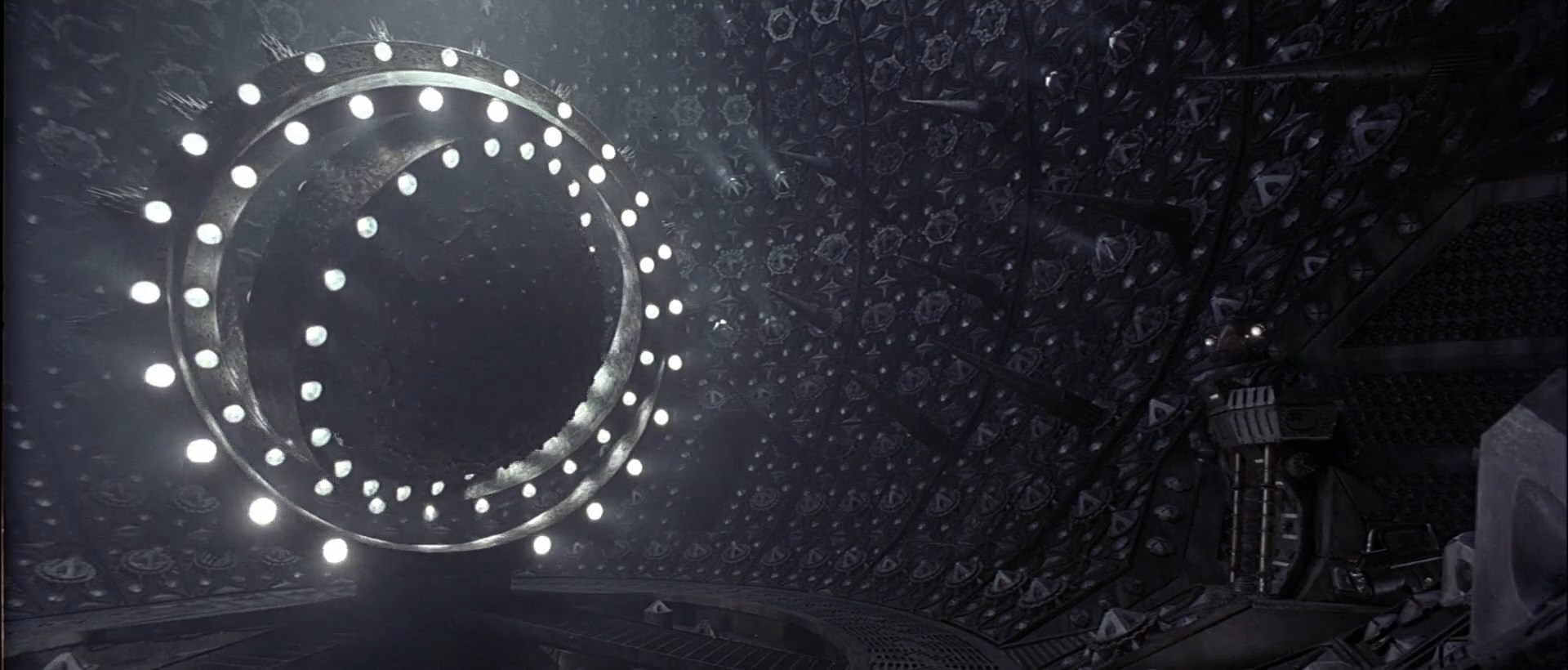
The gravity drive consists of three rings covered in spikes and knobs orbiting a metal globe also covered in spikes

Any sane person would’ve been wary of the drive even before the hallucinations started: just look at the fucker. That gothic design just screams evil. Event Horizon is not a subtle film, squarely in that tradition of sci-fi movies warning about things we’re not meant to know. Sam Neill’s scientist character, Dr Weir, is very much in that same tradition of scientific villains driven by hubris, opposing Laurence Fishburne’s captain Miller, the commander of the Event Horizon whose first concern is for his crew’s safety. The situation deteriorates as you would expect from a horror movie following the usual pattern of crew members picked off one by one by either the ship or Dr Weir, until the last few survivors manage to escape — or do they?

I’m not the first one who made the connection between Evetn Horizon‘s gravity drive and Warhammer 40K’s treatment of warp space, far from it, but that was honestly the first thing that came into mind. Just the design of the ship is reminiscent of Warhammer 40K, let alone the idea that warp space drives you mad and is filled with demonic beings. But it’s not the only comparison that comes to mind. Hellraiser, where you can be summoned to hell if you solve a particular puzzle box, is another one, but there are also other connections to be made.

On some level you could see Event Horizon as a movie about alien contact. Something lives in warp space and ‘talked’ to the crew: it’s not its fault that contact drove them mad. Granted, Dr Weir’s actions are purely malevolent, trying to either keep the others onboard or killing them if they try to escape, btu that might just be him, not whatever entity contacted him in the first place. It might just be a Solaris situation, with an intelligence so different from ours communication is impossible, so bizarre that our minds cannot handle it. Forbidden Planet is another such movie this reminded me off, which also had some sort of creature killing off the members of an expedition to an alien planet.

A predictable, but enjoyable horror sci-fi movie.