Metal Monday interlude

It was my year’s resident metalhead who made me realise back in high school that classical music is something that can actually be enjoyed rather than something that needs avoiding. And to be sure, much of what metal does is stole^wliberated from classical music, especially from opera, especially especially from Wagnerian opera. What after all is more metal than a long spun out story of warring gods, magic rings and chicks in chainmail bikinis?

The one problem is, that while you might think Kreative Destruktion‘s twenty minute song about the Battle of Wesnoth drags on a bit, taking in the Ring Cycle takes twenty hours. It can therefore be a bit hard to keep focused and keep track of the story. Luckily there’s Anna Russell to put you straight on the players and the play both:


Missing the point

I’ve got a fair bit of sympathy for people who get annoyed when their culture is misrepresented or appropriated by some science fiction or fantasy writer looking for some exotic colour, but I think Kosin Grigor’s critique of China Miéville’s The City and the City misses the point:

Since we’re hardly lacking in places where people really do practice the kind of mental gymnastics that’s exercised in Besźel/Ul Qoma, the learned knowing of “ours” and “theirs” and never transgressing – though of course not as drastically as to literally unsee The Other Place – it strikes me as gutless to spend so much energy on crafting an allegory (and inevitably leaving it full of holes and failures in this desperate effort of making it Distinct; hell, one of the characters even attended a workshop on policing (real) politically divided cities so that once again we could be assured we’re not reading a roman à clef on any of them) instead of going all the way and writing a fantasy Stolac or what have you, and labelling it clearly as such. Sure, it would piss people off something rotten whichever real divided city one chose to write an alternative history and present reality of, but it’s not like the book isn’t already insulting in its carefree ignorance of its building blocks.

Some of the objections it raises may very well be valid, but it misses the point of the novel. The City and the City is not meant to be a standin for anything, or function as a metaphor for some really existing Eastern or Central European countries. The setting is not quite meant to be realist, rather than evoke just enough of a feeling of realism to serve its central conceit, that of two cities geographically sharing the exact same space yet being separated through the inhabitants of each city deliberately unseeing the other one. The book would not work if it was based on a real situation. I’m sure Kosin Grigor is right to say Miéville made a mess of the language and names and it therefore doesn’t work for them, but again, this is a fictional city we’re talking about, not meant to be representive of anything actually existing. That the language therefore is reminiscent of, but doesn’t quite work like real Eastern/Central European languages is a feature, not a bug.

It’s one thing to be annoyed by this, which I can well understand, but that doesn’t mean that Miéville is guilty of culturefail, as Kosin puts it. Miéville’s cities are not some Ruritania, created to indulge in “Balkans” cliches, but rather use Eastern/Central Europe as an inspiration in the same way that his earlier creation of New Crobuzon.was inspired by London, but not meant to be London. Ultimately everything about Besźel and Ul Qoma is in service to the central idea of unseeing; their existence only needs to make enough sense to support this and to criticise it for not being real enough is missing the point; it was never meant to be.

Insult to injury

The IDF did not just storm the aid convoy to Gaza and kill nine activists, they also stole their possessions:

Israeli troops have been accused of stealing from activists arrested in the assault on the Gaza flotilla after confiscated debit cards belonging to activists were subsequently used.

In their raid of 31 May, the Israeli army stormed the boats on the flotilla and, as well as money and goods destined for the Palestinian relief effort in Gaza, the bulk of which have yet to be returned, took away most of the personal possessions of the activists when taking them into custody.

Individual soldiers appear to have used confiscated debit cards to buy items such as iPod accessories, while mobile phones seized from activists have also been used for calls.

The goggles do nothing


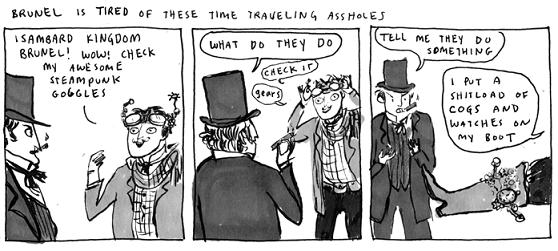
Isambard Kingdom Brunel is tired of steampunk. By Kate Beacon

In the past two-three years steampunk has mutated from a science fiction sub-subgenre derived of cyberpunk into something of a lifestyle, taken up by goths looking for something new to be mopey in and hipsters looking for the next ironic thing. It’s been going on for longer of course, but it broke the ‘net’s awareness threshold only recently. In the process steampunk has been stripped of all meaning, as the above Kate Beacon strip refers to, reduced to a series of tropes and fashion accessories. Nothing wrong with playing a bit of dressup, but it has become so ubiqitous now it’s starting to piss people off, as the following heartfelt rant by Philip Reeve shows, already deleted from his website but still in Google’s cache:

No, the problem that I have with Steampunk as a genre is that it’s basically dead. Returning again and again to the same tiny pool of imagery, the writers of Steampunk are doomed to endless repetition. What I used to love about Science Fiction as a teenager was the way that, when you picked up one of those yellow Gollancz SF titles at the library, you had no idea where it would take you; it might be to some dazzling technological future or post-apocalyptic wasteland; it might be to another planet; or it might all be set in the present, just around the corner. But when you pick up a Steampunk book you know pretty much exactly where you’re going; it will take place in an ‘alternate’ nineteenth century which will be neither as complex nor as interesting as the actual nineteenth century. There will be airships; rich villains will be hatching plots involving clockwork and oppressing the workers; rich heroes will see the error of their ways. Most of the characters will not display any of the attitudes or beliefs of the past, but will act and speak like modern people in Victorian fancy dress.

[…]

Steampunk is a genre cul-de-sac: it’s Science Fiction for people who know nothing about science; historical romance for readers whose knowledge of history comes from costume dramas.

I can understand where Reeve is coming from, though he’s stacking the deck somewhat by comparing science fiction with steampunk. If you look at any of science fiction’s subgenres, be it steam or cyberpunk, or planetary romance or space opera or whatever it will seem more limited and codified than the field as a whole, but that’s comparing an entire forest with one of its trees…

If you look at the mainstream works within any given (sub)genre, science fictional or otherwise, these works will tend to resemble each other, with the interesting/innovative stuff happening at the borders where genres meet. But there’s nothing wrong with being a well written genre work that does not confound expectations either. What Reeve sees as the problems of steampunk in the first quoted paragraph, are not faults of the genre, but rather of lazy writers taking the set of assembled cliches and not doing much with them. A better writer could take all these cliches and get more out of them.

Reeve is more on the mark in the second paragraph I quoted. He’s echoed by Steampunk Scholar, who is obviously more tolerant of the subculture [1]:

While there are steampunks who have read the original three (Jeter, Powers, and Blaylock), who watched Wild, Wild, West when it had nothing to do with Will Smith or giant steam-spiders, there are those who seem to think that steampunk is the product of the last three years of what I would call the steampunk boom years. Few steampunks read, and even fewer have read early steampunk, or proto-steampunk like Pavane or Nomad of the Time Streams, to say nothing of the handful that have actually read Verne and Wells. So I’m not too surprised when steampunks display an ignorance for the literary origins of the sub-culture.

Steampunk as a literary genre speaks to a weird sort of nostalgia for an era none of its writers or readers have lived through, unlike e.g. sixties nostalgia which is largely driven by baby boomers remembering their childhood. Instead, it’s nostalgia at a remote, based on media recreations of the era like the Disney adaptations of Jules Verne novels or the various movies of Classic Victorian novels. In science fiction it is perhaps as much driven by a nostalgia for earlier eras of science fiction itself, as much as an aesthetic preference for the look and feel of victoriana. It’s no coincidence that the first wave of steampunk novels or steampunk precursors, like the two examples Steampunk Scholar gives, Pavane and Nomad of the Time Streams were written in the late sixties and early seventies, after the New Wave had completely reimaged science fiction. There was something of a nostalgia backlash going on in science fiction then, even amongst those like Moorcock who had been the driving force behind the New Wave. Yet at the same time, how Moorcock (or Harry Harrison in A Transatlantic Tunnel, Hurray! amongst others) used steampunk was as much as to criticise the contemporary world around them as much as it was an escape to “a simpler time”. There was a political element to those early works that may well be lacking in contemporary steampunk.

It should not come as a surprise that proto-steampunk or early steampunk is more interesting, more eclectic than those works currently sold as cyberpunk: the same happened with cyberpunk before it and the New Wave before that. It’s the difference between novels written as a singular enterprise and those written within the knowledge and expectations of an already defined genre. And of course genres mutate over the course of their lives; how much does contemporary steampunk still have to do with the examples Steampunk Scholar mentions of earlier works? How much is complaining about people not knowing their history justified and how much is it just yelling at those kids to get off your lawn?

[1] Both posts found via my namesake.
Big Planet – Jack Vance

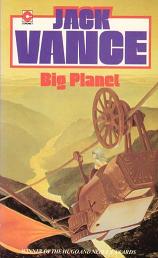
Cover of Big Planet


Big Planet
Jack Vance
158 pages
published in 1951

It’s always dangerous to reread books you fondly remember from your youth. As Jo Walton put it, between the time you last read it and your rereading it, a book might have been visited by the suck fairy, which has taken all the awesome bits you remember and replaced them with dullness. Worse, the racism or sexism fairy may have also visited… I was therefore taken a risk in rereading Big Planet, one of the earliest Jack Vance novels I had ever read. Would it still be the great planetary romance I remember, or would all the adventure and wonder have been sucked out of it?

It turned out to be a bit of both. Not as good or great an adventure as my memory had made it, but still worth reading on its own accord. What my memory had made of Big Planet was much more exotic and detailed than it turned out to be, the real thing much more sketched out than filled in and how could it not with only 158 pages to play with. Nevertheless Big Planet is an important novel in Jack Vance’s development as a writer, as well as influential on other writers, as it shaped the planetary romance subgenre. Planetary romance being any science fiction story which takes place on a single planet and where most of the book revolves around the exploration of the planet, the stage more important than the actors on it.

Read more…