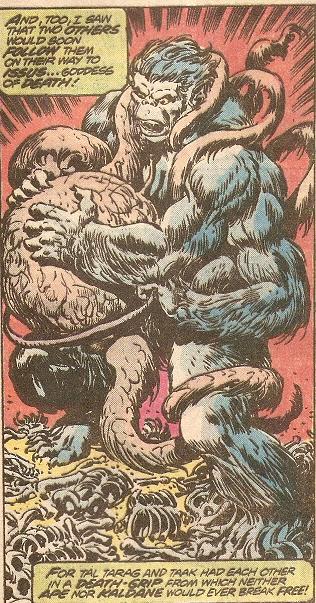
From Snell’s fond look back at Marvel Comics’ version of John Carter, Warlord of Mars comes this panel of “a four-armed ape wrestling with a giant, tentacled talking brain” — tell me this isn’t a fetish for somebody…
From Snell’s fond look back at Marvel Comics’ version of John Carter, Warlord of Mars comes this panel of “a four-armed ape wrestling with a giant, tentacled talking brain” — tell me this isn’t a fetish for somebody…
Sometimes even normally sensible bloggers can get it wrong. That the Flying Rodent actually takes professor Norm seriously is bad enough, but that he would give the following motivation for as to why people support a cultural boycott of Israel:
Here’s my take on why that is – it’s because you have a lot of people who want to do something about a horrible situation. This is something, they think, ergo let’s do that. I don’t think I’m being uncharitable to Norm if I note that he himself is a great thinker-upper of somethings to do in horrible situations, those somethings often being highly dubious and counterproductive themselves.
Further, it’s clear that the issue attracts a lot of people on both sides who like to see the world in very black and white terms, and find shades of grey confusing and annoying. I think that in many ways, stuff like Israel/Palestine has become a replacement for domestic politics, since the UK’s national discourse has largely devolved into a glorified piss-fight over who can empty the public’s bins most cheaply. Again, I have to observe that Norm himself is not entirely bulletproof against that type of criticism.
The idea that people only care about Israel’s oppression of the Palestinians out of dissatisfaction with domestic politics not just insulting but dumb. It’s just another form of whataboutery: “why do you care about the Palestinians so much when the NHS has to cut spending”. People, certainly on the left and especially in the socialist left have always combined domestic causes with international involvement and it’s a sure bet that the people most involved with the boycott and disinvestment campaign are also active in more local activism.
Let’s not even mention the crack about wanting “to see the world in very black and white terms”. That’s such a cheap shot, only a step above accusing people of being terrorist sympathisers. The facts being as they are, it is quite possible to acknowledge that in Israel/Palestine both sides have their faults while still conclude that it’s better to be on the side of the people with no heavy weapons being put on a “starvation diet” for having elected the wrong government than on the side of the people who do have heavy weapons and use them to make sure the first group of people remain on that diet.
Meanwhile another normally sensible blogger also has a bee in his bonnet about the boycott. Steven Poole objects to Iain Banks’ announcement of no longer allowing his books to be sold in Israel:
I have written hereabouts before on why cultural boycotts are stupid, and that still applies (the idea that the refusal of pop musicians and sportsmen to play in South Africa somehow broke the apartheid régime is a fairytale). Iain Banks himself realizes too that it is a stupid (and actually vicious) idea: his plaintive “what else can we do?” doesn’t even pretend to be a justification; it is merely the Politician’s Logic of “Something must be done; this is something; therefore, we must do it.”
Banks himself calls a boycott “a form of collective punishment”, which Steve takes seriously. Clarifying himself in the comments, he says that a boycott is “an act of collective punishment. I assume we can all agree that collective punishment is vicious?”
I disagree with both of Steve’s points: a boycott is not a form of collective punishment, nor is it stupid. He’s right to say that the cultural and sporting boycott of South Africa didn’t end Apartheid, which nobody has ever claimed anyway, but wrong to think it didn’t matter. This boycott was a necessary tool to put pressure on the South Africa, but only one part of a much larger boycott and disinvestment campaign against the Apartheid regime in South Africa, just like the academic boycott of Israel‘s apartheid regime. What happened in the case of South Africa was a series of campaigns, that costs years and decades to get going, which slowly isolated the regime from the outside world, aimed at making Apartheid economically unsustainably. It involved getting western companies to stop investing in South Africa, getting western governments to stop selling arms to them, getting ordinary people to no longer go on holidays there, etc. The cultural boycott was one part of this broader campaign and was important, especially in the eighties, as South Africa did put forward a last ditch effort to rehabilitate its image — remember Sun City?
The same goes for the boycott and disinvestment campaign underway against Israel, which has built its own Apartheid system. Like the campaign against South Africa its aims are to put economic pressure on Israel while creating the sense that this is not a normal, democratic country. Which is why an academic boycott matters, even if it wouldn’t harm Israel all that much. Actions like Banks’ send the signal that the ongoing Israeli treatment of the Palestinians won’t be tolerated, that our governments might think Israel is an acceptable ally/friend of the west, but that we don’t share that opinion. Again, this is exactly what happened with the campaign against South African Apartheid.
That this is a form of collective punishment is nonsense. A bit of an own goal for Banks to say that his act of individual boycott is “an act of hypocrisy for those of us who have criticised Israel for its treatment of the Palestinian people in general and those in Gaza in particular” as that puts not being able to read one particular author’s books with blowing up the sole power plant in Gaza. (A quick aside: many of the institutions targeted by the disinvestment and boycott campaign are either part of the Israeli oppression machine or profit from apartheid directly.) The collective punishment Israel unleashes on the Palestinians at their whim directly threatens them in their existence: houses are demolished, supposed terrorist headquarters are bombed, olive trees are uprooted etc. In contrast, the academic boycott might mean Israeli students can no longer go to Oxford…
There ar e quite a few metal bands whose name starts with “l”, but there’s only one band that counts, those archetypical rock dinosaurs: Led Zeppelin. With Black Sabbath and Deep Purple they were one of the founders of hard rock, influencing zillions of bands, if not with their music, then with their lifestyle…
Musically you could say their work falls into two categories: their earlier, blues inspired songs (where “inspired” sometimes meant “shamelessly stolen from”) and the much more bombastic (some would say indulgent) rock songs they performed on their later records. The first video is one example of that style – Kashmir:
Dazed and Confused is a good example of their earlier style:
This song comes from the first Zeppelin album, creatively called Led Zeppelin. I had that and the second album, even more creatively called Led Zeppelin II as a double album and used to play them on Saturday mornings while reading Usenet. Ahh, memories.
Immigrant song was once memorably covered by Joel Veitch’s Viking Kittens. This is the original.
And of course…
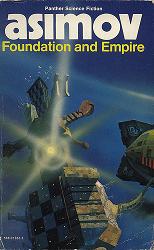
Foundation and Empire
Isaac Asimov
172 pages
published in 1952
Foundation and Empire is the middle book in the Foundationtrilogy, to which no sequels were ever written and suffers a bit from being a transitional book. The trilogy had originally been written as a series of short stories, published in Astounding before being fixed-up into novel form for publication by Gnome Press in the early fifties to prove that there was a market for science fiction novels. This fixup worked well in Foundation, but Foundation and Empire could just as well been split up between the other two books. The first half follows on naturally from Foundation, while the second half is continued in Second Foundation.
As seen in the first book, Hari Seldon was a psychohistorian who predicted the fall of the Galactic Empire and set up the Foundation to help limit the period of barbarism that would follow to a mere 1,000 years, rahter thann the 30,000 it would take otherwise for a new empire to rise. Through various crisises, predicted by Seldon and manipulated by him so that there was always only one choice for the Foundation to whether the crisis, it became a regional power in the periphery of the Galaxy, second only to the old empire. Now the Foundation faces its first direct confrontation with the empire, in the last crisis Seldon predicted correctly, while the second half of Foundation and Empire tells the story of the crisis Seldon didn’t predict: the rise of the Mule.