Finally a proper Marxist videogame

According to Jonathan McCalmont , Dead Space is The Shock Doctrine Gone Interplanetary:

The French intellectual and artist Jean Cocteau once said that for some, style is a simple way of saying complicated things. EA Redwood Shores’ Dead Space (2008) is a game that proves how much can be said with minute shifts of emphasis for while the game is ostensibly yet another title all about collecting money and killing monsters, Dead Space is a fiercely left wing game whose narrative constitutes a vicious critique of neoliberalism and the monetarist policies of Milton Friedman and the Chicago Boys. It is a game about the brutal economic dismemberment of developing economies in the name of Free Trade and how, finally, the world is starting to realise that you do not cure poverty with Shock Therapy as that only makes things worse. Much worse.

[…]

Indeed, the necromorphs are not alien interlopers into a natural process, but products of that process itself. This is an important distinction, as it chimes so well with the way in which Friedman talks about the free market. Indeed, one of the more intriguing tactics used during the rise of neoliberalism as a political doctrine is the idea of the free market being in some way natural, like a default setting. If this is true, then it follows that any intervention by the state in the market is a ‘distortion’ of the market and ‘unnatural’, but this is mere political rhetoric… the market is a human institution and, as such, it has no existence beyond that granted it by humans. Living in a state of bare-knuckle free market capitalism is no more natural than living in a Stalinist planned economy… and even if it was, it would not be clear what kind of moral or political authority ‘natural’ carries. It is not ‘natural’ to have a special room to defecate in, but it does not follow that we should all let it drop out the back like cart horses. Dead Space’s suggestion that the necromorphs’ presence is a result of the planet cracking suggests that the human costs of the market must be taken into account and not merely repressed with force. Indeed, the game’s final act sees Isaac Clarke desperately trying to mend fences with the hive mind by returning the marker to the planet. This also chimes intriguingly with the history of neoliberal thought…

You know, I think Jonathan might hve been slightly tongue in cheek here…

SWP stunt causes failure of world revolution forever!!1!

Protesters surround BA boss Willy Wash

So, to recap: last Saturday, at the end of the Right to Work Conference, coincidently held close to where British Airways was “negotiating” with the unions, several hundred or so people went from the conference to the negotiations to show their support for the airline workers and ended up shouting at BA boss Willy Walsh, with the union leaders looking on in annoyance, while . Cue much pearl clutching from Andy Newman and co, convienced that this would finally be the end of the SWP (joy!) but also mean the ultimate failure of the negotiations, union militacy in general, the socialist project and world revolution (oh noes!).

The whole controversy is remarkably silly, but to be expected from people for whom that bit from Life of Brian about the Judean People Front isn’t satire, but an instruction manual..

Back in the real world it’s clear this stunt didn’t matter much one way or another. It didn’t “disrupt” the negotiations as overblown rhetoeric had it immediately afterwards, but neither did it achieve anything else, other than provide a show of moral support that might have been better expressed differently. I do worry about the attitude of people who think a stunt like this is inherently wrong and counterproductive, or who worry too much about how “the rightwing media” or “the bosses” will spin this, or who get outraged at the “disrespect” shown to union bosses. It reminds me of those liberals who back in 2002/2003 were too good to join antiwar protests organised by giant puppet making hippies.

On bad reviews

I don’t quite know why I found this review of The Brave and the Bold #33 so annoying, as I neither read the series nor particularly like the creators (J. Michael Straczynski & Cliff Chang) involved. But it might have something to do with this:

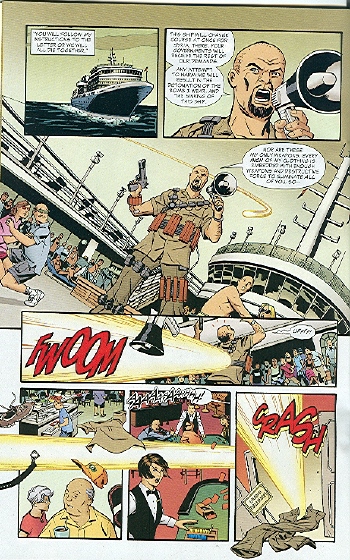
Well, to start off with, Wonder Woman makes yellow light explode out a man’s pants, and not in a good way.

First, I couldn’t tell which direction the yellow stream is even supposed to be going. And what’s with the old duffer’s flying trucker cap? Isn’t it enough to be disrobing one person per panel with unfortunately pee-yellow light explosions?

Grand Ballroom, this way to the yellow pants! It’s like a Dr Suess, except not funny.

Below is the page being mocked. Now, apart from the hilarious joke actually not being all that funny, what is annoying about this “criticism” is that this page surely isn’t that difficult to understand? Two establishing shots with some cruise ship, some terrorist leader yakking away on his megaphone, a superhero flying towards him in a streak of yellow light (“Like pee hur hur hur”), slams into him from behind in the next shot, with the bottom three panels showing the bad guy being pushed at speed over the boat, losing his clothing in the process. The action flows from top to bottom, left to right, with the only tricky bit being the transition between panel three and four, when the camera moves from in front of the bad guy to his back. The art is a bit too static for my liking and a more “blurred” effect on the speed lines would’ve been more clear, but is this really such a bad sequence that pee jokes are the best you can say about it? Really?

a page from Brave and the Bold 33

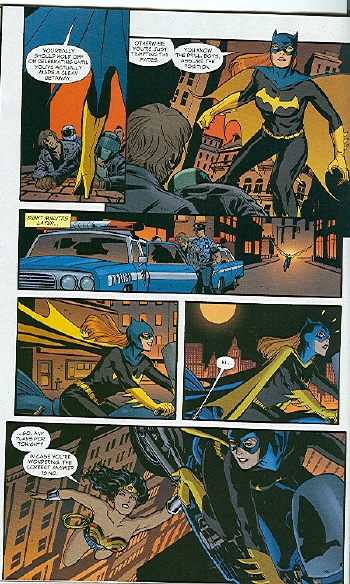
Luckily the post moves on from pee jokes when describing the next problem page which, to be honest, could be a lot better:

a page from Brave and the Bold 33

I stared at this page and tried to figure out what the heck is happening. Finally, I decided that her bike flies between panel 4 and 5, although I don’t know why. Apparently so we can see Wonder Woman hanging onto the middle of the bike? I don’t even know.

The sequence in question, at the bottom of the page, is one that’s been used in hundreds of comics in one form or another: guy drives along, suddenly is driving in the air, looks down and sees Superman e.g. holding up his car. It’s done badly here, both because the background in the first two panels of the sequence is not very clear and because the panels themselves are too small, squashed between the payoff panel at the end and the big panels at the top of the page. Even so, how long does it take you to work out what’s happening, even if you’re not so familiar with (superhero) comics?

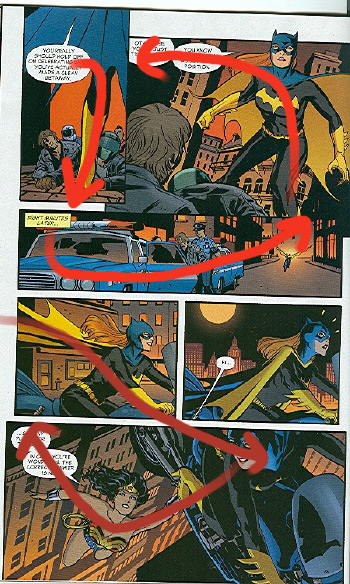
Rather than asking what’s happening here when, though confusing, it is relatively easy to work it out, it’s much more interesting to show why this page can be confusing to new readers or manga readers, as is done in a later post. This is where the final page shown here comes from, on which commenter Telophase has marked up the flow in which a typical manga reader would read the page. According to them, a manga reader would figure out the visual flow from the artwork, rather than from the panel layout — looked at the page this way, it is confusing. Now that’s a good piece of criticism.

a page from Brave and the Bold 33

I’m not defending this comic; since I haven’t read it I can’t. Nor do I mind people making fun of a comic. What I object to are unfunny, lazy jokes done on material that doesn’t deserve them and the defensive attitude in the comments when a few people voiced their objections. But perhaps it’s a bit much to expect indepth analysis of such a piece of epheremal storytelling when pee jokes are so much easier…

Metal Monday: Unleashed in the East

Judas Priest. Who could guess the leather daddy lead singer was gay?

For the “J” installment of Metal Monday there’s only one band that can be featured, the lawbreakers themselves: Judas Priest. To me Priest is the perfect link between hard rock and heavy metal, sort of halfway inbetween hard rock pioneers like Sabbath and Deep Purple and NWOBHM bands like Maiden, able to match both. Discovered them sometime in the late eighties, when I found a huge stack of their records on a flea market, for a guilder a piece. Not quite in pristine quality when I got them, played them so much over the years the grooves have worn out — long live MP3s.

Now the least interesting thing about Priest is that their lead singer, Rob Halford, is gay, which he only openly acknowledged in 1998, though it really couldn’t come as much of a surprise to anyone, considering the outfits he tends to wear. Heavy metal may unironically celebrate the macho leather look, but Halford is a bit over the top even so. Again, it shouldn’t matter and luckily for most fans it didn’t, but it seems still to come as a bit of a surprise to outsiders. Metal has a bit of a reputation as neanderthal music I guess…

The other thing everybody knows about Priest is that they were accused of putting subliminal messages in their songs to get their fans to commit suicide, to which Halford said that would be the dumbest thing a musician could do, kill of their fans and that they’d rather subliminally influence their fans to buy more albums…

Priest’s music has evolved a lot over the years, though the core qualities remain the same. One of their earliest classics is “Diamond and Rust”, a Joan Baez (!) cover from 1974 here in a great recent version:


1980 album British Steal saw this breakthrough hit, complete with naff videoclip:


From 1990 comes Painkiller, which may be one of the few songs in which I prefer the studio version. The quick pounding drums come through much better that way. Especially with the sound turned up to eleven on headphones. Still haven’t lost the buzz…


And of course, no metal band should be without their serial killer shoutout — The Ripper:


Once Upon a Time … Space


The local cable network is doing a promo for their kiddies channels package, which would not be of much interest to me, if not for one thing. One of the channels involved is repeating episodes of Er Was Eens… De Ruimte, (Once Upon a Time… Space) that was about the only proper science fiction on the telly when I grew up. I last saw this when it was first broadcast, in 1982/83, when I was already reading science fiction but Dutch television had little of interest; Battlestar Galactica was a few years ago, V would come a few years later. So it fell to an originally French cartoon series that was a sequel to a not very good series about The History of Man to fill the gap.

Which it did quite well.

Now compared to a roughly contemporary Japanese series like Gatchaman/Battle of the Planets (or Sj-force as it was also know in Holland) the animation quality was … not quite … as good and the characters somewhat on the stereotypical side (the main bad giuy actually being called “Generaal Naarling” (General nasty)), but it was also much more properly science fiction. Set some 1,000 years in the future, where a dozen or so races including humans have formed a peaceful union, the series follows the adventures of several new members of the union’s space police, as they have to deal with natural disasters as well as intrigues by the bad guys from Cassiopeia, a military dictatorship part of the union but constantly trying to gain ultimate power. The good guys are led by Omega and tend to go for peaceful solutions before grabbing for the laser.

The series lasted twentysix episodes, with the last six-seven or so forming one big story arc, featuring a new big bad manipulating Casseopia, a threat only resolved in the last episode. It was this that made the biggest impression on me, the first sustained space opera I’d seen. And what also made an impression was the music, both the opening theme as featured above, as the incidental background music, which is as burned in my memory as the Star Wars music…