Mean but accurate
Adam Roberts’ parody of Robert Jordan’s writing is mean but accurate:
Why did I fail? Oh, why did I fail to polish off wotviii this week, I thought to myself, creasing my brow and tugging my braids. Since the Age of Legends I have been reading this bu’u’ook, as the ancient bound codices were called. White streaking my beard and hair, I stroked the mindtrap upon my bedside table. I must be careful, I thought. Careful. To take care. Three different skills were in play, the ancient art of readin, the even more ancient and venerable art, of which only a few dozen in the world were true masters, of Turnian Pages, and, most difficult of all preventing the bitter, lethal brain num that inevitably pursued any man who dared to channel the antique magic of this kind of readin. It could be fatal, brain num. Fatal, it could be. I tugged my braid. The old Ar Selbow proverb came back to me: readin should be a chore, not a pleasure. I thought, oh, but I’ve read so much! To give up now would be … but I left the utterance an axe-handle short of completion. Was there room for any more? I tugged my braids. Hardly any hair left, I thought to myself. I wonder if tugging it all the time is responsible for it falling out? I wonder. I wonder.
But the parody quoted in a 1993 David Langford fanzine is more concise and just as funny, if not funnier. Which totally makes Adam’s version the more accurate, as Jordan, for all his virtues, was never adverse to use ten words when one would do, or seven sentences where two would suffice…
Adam is reading and reviewing the entire Wheel of Time series and not enjoying it much, hence the parody. He does so because, while he has read his share of epic fantasy, he’s “too ignorant of the 1990s and much of the noughties” which is why he “decided to give Jordan a whirl”. It’s been interesting to read his critiques, though not surprising that he finds Jordan hardgoing and not very good. Most honest fans of the series able to aprpeciate good writing will readily admit Jordan’s writing is not very good, workmanlike at best; much of the criticism Roberts levels at him was already talked about in rec.arts.sf.written.robert-jordan in the mid nineties. Where Adam gets it wrong is when he attempts to understand why people despite this keep reading the Wheel of Time books:
I get that for many people the deal is escape. Leave your worries behind; you enter this better world. It’s a world in which you don’t work in the accounts department of a mid-size educational supplies firm; where, instead, you live in a palace and command servants and have magic powers and enjoy exciting sex with beautiful people and are able to vent your repressed aggression in fighty-fight. Jordan’s twist on this venerable textual strategy is, partly, giving his readers much more detail than his market rivals; and partly, more cannily, creating the illusion of psychological depth. Simple wish-fulfilment gets old too soon; so Jordan’s Alexander-the-Great-alike is troubled by the fear he’s going mad. It’s not much, but it’s enough to separate him from the bulk of competitors.
[…]
And this is the part I can’t seem to get my head around: the fans know that it’s terribly written. They know and they don’t care. Why don’t they care? I don’t know why they don’t care.
[…]
What to say to such a review other than: don’t! Please don’t! The libraries of the world are crammed with beautiful, powerful, moving, mindblowing literature! Read some of that instead!
Adam gets two things wrong. Why people read The Wheel of Time when they know it’s not that good and that it’s possible to “trade in” the WoT series for better books and get the same pleasure out of it. It isn’t wish fulfillment that made me read the first book and then kept me reading: it was the story and the way Jordan told it. And I know the writing is workmanlike at best, the plot not all that original and the padding, oy, the padding! But as I said in my own review of The Eye of the World, Jordan had me hooked from that first scene. It’s not something you can really analyse and it has little to do with literay qualities: you get it or you don’t. If you don’t get it, that’s no big deal; the world is full with better books, but you can’t substitute them for the story Jordan told and the world he created.
It’s always difficult to explain why you enjoy something: in the end it all comes down to “I like it because it’s fun”. What I like in epic fantasy in general and Jordan in particular is a bit of escapism, of losing myself in a story, preferably a long story. The writing doesn’t have to be good to do this, as long as it isn’t so bad it becomes noticable. This isn’t at all comparable to the pleasure I also get from a good science fiction novel or something clever and literary; much more visceral, less intellectual perhaps. It’s also the pleasure in worldbuilding I got from Jordan, the way he which took standard fantasy concepts and remade them over the course of the series. The Encyclopedia of Fantasy agrees with me on that, noting the “ingenuity with which standard plot devices, backgrounds and charachters are subjected to constant and sophisticated modification”. That’s a pleasure that for others may not be enough to struggle through the series, or the kind of pleasure somebody like Adam is looking for, which is okay. It’s just that you can’t recreate this pleasure with a different set of books; certainly not with Nabakov…
Amsterdam garbage strike is over
But it will take an estimated two weeks before the entire city is clean again. The strike ended yesterday, after the unions and the joint Dutch municipalities reached an agreement in which the unions got much of what they demanded. This year municipal civil servants will get a onetime raise of 1.5 percent on their wages, as well as a 0.5 percent raise on their end of year bonuses this year and in 2011, with the minimum bonus for the lowest pay scales raised from 836 to 1750 euros. As important if not more is the agreement that there will not be forced redundancies in the next two years. The agreement still has to be voted on by the union members, but there’s a good chance that they will accept it and in the meantime the strikers have gone back to work, just in time before the weather gets too hot…
All in all another excellent lesson in how a little bit of pressure can force employers back to the negotiation table…
Middelburg 17 May 1940 — the Forgotten Bombardment
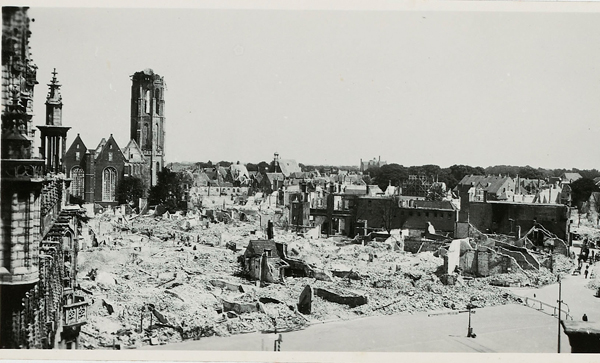
Market square after the bombardment.
If the bombardment of Rotterdam, together with that of Warsaw is one of the biggest atrocities of the early Second World War, it was not the only one. Three days after the bombardment forced the capitulation of the Netherlands, another Dutch town was bombed to the ground: my hometown, Middelburg.
Unlike Rotterdam, Middelburg has been somewhat forgotten outside Zeeland, only a footnote to the history of the German invasion in the “frightening May days of 1940”. But since this is the seventieth anniversary of the bombardment, some care has been put into making sure it won’t pass by unnoticed again. An academic research and lecture programme has been set up, as well as a series of more conventional remembrances, an educational package has been prepared for the province’s secondary and primary schools, all of which is of course coordinated with a frankly not very good website. A bit of a waste opportunity that site, only available in Dutch, with the history of the bombardment, the most important part, hidden away in PDF files. On the plus side, it has some good pictures of the devastation caused by the bombardment, the picture above being one of them.
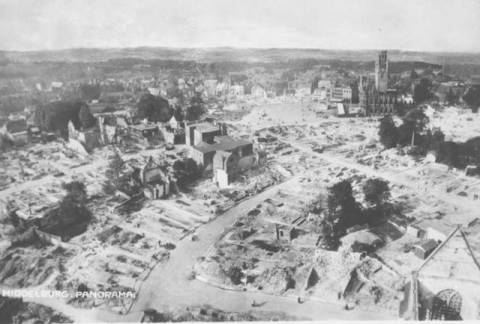
What Middelburg looked liked after the bombardment.
On 10 May 1940 the Germans invaded the Netherlands and Belgium on their way to France. As they had tried more or less the same thing in the First World War the French strategy was to meet them halfway, moving into Belgium and the Southern Netherlands to stop them. As you know this wasn’t quite succesful, but some French units (including French Moroccan units) managed to get as far as Breda before retreating westwards into Zeeland. This was the reason why the Dutch surrender on the fifteenth did not include Zeeland, as that was occupied by French troops. The slow withdrawal of the French meant that on the 17th Middelburg was near the frontline, with most inhabitants fortunately evacuated already as a precaution. That day a combination of aerial and artillery bombardment by the Germans broke the last resistance in Zeeland, with the last French soldiers already having disappeared into Belgium.
Twentytwo people died in the bombardment, which could have been much higher had there been no evacuation. The material devastation however was enormous, with most of the historical centre — some parts dating back to around 800 CE — destroyed. Some 253 houses and 320 shops and other business buildings were destroyed, as well as another 18 or so public buildings, including the old abbey and the city hall. The evacuation may have saved lifes, but it also meant there were few people other than the voluntary fire fighters available to extinguish the many small fires that the bombardment started; much of the damage therefore was done by fire rather than explosion. That it was such nice, warm, dry spring weather didn’t help either…
Unlike Rotterdam the bombardment was not intended as a terror bombardment, but a tactical decision to break the remaining resistance in Zeeland. The Germans supposed that Middelburg was were the French units had their headquarters and allegedly also believe there were artillery and anti-aircraft guns in place in the city, which was not the case. These reasons for the bombardment do not excuse the crime of course, but do make the bombardment more understandable than that of Rotterdam.

Middelburg today.
After the war the rebuild of Middelburg had to start. Where in Rotterdam the city had chosen to be brutally unsentimental in rebuilding its city centre, chosing for a throroughly modern approach, Middelburg chosen to try and recreate the old centre, though it did take advantage of the opportunity to rationalise the centre somewhat. The large open market in the heart of the city was split in two by creating a new row of houses through the middle of it, several smaller streets completely disappeared, while a few other changes meant the rebuild city hall and abbey were more visible, no longer hidden behind cramped streets. It worked out well in the end, though the price was high.
Metal Monday — on Sunday!
Because of a post I’m doing tomorrow remembering the bombardment of Middelburg then seventy years ago, I thought I’d do MEtal Monday today… We’re at “I”, so let’s have an Iron Maiden classic first, eh?
In Extremo is a band I discovered one night in 2006 or 2007 when I was idly zapping past some German channels and found a live registration from Wacken 2006. I don’t know what kept me, but it might have been the extremely loud bagpipes. It was brilliant though; turns out In Extremo is a folk metal band who take their inspiration from all sorts of traditional songs and take them up to eleven, as the selection below will show.
Spielmannsfluch:
Villeman Og Magnhild:
Vollmond:
Not everybody’s cup of tea perhaps, but I love the combination of traditional instruments and songs with metal.