AI: Threat or Menace — Tracking with Closeups

The Ai Acceleration Whiplash

The AI Accelaration whiplash: output is off but productivity is declining

The AI Engineering Report 2026 is not a survey of how developers feel about AI. It is a measurement of what AI is actually producing across the full software development lifecycle, tracking metric change between periods of lowest and highest AI adoption within each organization.
What it found has a name: the Acceleration Whiplash. AI has flooded a system built around human-paced development and human-quality code with output it was never designed to absorb.

Study finds AI tools made open source software developers 19 percent slower:

Before performing the study, the developers in question expected the AI tools would lead to a 24 percent reduction in the time needed for their assigned tasks. Even after completing those tasks, the developers believed that the AI tools had made them 20 percent faster, on average. In reality, though, the AI-aided tasks ended up being completed 19 percent slower than those completed without AI tools.

Findings backed up by more recent researtch (PDF) from Harvard:

We study the impacts of AI coding assistants and agents on software engineering work, usinga novel proprietary dataset from an engineering analytics platform, covering 300 million work events — including GitHub coding activity, Jira issues, and Google Calendar events — across 718 firms. We use a staggered difference-in-differences design, exploiting variation in firmlevel adoption timing of AI coding assistants and agents. Both technologies increase coding productivity. However, productivity gains do not fully pass through to changes in software output or employment. For AI agents, this incomplete pass-through reflects a bottleneck from code review: review times increase, a larger share of code updates require revisions, and reviews involve more comments. We develop a model of software production to structure these results, in which AI affects both productivity and quality of intermediate outputs, and in turn can generate a review bottleneck and limit pass-through.

AI sitcom accidentally a Lynchian fever dream. The sort of general malaise that only the genius possess and insane lament.

[image or embed]

— 𝔻𝕒𝕟 🏈🍻💀 (@danmynrd.bsky.social) October 29, 2025 at 10:47 PM


AI assistance reduces persistence and impairs independent performance:

AI assistance reduces persistence and impairs independent performance: After brief AI-assisted sessions (~10 minutes), participants were significantly more likely to give up on problems and performed significantly worse once the AI was removed, compared to participants who never had AI assistance.
Effects are concentrated among users who seek direct solutions: Persistence costs were concentrated among participants who prompted AI to solve tasks for them directly. Using AI for hints or clarifications did not produce significant impairments.
Effects generalize across domains: Effects replicated across fraction arithmetic and reading comprehension, suggesting it is a general consequence of AI-assisted problem solving, not specific to any particular task.

The Rise of AI Is Making Life Even Harder for Real People in Gaza :

The 22-year-old has endured almost two years of war in Gaza, as Israel continues an assault that has killed at least 57,000 people and left the territory of 2 million on the brink of starvation. Saeed has been raising money online to feed his family. But many people on social media have been convinced that he isn’t real at all. They believe he’s an AI-generated creation, used by scammers to get donations through crowdfunding platforms from well-meaning people. And in a world where AI videos and images have flooded our digital spaces, it’s easy to understand why some people are so skeptical.

AI-driven productivity gains enable more CO₂ emissions than they avoid:

Under parallel adoption scenarios, net annual CO₂ emissions increase by 0.47–1.8 gigatonnes (1.2–4.8% of 2024 global energy-related CO₂ emissions). Enabled emissions exceed avoided emissions whenever fossil-sector gains are nonzero; net emissions reductions require renewables gains 4–5× greater than fossil fuel gains. Absent policy steering, AI’s modeled effects increase the carbon intensity of the global economy and reinforce fossil fuel incumbency—outcomes that current analytical and governance frameworks do not fully capture.

Metal Monday: Anthrax

It was 1988, I was fourteen in my second year of high school and the one other metalhead/comics reader in my class brought in Among the Living: “look they’re doing a song about Judge Dredd”:

That day we poured over the liner notes in which the band members put shoutouts to their then favourite authors and characters: Stephen King, Frank Miller, Daredevil, Batman, Alan Moore, Judge Dredd, all of which was catnip to me, a nascent comics geek. The late eighties was when American comics, mostly American superhero comics became salonfahig in the Netherlands, or maybe it was just me having discovered them roughly a yaear before. In any case seeing my own interests shared by sucha cool band made me an Anthrax fan.

Among the Living has always been my favourite Anthrax record for these reasons, but that whole run from Fistful of Metal to Sound of White Noise is essential thrash metal. That last one was the first with Jon Bush as lead singer instead of Joey Belladonna and also was somewhat more …experimental and I lost interest in their later albums to be honest. Persistence of Time was the last Anthrax album with the classic lineup and it speaks to the band’s broadmindness that one of the lead singles was a Joe Jackson cover (which came as a real shock decades later when I first heard the original…)

Anthrax also introduced me to Public Enemy thanks to them touring together and doing collabs like “Bring Tha Noize”. It may seem weird, but metal and hip-hop after all were both outcast music back in the eighties, equally reviled by the moral majority and Tipper Gore’s crusade to clean up music.

So long live the greatest of the Big Four of Thrash Metal!

Casshan Ep. 9: Concerto in the Flames of War — A Response to Fascism

It’s September 11, which means it’s the 53rd anniversary of the brutal Pinochet coup that would plunge Chile into two decades of military dictatorship in which thousands of people would be tortured, raped and murdered. One of the coup’s earliest victims was folk singer Victor Jara, whow as taken to the Chilean national football stadium and when recognised had his wrists broken, then was mockingly ordered to play guitar before he was tortured further and killed on September 16th. The song Pete Seeger sings below was the one Jara wrote on the day of his murder.

By design or coincidence Shinzo Ningen Casshan episode nine, from November 1973, might be a response to this horror.


Casshan is a human turned cyborg fighting against the robotic hordes of Braiking Boss, a creation of his father which driven mad by a lightning strike in the first episode and now wants to rule the world. Casshan, with his robot dog Friender (who is capable of turning into a plane, boat or car because seventies anime series) stand in his way. Each episode has Braiking hatch a new plot which Casshan has to foil. So far then Casshan looks similar to series like Mazinger Z andGatchaman (both from 1972). Where Casshan differs is in the way the conflict and the violence it entails is shown.

A robot rat kills a cat pouncing on it by shooting it with a heat ray.

Take that scene above, a cat burned alive by a robot mouse, which does the same to the two cops showing up to investigate the noise. That’s not something you’d see much of in Mazinger Z, whose violence is much more abstract: cities are destroyed and building collapsed but you see no bodies. And the fights are strictly between Mazinger Z and the monster of the week, whereas in Casshan the villain does wage war on the entire planet. A conflict in which people are killed even when Casshan wins the battle.

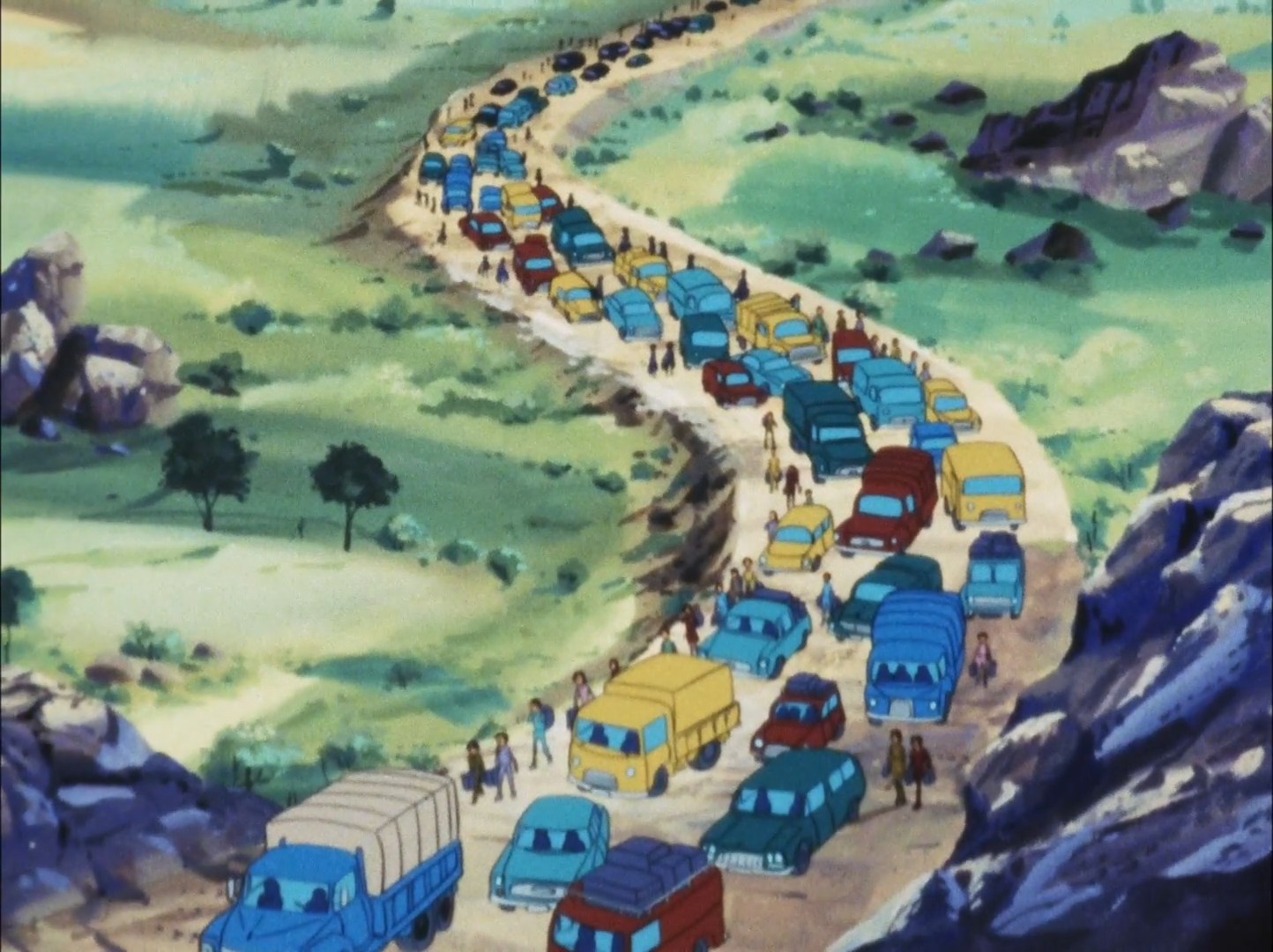
A large group of refugees on foot and by car leaving Queen City

Episode nine, “Concerto in the Flames of War”, scripted by Tadashi Fukui and directed by Seitarō Hara, shows this brilliantly. It opens with a city being bombarded by flying robot missiles as a narrator explains that this has forced people worldwide to flee their homes. In the next scene we follow one such column, escaping from Queen City, the Android Army’s next target. They flee in vain as the entire column is attacked by the same robot missiles we saw before. A hell of a way to open a show.


Casshan and his comrades, Friendster and Luna, his childhood friend whose father was killed by the Android Army, of course also arrive in Queen City to prepare for the robots to lay waste to it. Expecting to find the city empty they are astonished to hear music coming from the main concert hall. Turns out not everybody left the city. Famed for its music, several musicians and their fans have opted to remain. Others return after having fled first, enough so to put on a concert (Tchaikovsky’s Piano Concerto No.1)., in the face of Boss Braiking’s marching troops. That contrast of the mechincal, fascist march on the city and this performance held in defiance of it is a rebuke to Jara’s murderers.

Fascism always wants to stamp out art, stamp out music, destroy the human spirit but even on the day he died, after he was tortured and had his wrists broken, Jara could still write that poem, still was able to make the truth know to the world. I doubt that this last, heroic act was known to the animators two months later, but that defiant stance of a music loving city and its citizen against the literal metal boot of robot fascists is still a fitting rejection of a fascism that was very much alive again in 1973, less than thirty years after the last great war against it ended.

Metal Monday: Manowar

Manowar arguably is the metal band that does the most to confirm all the prejudices normal people have about metal bands. As The One True Poster over on Bluesky has it, in their consideration of metal albums that should be included in any best of ’88 competition:

KINGS OF METAL is an act of self-flanderization so extreme it rewrote the perception of Manowar entirely, and created a love-hate relationship with metal fans who saw the band as by turns true-believers, jokes, or jokers. To this day there are those who can’t quite believe Manowar is an entirely-serious proposition, despite half a century of rigorous commitment.

This perception of Manowar comes down to the version presented on KINGS OF METAL, and maintained ever since—a ridiculous band making absurd pronouncements of their own mastery on songs that could be self-parody if the band ever winked. Manowar, as a concept, an ethos, a representation of metal, is such a big part of the genre’s psychic real estate that I think the album that captures them at their most Manowar is simply an essential for consideration.

I first encountered Manowar listening to VARA’s Vuurwerk, a Dutch metal radio show presented by the lead singer of the country’s second most famous new wave teenybopper pop group (their sole attempt at an English song, translated for Eurovision), Henk Westbroek (and who’d later be the front man for a right populist local party but then nobody is perfect). For a couple of years the program would run an annuel top fifty with the songs chosen by the listeners and in 1989 Manowar’s Battle Hymn was number fourteen. Heady stuff for a fifteen year old kneedeep ine pic fantasy to listen to.

It immediately madeM anowar one of my favourites, despite or maybe because of how over the top and ridiculous their songs were. You can call it camp, but it’s genuine camp, made from the heart and without an ironic wink at the listener; just look at the absurdity of that live performance: three drummers, motor cycles on stage, flames everywhere. This is high camp but it refuses to be in on the joke. Manowar is the perfect exemplar of something that’s been part and parcel of metal for at least as long as Rob Halford has been swanning around in macho leather outfits.

So yeah, having gotten in the mood for some metal thanks to this I thought I’d return to an old series of mine, last updated in *good lord choke* 2010.

As for my essential metal albums of 1988? I’d go for Death’s Leprosy, Slayer’s South of Heaven, Metallica’s …And Justice For All, Queensrÿche’s Operation: Mindcrime, Maiden’s Seventh Son of a Seventh Son and Carcass’ Reek of Putrefaction as the first half dozen that come to mind. These are the albums I listened to as a budding metalhead: they still hold up for me. That decade and a half between roughly 1982 and 1998 or so will always be my peak metal era.

David Correos: He Won’t Betray Us

Look at what Taskmaster brought me for my birthday:

Not sure quite when I started watching Taskmaster videos, but sit must’ve been sometime in late 2021 or early 2022, when the official channel started doing those single tasks exceprts and the like, before they put out entire episode on Youtube. But David Correos I first found in an unofficial compilation showing off just how chaotic Taskmaster New Zealand’s second season was. And while David certaintly was the most unhinged candidate that season (or really, in all of Taskmaster), the rest of the cast was pretty out there as well.

You had Urzila Carlson there to have a good time, not a fast time and her good time mainly consisted of menacing Paul the Taskmaster assistant. Guy Montgomery meanwhile menacing Paul in another way, by wearing a series of t-shirts with youth photos of Paul. Matt Heath was there as the straight man, continuously failing to understand the tasks, trying hard but not succeeding very often. Finally, Laura Daniel, the most normal and competent one, but she too had her unhinged moments, like when she stole everybody but Urzila’s girlfriends for a prize task.

And yet David sticks out from all of them. Good or bad, he gave everything he got for each task, throwing himself into them with equal measures delight or desperation. Usually the chaotic candidates tend to be at the bottom of the rankings, but he closely trailed Laura for most of the series, finishing second. You can see this dual nature at work in this compilation, especially with the “float a sprout down from the balcony” task. The idea of tying the sprout to a helium balloon is genius; the execution …not so much.

What I really like about David Correos is how genuine his reactions are, both when doing the tasks and in the studio. For example, his reaction to how Laura solved the floating sprout task, angrily shouting “It was there for so long! I’m so proud of you”! Or the infamous team task rap he made, dissing Matt and Urzila on the other team, which he apologised for in the studio by gifting them each meat platters…

In short, David is the cherry on top of the cake that is Taskmaster New Zealand Season 2, arguably the best single season of Taskmaster ever.