The future is white

the Legion of Superheroes

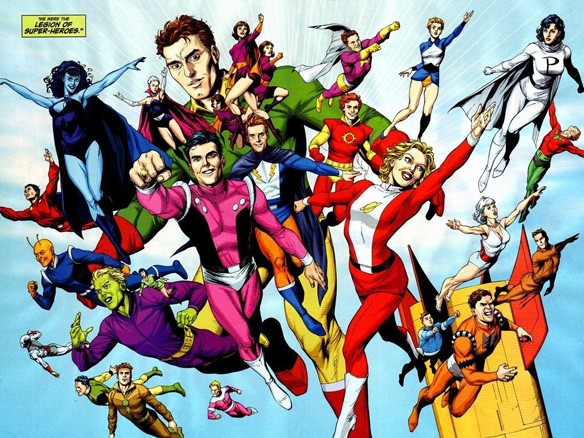
And occasionally green. That’s the Legion of Superheroes above, DC comics’ 30th century superhero group, with heroes from all over the galaxy but still mighty white. As the team was originally concieved and developed in the whitebread world of early sixties DC this is not too surprising, but over the decades and with various reboots some colour had been added to the team, through new characters and re-imaginations of older ones. All for nothing though, as yet another continuity reboot for the LoSh series has dumped them back to their pristine white roots. They’re a good example of what Chris Sims calls the racial politics of regressive storytelling:

And much of the time — not always, but enough that it’s more than notable — they’re being passed back from a non-white character to an Aryan ideal. Jason Rusch is still part of Firestorm, but it’s back to being Ronnie Raymond’s Caucasian body. Kimiyo Hoshi is still Dr. Light, but that name’s been permanently soured by “Identity Crisis” and the fact that James Robinson had the original Dr. Light threaten to rape her children on the Justice League Satellite. Even the regressions of ostensibly white characters often have racially charged consequences: Wally West’s interracial marriage to Linda Park has been sidelined in favor of on-the-go suburbanites Barry Allen and Iris West, and Kyle Rayner (who was created as an Irish-American but later “revealed” to be the son of a Mexican-American CIA agent) has suffered the strange fate-worse-than-death of a fictional character who gets demoted from a starring role to a supporting one. He’s still a Green Lantern, but he’s not the Green Lantern.

This is pretty much a DC only problem, Marvel has always been slightly better (though not great) at having non-white characters and also has done much less rebooting of their main characters — they tried to remake Spider-Man into a funkier version in the early nineties and it backfired horribly. Though much of DC’s endless fidgeting has been awful, it did mean more room for characters of colour in a starring role. But in the last few years the pendulum has swung back as writers who grew up with the originals took over and started to “restore” them to their rightful places. The end result is the draining of colour that Chris describes. It does nothing to dissipate the idea that superheroes are for white folks only, or that superhero fans are uncomfortable with heroes of colour…

Now what?

So what’s going to happen now there’s a hung parliament in the UK? First, we need to remember the incessant background noise send out through the media from the City:

Of course, the guys in braces who pop up on Sky every five minutes aren’t lowering themselves to support any given party. What they all want is strong government, strong enough to take the necessary measures on the deficit, and they want it soon. Soon, like Monday morning? ventures the tremulous interviewer, as though in the presence of an oracle. Well, perhaps Tuesday afternoon at the latest, says man in braces, chewing his lip, but soon, or the markets will be displeased, as though this displeasure came from De Lawd Above and has nothing to do with him and his confreres.

Once again, this is much like the same pressure seen after the 2000 US presidental elections to get a quick decision, rather than the right decision, but then it was the Republican party itself, now it’s the “financial markets” directly, worrying that if the wrong government gets in they won’t deliver the deep spending cuts they want. Spending cuts that are needed to free up the money that’s needed for the UK government to pay back the billions it had to borrow to save the very same “financial markets” from their own fuckups two years ago. They want their pound of flesh and they need a “strong government”, preferably a dependable Tory one, to deliver it. It would mean that the scenes Johann Hari witnessed in Hammersmith and Fulham will be repeated all over the UK:

She “panicked” when a bill came through saying she had to pay £12.50 for every hour of care she needed. “I thought, ‘Oh my God, how am I going to do this?’ The more care you need, the higher your bill, so the most disabled people got the highest charges. Everyone was distraught. I had friends who had to choose between having the heating on in winter and paying for their care … I know a 90-year-old woman with macular degeneration who can’t see, and she had to stop her services. There are lots of people who have been left to rot, with nobody checking any more that they’re OK, and I’m sure some of them have ended up in hospital or have died.” One of the council’s senior social services managers seems to have confirmed this, warning in a leaked memo that the charges could place the vulnerable “at risk”.

Debbie co-founded an organisation to fight back – the Hammersmith and Fulham Coalition Against Community Care Cuts – and, after appealing, she finally had her charges cancelled. “But there are a lot of people who can’t appeal,” she says. “You’re talking about very vulnerable people – the very old, the mentally ill, the blind. A lot don’t know how, or would be ruled to have to pay anyway, because the rules are so arbitrary. Now they’re being taken to debt-collection agencies for non-payment. I know an 82-year-old woman who’s never been in debt in her life who is being taken to a debt-collection agency for care she needs just to keep going… They want volunteers to do it instead. But you don’t want to have to ask your friends or a volunteer to pull up your knickers for you.”

That’s why it’s good Gordon Brown has not resigned and should resist the pressure to resign; it makes it that much harder to install a Tory government by coup de main. The weak link is of course Nick Clegg: is he tough enough to stand up to pressure to form a government with the Tories rather than with Labour, tough enough not to be fobbed off with vague promises of electorial reform. If we look at the popular vote more than half the voters voted for left of center parties, so selling a Tory-Liberal coalition as “the will of the voters” is a bit of a cheek, but that seems to be the recieved wisdom the media are parroting. Don’t do it Nick!

Bye-bye Charles! Bye-bye Jackie! Hello Caroline!

Unfortunately Hazel Blears kept her seat, but nice to see both Charles “safety elephant” Clarke and Jackie Smith finally were told to bugger off by their constituencies. Also good to see the Greens win their first seat.

The overall impression seems to be that, despite all the triumphalism, the television debates did not have the impact on the election itself they were predicted to have based on the polls. It became an almost normal two horse race again, with the Lib Dems doing nowhere near as well as “Clegg Mania” was supposed to make them. Currently they’re at 47 seats according to Wikipedia, with 565 of 650 seats declared. Last time they won 62, if the end result is the same, slightly better or even worse then it’s clear that Clegg has failed to deliver the breakthrough the debates seemed to hand him.

And the reason might just be that enough people took a second look at the likely outcome, saw the Tories looming and decided better to vote for the devil they knew. Labour might be bastards, but the Tories seem to be even worse bastards and a Lib Dem victory at the expense of Labour might just have delivered a Liberal-Tory government. Meanwhile the Tory voters the Lib-Dems were chasing refused to be caught it seems, rather having the real ones in power than a surrogate. A wasted opportunity, though the Lib-Dems might still end up holding the balance of power in what now looks like a well and truly hung parliament. They should’ve gone for the left of Labour vote, not chase lefty Tories.

Good to see Caroline Lucas become the first Green MP. Results from Poplar and Limehouse, where George Galloway is standing, aren’t in yet, but it looks like Labour has won that, according to the BBC.

What’s really worrying are the reports of polls closing while there were still voters waiting to vote; that’s a sign of bad organisation.

On Kindle will reading highlights become ads?

In the same vein as that Facebook security leak that’s gotten Palau annoyed over at Prog Gold, here comes another scary story about how we’re losing our privacy and paying for the priviledge. This time it’s the Kindle that’s at the heart of it. Via Matt Ruff:

The Amazon Kindle, Kindle for iPhone and Kindle for iPad each provide a very simple mechanism for adding highlights. Every month, Kindle customers highlight millions of book passages that are meaningful to them.

We combine the highlights of all Kindle customers and identify the passages with the most highlights. The resulting Popular Highlights help readers to focus on passages that are meaningful to the greatest number of people. We show only passages where the highlights of at least three distinct customers overlap, and we do not show which customers made those highlights…

Matt invented a similar scheme for his novel Bad Monkeys, involving a bug in the spine of physical books noting how long you spent reading each page, so he’s a bit miffed somebody made his paranoid fantasy real. The next step is to sell ads based on this data… It reminds me slightly of the soup ads the German publisher of Terry Pratchett’s Discworld novels used to insert in his books. They’re not his publisher anymore.

First let them do no harm

More evidence for the fact that getting a hung parliament is the best that could happen in the UK elections. Niall Fergueson is urging the Tories on to crash the economy:

‘There is a very real danger that [things] could now spiral, Greek style, out of all control if foreign confidence in sterling slumps and long-term interest rates rise. Mr Cameron needs to do two things right away. He must instruct George Osborne to wield the axe ruthlessly with the aim of returning to a balanced budget over a credible eight- to ten-year timeframe.

That means not only reversing Labour’s disastrous expansion of public sector spending, but also encouraging business growth with incentives to innovate, invest and work. At the same time, he needs to initiate talks with the IMF in case external support proves to be necessary. In both cases, it is much better to act sooner than later. The mess we are in is the result of 13 squandered years in which an unprincipled government frittered away the achievements of the Thatcher era. We are back not just in 1979, but in 1976, the last time the IMF had to bail Britain out as a consequence of Labour’s economic mismanagement.’

Drastically cutting government spending at a time of economic crisis worked so well in getting the world out of the Depression in the 1930ties, but then this isn’t about economics, but ideology, as Jamie notes. Talking about “the achievements of the Thatcher era”, in which much of the industrial strength of Britain was destroyed so that yuppies could roam free, is a dead giveaway. Hence the need to not let the Tories win this elections is just as great as to let Labour lose: vote tactically, vote hung parliament. First, let them do no harm.

(Crossposted from Prog Gold.)