Let’s forget whether or not it’s a good idea for a thirteen year old girl to go for a solo sailing tour around the world, no matter how capable she thinks she is or how much support she’ll get, what annoys me about this is the sheer hypocrisy and entitlement of it. In the Netherlands all parents have the legal obligation to keep their children in school until they’re eighteen, yet Laura and her parents think that this obligation does not apply to them just because she has a chance a breaking a world record and a not unsubstantial number of media commentators seem to go along with them where normally they would be the first to cry shame about truancy. The reason being that Laura is a nice, articulate, cute middle class white girl of nice, articulate middle class parents rather than some difficult allochtoon street kid. It’s annoying as fuck that this is taken serious as an issue and that social services had to intervene to make sure her parents obeyed their duty.
The American fallacy
Ronald Reagan discovers that the Russians actually did think the US was capable of waging nuclear war on them:
“Three years had taught me something surprising about the Russians: Many people at the top of the Soviet hierarchy were genuinely afraid of America and Americans. Perhaps this shouldn’t have surprised me, but it did … During my first years in Washington, I think many of us in the administration took it for granted that the Russians, like ourselves, considered it unthinkable that the United States would launch a first strike against them. But the more experience I had with Soviet leaders and other heads of state who knew them, the more I began to realize that many Soviet officials feared us not only as adversaries but as potential aggressors who might hurl nuclear weapons at them in a first strike … Well, if that was the case, I was even more anxious to get a top Soviet leader in a room alone and try to convince him we had no designs on the Soviet Union and Russians had nothing to fear from us.”
Quote found at the Wikipedia page about Able Archer, the 1983 NATO exercise about nuclear war that was so realistic it almost fooled the Russians into believing the exercise was real and into launching a first strike.It nicely sums up the American cluelessness about how other countries and people see them, to understand that not everybody agrees that they are the good guys. It’s a classic fallacy of empire of course, this lack of empathy, previously seen in Britain as well as Rome. It exists because as an empire, you do not have to take into account the wishes, desires and fears of lesser countries, it’s they who have to take into account yours. It’s a disease that leads to quite a lot of nasty surprises and which can only be cured by no longer being an empire. The British may pride themselves these days on how much better they understand whichever people they’re the junior partner in the American subjugation thereof they are, but they were just as clueless when Rule Brittannia was still true.
Books read August
I read a lot of non-fiction this month, helped by a generous birthday gift from my sweetie. Bit of a mixed bag, quality wise, some disappointments, but also some of the best books I’ve read this year or longer.
The Grain Kings — Keith Roberts
A disappointing collection of short stories by a writer I thought was better than he actually might have been.
Bad Science — Ben Goldacre
An early birthday present. Ben Goldacre explains how all sorts of hustlers, quacks as well as respected mainstream companies are exploiting our ignorance of science and how the media collude in this. He manages to do this with a considerable sense of humour and some sense of perspective.
The Red Hourglass — Gordon Grice
A very entertaining look at some animal predators likely to induce phobias: black widows, rattlesnakes, tarantulas and pigs. Grice is an amateur biologist, a keen observer and an unsentimental describer of the killings he witnesses his animals do. Certain descriptions are gruesome, but not gratuitous.
Belching out the Devil — Mark Thomas
Bloody Mark Thomas forced me to stop drinking Coca Cola with this book. ‘Nuff said. But if you want to know more, it’s all about what lies behind the family friendly image of the Coca Cola company: the murder of trade unionists in Columbia, abuse the drinkwater of waterpoor Indian states, water pollution in Mexico, poor labour relations everywhere.
What’s Going On? — Mark Steel
Steel’s previous autobiography helped convince me to become a socialist; in this one he explains how he went through a midlife crisis as he hit forty while both his marriage and his almost lifelong commitment to the Socialist Workers Party both collapsed. He does that in the context of Blairism, the runup to the War on Iraq and the developments since. Somewhat depressing as what could’ve the most positive development on the left in a generation is squandered, but fortunately Steel’s innate humour comes through.
Vive La Revolution — Mark Steel
Another Mark Steel book, this one about the French revolution, based on the series of comedic radio lectures he did about it. A nice, readable introduction that skewers a lot of the preconceptions about it that are particularly current in the UK. If you ever heard him do one of his standup routines or comedy panel show appearances, you’ll recognise his mannerisms in print as well.
The General Strike — Margaret Morris
An excellent historical overview of the failed general strike of 1926 in Britain, which holds some key lessons for socialists and trade unionists. Morris showed the union leadership was far from radical, unprepared, unwilling to take the measures needed to win the strike, did not realise that they were fighting both the government and business until it was too late and had more invested in safeguarding the system they were part of than actually winning and facing the consequences of their victory.
The Course of the Heart — M. John Harrison
I knew Harrison had a reputation as an excellent but difficult to get into writer but so far the two novels of his (The Centauri Device and The Pastel City) I had read had only been good. This novel however completely blew my expectations. It’s an woefully inadequate description but the best I can do is call this a magic realist love story, in which the protagonist is more of a spectator than a participant in the events he describes .
Signs of Life — M. John Harrison
A much more hard edged novel than the previous one, but the narrator is equally as much a spectator and this is as much a love story.
Supercontinent — Ted Nield
I’ve read other good books on geology and the history of the Earth, notably Richard Fortey’s books, but this is the best one volume introduction to the idea of continental drift and the underlying dynamics driving it that I’ve seen. Nield is very good at explaining difficult concepts to a lay reader without simplifying them into incoherence.
Heat — George Monbiot
Global warming is real, we need to cut ninety percent of our CO2 output by 2030 to make sure we have some chance to safe some of our environment as well as ourselves, how do we do that and not have to become a third world country? That’s the challenge Monbiot sets himself, looking at various parts of our daily lives to see what can be done.
Agent of the Terran Empire — Poul Anderson
Another collection of Dominic Flandry stories. These started as light space opera, but the underlying politics and gloomy worldview Anderson soaks them in takes away a lot of the
pleasure. Pessimistic about the ability of humanity to establish anything better than an empire and even more pessimistic about its ability to keep the empire strong, Anderson bought into a lot of the myths the neocons believe as well.
Old Twentieth — Joe Haldeman
A 2005 novel proving once again that Haldeman probably is the quintessential baby boomer science fiction writer, written as it is around the boomers’ stereotypical twin obsessions of their encrouching morality and the sixties. Not a good novel, but interesting to take apart, so to speak.
Spidey has to buy white gloves now
The mouse of ideas? Disney wants to buy Marvel:
Burbank, CA and New York, NY, August 31, 2009 —Building on its strategy of delivering quality branded content to people around the world, The Walt Disney Company (NYSE:DIS) has agreed to acquire Marvel Entertainment, Inc. (NYSE:MVL) in a stock and cash transaction, the companies announced today.
Under the terms of the agreement and based on the closing price of Disney on August 28, 2009, Marvel shareholders would receive a total of $30 per share in cash plus approximately 0.745 Disney shares for each Marvel share they own. At closing, the amount of cash and stock will be adjusted if necessary so that the total value of the Disney stock issued as merger consideration based on its trading value at that time is not less than 40% of the total merger consideration.
Based on the closing price of Disney stock on Friday, August 28, the transaction value is $50 per Marvel share or approximately $4 billion.
Speculation is running rife of course, the most obvious nobrainer commentary coming through Rich Johnson:
Jason Wood, comic geek and market analysis tells us that Isaac Perlmutter is expected to have full autonomy, or certainly to begin with. And that publishing comics would only have been a small part of this deal, it’s all about movies, merchandising and theme parks.
Well duh. Comics have only been a pimple on Marvel’s back ever it reinvented itself as a holding library for movie ideas, while Disney has never cared about comics — even back when it tried to publish comics directly in the early nineties, it only lasted until some executive decided the money could be better used on yet another mediocre Disneyland ride. No comic company has ever been worth four billion dollars (certainly no American ones)…
Despite having been pissed off at Marvel for decades now, I still have some fondness for the characters. Having them whored out by Disney might not be that much different from what they’re already subjected to, but Disney does have the ability to make everything they get their hands on slightly worse. Gods know what will happen if Disney insist on making Marvel more family friendly…
Way too plausible
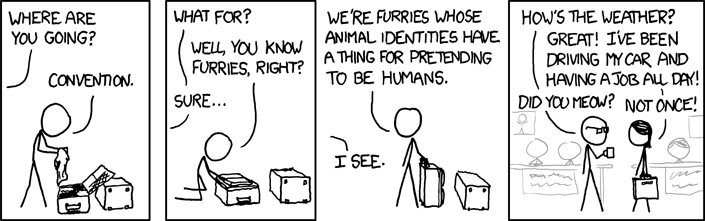
XKCD is the best non-continuity webcomic I’m reading right now and strips like this are why. Randall Munroe knows geekdom, the splendor and silliness both and is able to celebrate it without being smug or mock it without being nasty. He also draws the neatest stick figures since Matt Feazle.
the best continuty strip is of course Questionable Content, by Jeph Jacques., which I’ve been following from not long after he started it. It’s a comic you get the most out if you’ve been following it for a while, but you can read the archive in a single afternoon if you so please, guiltily clicking away at work hoping the boss isn’t looking. What I like about QC is that, yes, it is another twentysomething vaguely hip slackers and their romantic entanglements, but Jacques isn’t afraid to change the status quo and actually let his characters develop. The art as well has improved hugely, from servicable to a delight in its own right.