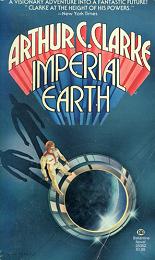
Imperial Earth – Arthur C. Clarke

Cover of Imperial Earth


Imperial Earth
Arthur C. Clarke
305 pages
published in 1976

The last Arthur C. Clarke book I’ve read was Rendezvous with Rama back in 2002; unfortunately it was the news of his death that brought me to read another, as a private homage. I had read Imperial Earth before, in Dutch, as Machtige Aarde and liked it, though it never became a favourite. It seemed a good idea to reread this rather than one of the more obvious classic Clarke novels, to get a good idea of the strengths of Clarke’s later works. Imperial Earth was written and published in 1976 and set three hundred years later, at the United States’ quincentennial, which to be honest immediately dates it for me. On the other hand it is refreshing to read a sf novel that has the US still existing three hundred years in the future, rather than as subsumed into a world government or fallen apart into a Balkanised mess. At the very least setting the book at the quincentennial signals how much of a seventies book this is.

Imperial Earth starts on Titan where despite the harsh circumstances a flourishing colony has been established, which makes its living supplying hydrogen for interplanetary fusion rockets as the only place in the Solar System where hydrogen was abundant enough to be worthwhile to harvest and gravity light enough to be able to do it cheaply. It was through the drive and will of one man, Malcolm Makenzie, that the Titan colony became a reality and he and his family have ruled it since. That same drive meant that when it became clear he suffered from too much gene damage due to space travel to produce children the normal way, he instead let himself be cloned on Earth. His son did the same and Duncan Makenzie is the second generation of Makenzies to be born this way, now old enough to do the same himself and fortuitiously invited to the quincentennial celebrations of the birth of America.

Read more…

Books read April

Raw Spirit — Iain Banks
Sometimes the life of a bestselling novelist is hard. This isn’t one of those times, unless you consider driving around Scotland drinking single malt whiskies a hard life. Nicely diverting, nothing knew if you know your whiskies already but who cares?

A Writer’s Diary — Virginia Woolf
Selected by her husband Leonard Woolf a decade or so after her death, this is an extract of her diary edited to keep most of the personal stuff out but the entries about writing in. Completeness aside, this was long enough for me already, hard going in places but ultimately rewarding. Interesting to see the rhytm in how she writes her books.

Cetaganda — Lois McMaster Bujold
A Miles Vorkosigan novel I reread because Jo Walton is rereading the series for tor.com. Ironically, she doesn’t seem to like Cetaganda as much as I did. A fun adventure romp.

Old Tin Sorrows — Glen Cook
Another adventure of Garret P.I. , a Chandleresque hardboiled detective stuck in fantasyland. This time an old army comrade recruits him to find out who might be poisoning the retired general he’s working for.

Blessed Among Nations — Eric Rauchway
An examination of how nineteenth century globalisation made America into the country it still is today and why its evolution went so different from that of other advanced countries during that period.

Prador Moon — Neal Asher
Fastpaced space opera in which you don’t have to think too much.

Night of Knives — Ian C. Esslemont
Esslemont is the friend with which Steven Erikson thought up the world of the Malazan Empire. This is his first novel in that world. Quite good, but different enough from Erikson to be confusing at first.

The Worlds of Poul Anderson — Poul Anderson
Three unrelated novels too short to be published separately. Not Anderson’s best work, but entertaining enough though each is decidely gloomy in its own way.

The Pastel City — M. John Harrison
The first of Harrison’s books set in Virconium, the Pastel City in the evening of humanity’s existence. Of course this is inspired by Jack Vance’s The Dying Earth, as viewed through a New Wave sensibility.

The Broken World — Tim ETCHeLLS
My eye fell on this when I picked up Night of Knives. Twentysomething slacker obsessively writes a walkthrough to his favourite game while his life tears apart around them. It reminded me of Douglas Coupland’s Microserfs.

The Wartime Kitchen and Garden — Jennifer Davies
A companion book to a BBC tv series I never saw, this was a quite good introduction of how people on the homefront had to cope with rationing and the demands made on them for food production.

When Daddy Came Home — Barry Turner and Tony Rennell
What happened after World War II was won and millions of British soldiers returned home.

Dread Brass Shadows — Glen Cook
Another Garret P.I fantasy mystery. When his on-again off-again girlfriend is knived in the back on her way to see him, Garret gets involved in the fight over a powerful book of sorcery.

Penguins, science fiction and modern art

via Torque control comes The Art of Penguin Science Fiction, whose raison d’etre is as follows:

This curious linkage of modern art and sf is at the heart of this website, and is made all the more intriguing by the subtle and often ingenious connections between the artworks and the stories within. Following on from this, Penguin continued to publish sf as a number of mini-series, with covers that reveal the influence of Pop Art and to some extent Op Art. But to put these later developments in perspective it is necessary to go back to the first sf titles that Penguin published in the 1930s, for these early covers, now celebrated on a stamp, have come to be regarded as artworks in their own right.

I have a hunch that having science fiction in Penguin editions, especially once the modern art covers started to show up, has done a lot to enhance the respectability of the genre in the UK. To this day any sort of abstract arty looking cover has me looking to see if it’s science fiction. The sort of science fiction that was available behind those covers — Ballard, Aldiss, Moorcock, Vonnegut undsoweiter — also fits in well with that whole post-war modernism that went on at the same time.

Until recently the history of Penguin sf and its cover art has been largely overlooked. This website, along with a series of articles on the subject, attempts to rectify this. But what the articles convey with words this website does with images, and thereby offers what words cannot: over 150 Penguin sf covers, and the ability to trace their evolution at the click of a button, as titles were reprinted and different covers came and went. As such this website complements the articles, which focus more on the science fiction and its linkage to each book’s cover art. Here, however, it is the covers themselves that light the way along the multiple paths that weave through the history, and art, of Penguin sf.

Which also makes for a nice parlour game: look to see how many of those Penguins you have on your bookshelves yourself. There are a lot of science fiction fans who collect publishers as much as they do writers; about the only one I could see myself do that with would be Penguin (and perhaps the old DAW imprint).

How capitalism aids swine flu

Mike Davis has an article in the Socialist Worker (US) about the swine flu, specifically how several profit driven business practises aid and abet the creation of virulent forms of swine flu and retard the fight against the threatened pandemic:

But the mythology of bold, preemptive (and cheap) intervention against avian flu has been invaluable to the cause of rich countries, like the U.S. and Britain, which prefer to invest in their own biological Maginot Lines, rather than dramatically increase aid to epidemic frontlines overseas–as well as to Big Pharma, which has battled Third World demands for the generic, public manufacture of critical antivirals like Roche’s Tamiflu.

[…]

Perhaps it is not surprising that Mexico lacks both capacity and political will to monitor livestock diseases and their public health impacts, but the situation is hardly better north of the border, where surveillance is a failed patchwork of state jurisdictions, and corporate livestock producers treat health regulations with the same contempt with which they deal with workers and animals.

Similarly, a decade of urgent warnings by scientists in the field has failed to ensure the transfer of sophisticated viral assay technology to the countries in the direct path of likely pandemics. Mexico has world-famous disease experts, but it had to send swabs to a laboratory in Winnipeg (which has less than 3 percent of the population of Mexico City) in order to identify the strain’s genome. Almost a week was lost as a consequence.

[…]

This has been a transition, in essence, from old-fashioned pig pens to vast excremental hells, unprecedented in nature, containing tens, even hundreds of thousands of animals with weakened immune systems, suffocating in heat and manure, while exchanging pathogens at blinding velocity with their fellow inmates and pathetic progenies.

[…]

Last year, a distinguished commission convened by the Pew Research Center issued a landmark report on “industrial farm animal production” underscoring the acute danger that “the continual cycling of viruses…in large herds or flocks [will] increase opportunities for the generation of novel virus through mutation or recombinant events that could result in more efficient human-to-human transmission.”

The commission also warned that promiscuous antibiotic use in hog factories (a cheaper alternative to sewer systems or humane environments) was causing the rise of resistant Staph infections, while sewage spills were producing nightmare E. coli outbreaks and Pfisteria blooms (the doomsday protozoan that has killed more than 1 billion fish in the Carolina estuaries and sickened dozens of fishermen).

Swine flu

I was somewhat surprised at the wall to wall hysteria about that outbreak of swine flu on display in the free newspapers here this morning. SARS and bird flu has us primed for worry about any novel flu epidemic, but is there really any reason to get so panicky about it? Especially when so far there haven’t been any Dutch cases whatsoever, nor all that many in Europe. So much tosh is talked about these “pandemics”, when the death rates even in Mexico are barely hitting three figures. It’s just embarassing how quickly we get paniced by these stories.

Some people may have ulterior motives for getting all het up about swine flu though, a certain kind of science fiction fan for example. Let Dr Elmo explain:

It is anthropologically interesting that SF fans are among the most eager hand-wringers. I think this is probably because it’s the kind of thing that allows an SF fan to demonstrate how Heinleinian they are–how prepared they are, how authoritative their flu kit is, how they reduce their chance of catching it, how exemplary is their (self!) treatment when they do catch it, compared to the mundanes, who are ignorant and incompetent.