Part one in an occassional series when it all gets a bit too much.
Michael Rosen. Poet, writer of childrens books, public intellectual in the best meaning of the word, socialist. And not too embarrassed to act out his own stories on Youtube…
Part one in an occassional series when it all gets a bit too much.
Michael Rosen. Poet, writer of childrens books, public intellectual in the best meaning of the word, socialist. And not too embarrassed to act out his own stories on Youtube…
Israel always had a bit of a problem with Gaza ever since it conquered the territory in 1967. It’s one of the most densely populated places in the world, it houses a lot of people driven out of their homes in 1948, doesn’t really have that much going for it and is therefore less of a prize than the West Bank is. As Christopher Hitchens (!) recounts in his foreword to Edward Said’s Peace and its discontents, Gaza has always been seen by the Israelis as a trap to spring on the Palestinians; as Moshe Dayn allegedly put it, “a bridge to doublecross”. The Israeli withdrawal from it in 2005 was therefore a bit of p.r. stunt; Israel could do with Gaza much more easily than it can do without its control of the West Bank. And because they kept control of the borders, airspace and the sea, the Israelis thought they had created more or less the largest open air prison in the world, a ghetto even, which if the inhabitants got too uppity could always be choked off. As Dov Weisglass, an adviser to Ehud Olmert put it in 2006 “The idea is to put the Palestinians on a diet, but not to make them die of hunger”. Olmert himself talked of “not allowing a humanitarian crisis in Gaza” but having no intention of “making their lives easier”. Such nice, humanitarian gestures are of course much more easy to pull off if there aren’t settlers stuck in the middle of Gaza of course.
But as we’ve seen again and again in the years since the Israeli withdrawal, the Gazans have not let themselves be cowed, voting in a Hamas government despite Israeli, European and American warnings about what would happen if they did, the rockets have continued to be launched against Sderot (founded in 1951, but once the site of a Palestinian village called Najd), so talk has been turning in Israel to more extreme measures…
Back in March of 2008, Lenny reported about a plan for a possible ethnic cleansing of northern Gaza, (or as the Israelis might call it, the establishment of a security zone), based on a report by an Israeli television channel. More rumours of such a plan have been floating around ever since and ever since the war began I’ve been thinking this was going to be the IDF’s ultimate war aim. When the ground invasion began this seemed to be further confirmed and now we learn that the Israeli defence minister has been asking legal approval to “evacuate” thousands of residents of Gaza City. It may not be necessary, as already some fifteen thousands people have
fled towns in northern Gaza, after being threatened by Israeli pamphlets and radio announcements…
But, as the inhabitants of southern Lebanon found out back when Israel targeted their country in 2006, fleeing does not make you safe. Even United Nations schools, known to the Israelis to be UN schools, with the UN having provided the IDF with the full details and GPS coordinates of all their buildings in the Gaza Strip, are not safe: thirty dead when an Israeli tank shelled it. As per usual the IDF blames their enemy for making them shoot the school, as the troops in question were supposedly fired upon. Of course, everytime something likes this happens, the IDF trots out the same old story and every time it turns out to be a lie.
So don’t put too much faith in all the “diplomatic efforts” being undertaken by the various bigwigs to end this conflict, especially when Tony Blair, with his usual brilliant prioritising thought the most important question was to stop Hamas getting weapons. This conflict will end when Israel wants it to end, or is forced to do so. If we don’t ratch up the pressure on Israel quickly, this will end with ethnic cleansing. When you have people like Avedon Carol talking about getting ‘a chill up my spine when I heard they were talking about a “permanent solution” to the Palestinian issue’, you know this is going to get much worse before it gets better, if it ever will. But it only will if we make the Israelis stop.
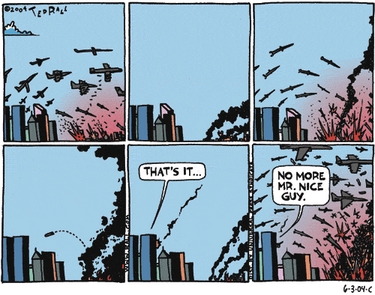
What more can you say than what the cartoon (found at Permanent Revolution) already expresses? The idea that Israel’s aerial attacks against and subsequent invasion of Gaza are a response to Hamas terrorism doesn’t pass the laugh test. We know this attack has been planned for a long time, we’ve seen the preparations, we know it fits the Israeli strategy of ratching up the pressure on Gaza. We’ve seen it all before, back in 2006, when the Israeli army did the same in their first attempt to topple Hamas. That ended with a Fatah driven coup against the democratically elected Hamas governement which saw Hamas ousted from power in the West Bank but the opposite happening in Gaza. With Fatah now powerless or unwilling to take on Hamas again, Israel now has to effect regime change on its own. Hence the ground invasion.
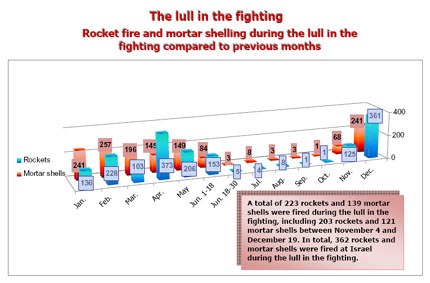
The reason we cannot take Israel at its word about why they moved from economic strangulation and “surgical strikes” to a fullblown airwar and invasion is shown in the graph above, taken from official Israeli sources. What do you see? That during the ceasefire agreed to between Hamas and Israel in June last year, attacks from Gaza decreased dramatically, only picking up again after Israel started attacking in force. There’s a lot of manufactured outrage spread by Zionist apologists about these attacks, but what they forget to mention is that during the ceasefire Israel did not lift its blockade, nor stopped its policy of extrajudicial assasinations, with 22 Palestinians having been killed by Israeli forces during the truce. The number of Israelis killed? Zero.
Everything about this invasion is cynical and calculated, from the way its being justified to the date it was implemented, two days after Christmas, when all the lights have gone off in the world’s government buildings anyway. It’s been so cynical I haven’t really been able to write about it so far, as it has just made me too depressed and outraged. Fortunately, there’s Lenin’s Tomb, which has done splendid work reporting on the invasion and its background.
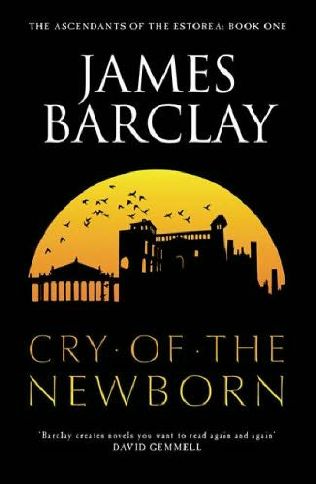
Cry of the Newborn
James Barclay
819 pages
published in 2005
James Barclay is not a writer I had heard of before I got this book out of the library. The backcover blurb sounded interesting and the frontcover sported a quote by Steven Erikson, one of my favourite fantasy writers, so while the first few pages I sampled were a bit dull I thought I’d take a chance. The library also had the sequel, but I didn’t put that one up as this was big enough already; I could always get it next time. But I don’t think I will. Erikson’s blurb said that Cry of the Newborn was “a most extraordinary and impressively ambitious novel”, but in reality it was just a bog standard epic fantasy novel. Not a bad novel by any standards, competently written certainly, but nothing special.
[…]
The second objection is more fundamental. The world Barclay has created is presented as if the Concord is a force for good, described in terms which argue that the Estorian hunger for empire is not driven by base motives, but out of a noble desire to create order and stability. Trouble is, I don’t buy it. Looking at it objectively, the Concord is just not that nice, happily waging wars of conquest only to then suck the conquered countries dry for further conquest, not to mention the enrichment of the Estonian elite. Sure, by author fiat there’s little of the cruelity on display practised by real world empires like the Roman or British Empire and it’s even fairly gender neutral, with the current ruler of the Concord being a woman, and with various viewpoint characters being female soldiers and officers, but this is just window dressing. I just could not see the Concord as the good guys, or help root for the supposed baddies, who after all only wanted to live in peace in their own country. Fantasy is a somewhat conservative, some would even say reactionary genre and I can overlook some of the more …odious… assumptions in a given novel if the story is right, but not this time.
So we finally come to the grand total of books read this year: 152, or almost three books a week. Yes, I’m quite proud of that.
The Horned Dinosaurs — Peter Dodson
An excellent overview of what we know about Triceratops and its relatives. Dodson doesn’t just tell what we know, but how we got that knowledge and isn’t afraid to show what isn’t known or cannot be known about Triceratops.
A Savage War of Peace — Alistair Horne
George Bush was supposed to have read this. In the unlikely case that he has, he may have noted the resemblance between the French experience in Algeria and what American troops were dealing with in Iraq.
Psychohistorical Crisis — Donald Kingsbury
A reworking of/semi-sequel to Isaac Asimov’s classic Foundation series that’s much better than Asimov’s own sequels.
Web of Angels — John M. Ford
A proto-cyberpunk novel by a vastly underrated author, with a style of storytelling that reminded me in equal parts of Zelazny and Delany.
Candle — John Barnes
A Barnes novel that actually ends on an optimistic note and with a protagonist that isn’t some masochist? Miracles still happen it seems.
War for the Oaks — Emma Bull
I don’t particularly like urban fantasy as a genre, but this is one of the novels that defined the genre.
The Perspective of the World — Fernand Braudel
The third and last volume in Braudel’s Civilisation and Capitalism series, taking a global look at the development of capitalism between the fifteenth and eighteenth centuries.
The Prince — Niccolo Macchiavelli
The book which gave us the adjective “macchiavelian”, it has a mostly undeserved reputation as an amoral treatise on how to stay in power as an autocrat.
KV – 1 & 2 — Steven Zaloga & Jim Kinnear
Another Osprey war nerd volume, on a Soviet World War II tank series not so well known as the T-34, but almost as important in the first stages of the Great Patriotic War. Heavily armoured and armed with the same 76 mm gun as the T-34, when these tanks first appeared the Germans had nothing to stop them with…
Bagration 1944 – The Destruction of Army Group Centre — Steven Zaloga
One of the most important campaigns of World War II, overshadowed by the Anglo-American invasion of Normandy in the same month. The speed and efficiency with which the Russians destroyed a German force much larger even than that during the battle for Stalingrad was a major reason for the almost complete collapse of the Eastern Front in 1944.
Anathem — Neal Stephenson
As is almost always the case with Stephenson, don’t read this novel for the plot, but read it for the various ideas he chews through on the way.
The Dutch Republic — Its Rise, Greatness, and Fall — Jonathan I. Israel
A very thorough if somewhat exhausting and occasional tedious history of the United Provinces, from its earliest roots in Burgundian times to its ultimate dissolution by Napoleon. It cost me a year to read this.
The Dragon’s Waiting — John M. Ford
A fantasy novel set ib a world in which Christianity didn’t break through, the Byzantium empire managed to restore much of the old Roman empire and some kinds of magic are real. This reminded me of some of Mary Gentle’s stories, especially the White Crow series.
The 2006 Lebanon Campaign — Stephen Biddle & Jeffrey A. Friedman
A US Army sponsored inquiry into the tactics and strategy employed by Hezbollah in the defence of Lebanon against Israeli attack in 2006. Was Hezbollah behaving as a typical guerilla movement or more like a proper army and what are the implications for US army policy?
Saturn’s Children — Charlie Stross
The last book I finished in 2008. A typical Stross novel, fastpaced, fun and smart. Awful cover on the American edition, but it is actually quite faithful to the description of the protagonist, who is in fact a redhaired sexbot whose nipples go spung. Yes, this is Stross doing Late Heinlein, warts and all, making it work.