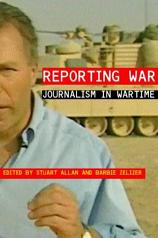
Reporting War — Stuart Allan and Barbie Zelizer

Cover of Reporting War


Reporting War
Stuart Allan & Barbie Zelizer (editors)
374 pages including index
published in 2004

Having kept a politically orientated weblog the past half decade or so I’ve become acutely aware of the limitations of journalism, particularly during wartime. The current war for South Ossetia provides a good example of these limitations, were we’re seeing live how difficult it is for journalists to even get to the combat zone, not to mention how dangerous, as the death of a Dutch camera man proved. Perhaps more worrying, as the conflict continued the reporting on it which started off fairly neutral has become more and more partisan, especially once the United States and the European Union got involved in its resolution, with Russia pictured as the agressor when in fact it was Georgia who started the war. Russian statements are treated with skepticism while quotes from approved official sources, like the Pentagon or NATO are quoted
verbatim. In general the war is treated through an American or European lens, rarely from the point of view of the Russians or Georgians, let alone the Ossetians…

All these problems are described in Reporting War, a collection of essays on the role of journalism in wartime, its difficulties and dillemas. Published a year after the American invasion of Iraq, a lot of attention is of course paid to the problems of that particular war. The book doesn’t just look at the role of the journalists themselves, but also how they are dealt with by armies and governments involved in war, with a specific focus on the US army’s management of journalist during the first and second Gulf War. What’s more, several essays look beyond the physical reaity of reporting wars to the role the media plays in general in covering wars. Not every conflict is covered equally after all.
Read more…

New Cold War ™ happy fun time with Marko and Denis

The disasters that have been Iraq and Afghanistan had sort of silenced all the humanitarian interventionists, decent leftists, war liberals and all the other surviving members of the “let you and him fight international brigage these past two years or so, but boy did the War for South Ossetia bring them back. Suddenly they have a new purpose in life, a new spring in their step: the Russians are back and everything’s all right with the world. No longer do they have to trouble themselves with tawdry, unwinnable wars in dusty countries nobody really cares about but for the oil; the Russian Bear is back and it’s happy party time for the Cold Warriors.

And nowhere more so than at the Henry Jackson Society, where Mark Attila “it’s the Serbs! The Serbs!” Hoare has been moved to ever highers flights of fancy in his descriptions of What’s To Be Done. As Aaronovitch Watch commented: “We have occasionally described the Henry Jackson Society in the past as the “I’ve got a cardboard box on my head and I’m a tank commander” element of British Decency – the breakfast cereal must be ankle deep on the floor at Peterhouse College today”

But he got competition, from none other than Denis “failed New Labour minister McShamne”, exhorting us at Comment is Free to stand Shoulder to shoulder against Russia:

As Sir Roderick Braithwaite, the astute former ambassador in Moscow and a man sympathetic to Russians pointed out some time ago, Russia has done far more invading than it has been invaded. Napoleon and Hitler failed to conquer Moscow but Russian armies – Tsarist and Soviet – have occupied every European capital east of the Rhine.

[…]

President Sarkozy’s remarks that Russia had some rights in Georgia sent a chill down the spine of Baltic states which have Russian speaking citizens, installed after Stalin’s invasion of these small countries in 1940. Finland, which fought a war with Russia in 1940, shivers at what the new Putin doctrine might mean.

[…]

Putin may have thought that sweeping the Georgian pawn off the board was the end of the game. Alas, it is is only the beginning, and Britain cannot betray Poland and its fellow EU and Nato allies as Chamberlain did in the 1930s.

McShane does seem to have a talent for distilling all the cliches uttered about Russia’s “aggression” in Georgia to the purest grade of wingnuttery, doesn’t he, with his talk about not betraying Poland “as Chamberlain did in the 1930s.” It’s great stuff, but to me Marko still has the edge, as he wouldn’t make such schoolboy errors in his rants.

Georgia: planning and propaganda

Jamie is annoyed at how a perfectly natural bit of Russian forward planning is seen as evidence of nefarious intentions:

Have we really got so used to just blundering about that the existence of a plan — in this case the organisation of a response if attacked, the institutional capability to bring it about and the intelligence assets to get the timing right — in itself qualifies the Russians as aggressors?

Apparantly we have, as I’ve not only seen this argument –that their quick response time proved the Russians had planned this conflict and were just waiting for an excuse to attack — in the Danger Room post that irked Jamie, but also in the big NYT
writeup of the war
, as well as on various liberal geopolitical blogs. Considering the speed with which the Russians responded — Georgia started its invasion of South Ossetia on August the 7th and by August 10th the Russians had chased them back over the border– it’s a natural conclusion to jump to.

But it’s the wrong one. There’s nothing strange about the quick Russian response, considering the crisis had been simmering for months, had just heated up in July and gotten active in the first week of August. All armies make contingency plans and it makes sense for the Russian troops stationed in North Ossetia to have a plan on how to deal with a Georgian invasion of South Ossetia. Furthermore, because there’s only one route between the two Ossetias, one that could be cut off relatively easy, it also makes sense for the Russians to start moving troops the moment Georgia attacks in earnest, as they can’t afford to be stuck on the wrong side of that tunnel when that happens. They need to establish a foothold outside the tunnel, keep it open for reinforcements and of course keep the Georgians from blowing it up. The Russian commander might even have standing orders to move in if Georgia gets too aggresive.

Now if we look what happened two weeks ago, we saw the Russians responding almost exactly in the pattern I just described. Their local forces moved into South Ossetia in a hurry, with some local air support but no air superiority and got to Tskhinvali roughly a day after the Georgians had started their invasion. At that time the Georgians were largely in control of that city, but there were still pockets of resistance. The Russian counterattack drove the Georgian forces from the city, but wasn’t strong enough to prevent them from regrouping and going back on the offensive. It was only after the weekend, on Monday and Tuesday that the Georgians fled South Ossetia and the Russians moved into Georgia proper. And it was then that I first saw stories saying that the Russians had planned this invasion.

By the time it became clear Saakashvili had gambled and lost, it was this narrative –that Russia had lured him into invading as to have a pretext for dealing with Georgia once and for all– that became established in the western media. With Georgian territory now in firm Russian control, it was easy to show Russia as the aggressor, as long as Saakashvili’s blunder could be ignored or whitewashed. The idea that Russia entrapted Saakashvili was tailor made for this.

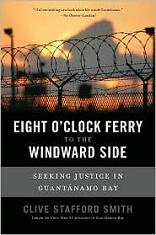
Eight O’Clock Ferry to the Windward Side – Clive Stafford Smith

Cover of Eight O'Clock Ferry to the Windward Side


Eight O’Clock Ferry to the Windward Side
Clive Stafford Smith
307 pages including index
published in 2007

Lord knowns there have been a lot of depressing books published about America’s war on terror; not to mention a metric shitload of blogs writing about it, including my own. So what good is yet another book decrying the injustices committed at Guantanamo Bay? After all, if you don’t know about them by now, you’ll never know. But when the author is one of the lawyer volunteers defending the victims of the war on terror, who has been coming to Guantanamo for years and who also manages to inject some humour in what’s otherwise a bloody dreary subject.

Clive Stafford Smith is somebody who has a lot of experience with worthwhile but hopeless causes, as he spent years working on death penalty cases in the American Deep South. When the news about the establishment of the Guantanamo Bay prison camp became known he didn’t hesitate, but immediately got involved. Eight O’Clock Ferry to the Windward Side is based on his personal experiences at Guantanamo. The title is a reference to the fact that all the lawyers have to stay on the leeward side of the bay and therefore have to take the morning ferry to get to their clients each day. Surprisingly for a book on such a dark subject matter, Eight O’Clock Ferry to the Windward Side is quite funny in places, due to the absurdity of some of the situations Clive Stafford Smith and his clients find themselves in.

Read more…