Books read in August

Here are the books I’ve read last month.

Have His Carcase — Dorothy L. Sayers
The second Harriet Vane novel, which starts when she almost literally stumbles about a body on the beach, its throat cut by a razor. Vane and Wimsey team up to solve the case and see whether it was murder or suicide.

Postsingular — Rudy Rucker
Despite having several of his novels in my bookcases, this is the first of his I’ve read and I got it from the library… As the title gives away, this is a novel trying to deal with the socalled Singularity and succeeding reasonably well. A fair but not brilliant novel, that looks to be written for a young adult audience.

Reporting War — Stuart allan and Barbie Zelizer (editors)
A collection of essays about journalists in wartime, the dangers they face and the possibility of honest reporting as well as the limitations they work under.

Dresden — Frederick Taylor
The frontcover blurb compares this to Anthony Beevor’s Stalingrad, which for once is
a quite good comparison. Like Beevor’s book, Dresden takes an iconic episode of World War II and put it into context, clearing away some of the myths that have grown up around it.

The Mercenary — Jerry Pournelle
One of the novels that set the tone for the milsf subgenre, warts and all. It’s all here: the glorification of military men, the cod-toughness and distrust of democracy

Sand against the Wind — Barbara Tuchman
The usual competent Tuchman history, this time mixing a biography of “Sour” Joe Sitwell with the story of US intervention in China between the wars and during World War II, while America’s strategy for defeating Japan slowly changed.

What We Say Goes — Noam Chomsky
A collection of interviews with Chomsky, talking about current events and explaining their background. Not much new here if you follow the right blogs (ie. mine) but he does have the knack of explaining complex things clearly.

The White Rose — Glen Cook
The third book of the Black Company series of dark fantasy books. The Black Company has been leading the resistance against the Lady, the Evil Overlord ruling most of the north and now after years of waiting things come to a head. What sets this series apart from other fantasy “trilogies” is Cook’s nicely unsentimental attitude towards his characters.

Silencing the Past — Michel-Rolph Trouillot
Trouillot is an Haitian historian, so it’s unsurprising that he would want to investigate the ways in which certain parts of history are routinely silenced, as so much of his country’s history has been, despite its importance not just to Haiti but the wider world.

Shadow Games — Glen Cook
The fourth book of the Black Company, starting a new storyline in which the Company goes in search of its past and

The High Crusade — Poul Anderson
An alien ship lands in Medieval England. The local nobles, too brave or too unimaginative to know fear of the aliens and their weapons storm it, then intend to use it to invade France. Instead they end up at the other end of the galaxy and set about conquering the alien empire that send
the ship…

Tunnel in the Sky — Robert A. Heinlein
A group of students are sent by teleportationt unnel to a distant planet for their solo survival tests. It shouldn’t have take more than two weeks, but something goes wrong and the tunnel doesn’t reappear. Now they have to work together to survive. The hero is as per usual in a Heinlein juvenile brave, goodnatured and a little dim so that his more clever friends and kindly elderly authority figures can explain the ways of the world to him.

Farmer in the Sky — Robert A. Heinlein
A teeneage boy migrates to Gandymedes with his father and his new family and grows up to be a man. They get a bit of a raw deal on the new colony but as usual with Heinlein the solution lies in hard working and no complaining rather than any collective action.

Under an English Heaven — Donald E. Westlake
A lighthearted history of how Anguila was the only British colony ever to rebel against its rulers with the intention to remain a British colony, rather than become independent, and how this led to an invasion compared to which the American invasion of Grenada two decades later looked dangerous.
Modern Christians: martyrdom without inconvenience

So the police stopped a Dutch woman during a routine road safety check, asked for her licence and found out it had expired eleven years ago. When questioned, she explained she couldn’t get an extension as the new style licence, brought out in 1997 featured the symbol of the European Union, a circle of twelve stars and it’s against her religion to use this symbol. It’s unknown which bizarre sect this woman is a member of, but Dutch nieuwssite FOK thinks she may be a member of the Vrije Herbvormed Gemeente (Free Reformed Community) in Ijsselmuiden. In any case, it’s a good if extreme example of the modern Christian, who wants to be a martyr for their belief, but doesn’t want the hassle that comes with it.

In this case we have a Christian who refuses to get a new drving licence because of her beliefs, but who also refuses to stop driving. In other, more serious cases we’ve seen Christian civil servants who refused to marry gay couples but expect to keep their job, Christian pharmacists refusing to sell condoms or morning after pills but expect to keep their job, a Christian political party that discriminates against women but expects to keep its state subsidies, and so on and so forth. In all these cases these socalled Christians want to be able to force their morals on us, but not to pay the price for it. It’s the worst aspect of modern Christianity, of feeling victimised without being victimised, of not being able to see that if you make a moral chocie you have to pay the price for it.

You refuse to get a drivers licence because you dislike the symbols on it? Fine, it’s your choice. But if you do so, don’t keep driving.

But what about Fatty Soames?

Fatty Soames

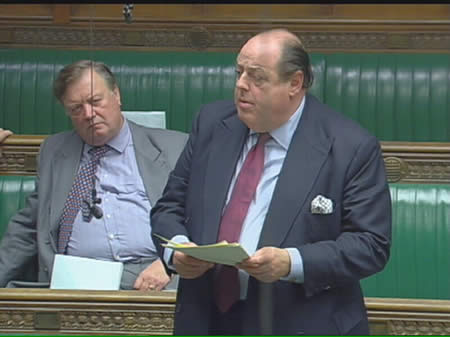
Yes, we could respond to the Tories scolding the fatties by pointing out that the link between obesity and health is not at all as clearcut as the moral panics make it out to be, that being fat is not just a question of being greedy, but of having access to good, affordable food, not to mention the time and ability to prepare it, that we’re being sold food that’s slowly killing us by one arm of a multinational company like Mars or Unilever while another arm is selling us dieting panaceas, but really all we need to do is point to Nicholas “Fatty” Soames, the Tory posterboy for self-satisfied gluttony, of whom it has been said having sex with him is like having a wardrobe falling on you with the key sticking out. Fat is good as long as it wears a bespoke suit, not tracky bottoms.

Breaking the Israeli stranglehold on Gaza

Activists manage to break through the Israeli blockade of the Gaza coast:

GAZA, Aug 23 (Reuters) – Two boats carrying activists challenging an Israeli blockade on the Gaza Strip reached the shore of the Hamas-controlled territory on Saturday.

The 44 “Free Gaza” activists from 17 nations, who had set out on Friday from Cyprus in two wooden boats, were met by thousands of Palestinians who cheered along the shoreline at their arrival.

“Today is a special day, we hope it’s the beginning. We have opened the path and we hope there will be more travellers,” said Vittorio Arrigoni, an Italian peace activist, after the ship anchored off shore.

Israel may have “withdrawn” from Gaza back in 2005, but took care to keep its control of Gaza’s borders; all its borders, not just the ones with Israel. The usual excuse is terrorism, but the reality is the slow economic strangulation of Gaza as part of a deliberate strategy to starve the territory into submission. Even the sea is off-limit for the people of Gaza, with Israeli warships firing on any fishing ship getting too far out of the coast. What the activists attempted to do is draw attention to this strangulation, but also to actually break the blockade. Just having another press stunt is not enough, but fortunately it seems the presence of the activists has enabled some fishermen to actually fish:

A statement by the group said the activists boarded Palestinian fishing boats on Monday and travelled with local fishermen eight miles (13 km) off shore, passing a 6-mile limit they said was generally enforced by the Israeli military.

The Gaza fishermen said that Israeli ships normally fire at them in deep waters and they had not travelled that far from shore in more than five years.

“We hope we will be able to go that far every day because it is our right, and it should not be a one-time event because of the presence of the foreigners,” said 27-year-old fisherman Fawzi al-Hessi.

The Palestinians themselves than are realistic about the chances of Israel allowing this situation to continue once the cameras have gone… To properly break the stranglehold the Israelis have on Gaza, not to mention the West Bank, there needs to be constant pressure from Europe and America and our governments need to stop supporting Israel.

Boycott the 2012 Olympics

Yesterday the handoff of the Olympic flame from one repressive regime to another went smoothly. While China ended its Olympics with an impressive display of old skool mass drill, Britain opted for a more modern theme, showcasing a celebrity front against a background of aspiring –and cheap– student dancers and the like. The level of drilling needed for Britain’s eight minute presentation is of course of the same level as that of China, just appearing more relaxed. It’s a good metaphor for the differences in approach to politics in the two states, the Chinese still having a no-nonsense, heavyhanded style of dealing with dissent, while the British offer authoritarianism with the fake smile of the Argos salesperson desparate to meet his target. However the two countries are converging in their approaches, as Alex discusses:

It’s so familiar; the insistence that anyone who disagrees is doing so out of spite, that only acquiescence is “serious” or “helpful”. I’m surprised he didn’t offer them a Big Conversation, but in fact, with the right mistranslation he might have done. Similarly, the re-education through labour order for disturbing the public is just a translator’s caprice away from an anti-social behaviour order.

Perhaps there’s a wider truth here; this sort of events/urban regeneration politics seems to follow the same grammar all over the world. It’s conceived of as a project; which implies there are only participants, or else obstructions. Despite the money and the bulldozers, it respects
class boundaries; veering around the villas of the rich. It needs special security arrangements which always turn out to involve some sort of summary justice based on vague and unchallengeable notions of appropriateness, propriety, or order; similarly, these are always temporary but are never revoked. The state authorities and private interests involved are indistinguishable. (Interestingly, the legislative foundation tends to be very hard to get rid of; the Act on the Great Exhibition of 1851 is still in force and still a major headache for anyone planning to build on or near the original site.)

We saw how ruthless China dealt with everything that threatened to disrupt the Olympics, from smog to Free Tibet protests, it will be interesting to see how the British authorities do. They’ll have an easier time of it of course, because the western media aren’t already inclined to be hostile to them in the way they are to the proven “totalitarian” regime in power in China. Britain after all is still a democratic country Unfortunately, as Jamie wryly noted, China is actually liberalising slowly while Britain is going the other way, recognising each other as they pass.

Britain these days is a country where you can be arrested and sentenced not for being a terrorist, not for helping terrorists but just for writing poetry “glorifying terrorism and where innocent Brazilian electricians can be murdered by the police in broad daylight with his killers escaping justice. Let’s not even talk about the warcrimes the country is involved in abroad, in Afghanistan and Iraq. At least China isn’t involved in hanging on the coattails of dodgy American imperialistic ventures…

Plenty of reasons to boycott the 2012 Olympics as effectively as y’all did the 2008 ones, no?