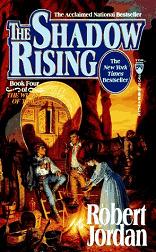
The Shadow Rising – Robert Jordan

Cover of The Shadow Rising


The Shadow Rising
Robert Jordan
1006 pages
published in 1993

The Shadow Rising is the fourth book in Jordan’s Wheel of Time series. In my view it’s the point where the series really started to balloon. For a start it’s some 300 pages longer than the previous installment, but the plot as well gets bigger and more complicated. The most common criticism of the Wheel of Time (apart from those who, perhaps unfairly, reject it out of hand as sub-Tolkien crap) is that the story stopped progressing halfway through the series; the seeds for this are sown here. In many ways this is the watershed in the series, between what Jordan started with, a fairly linear story in the Tolkienesque mold and what it ended up being, perhaps the most complex fantasy series ever written weaving half a dozen separate storylines together into an almost coherent whole. This is the first book in the series in which the various plotlines do not come together neatly at the end of the book, nor are intended to.

But this is not the sole reason as to why this is a watershed in the series. The character of the series also changes, from being largely a quest based story to one of a more political nature. Rand al’Thor has declared himself the Dragon Reborn, drawn the sword that’s not a sword and the unfallen fortress has fallen. From now on he has a nation and a army behind him, he has revealed himself to the world and the stakes have gotten that much higher. From now on he can no longer led himself be lead, he has to lead himself. And while his friends may still be his friends, their interests and his may no longer completely match…
Read more…

Why protect the identity of murderers?

As you know bob, the Metropolitian Police currently is on trial for breaching the health and safety laws when they murdered Jean Charles De Menezes. One of the more ridiculous features of this trial is the parade of police witnesses only indetified by their code names. Roobin at Through the Scary Door wonders: “Who on earth are the police officers identities being protected from? What do they imagine is going to happen?”

Good question. Perhaps they imagine angry De Menezes taking the law in their own hands, as they haven’t gottne justice through the normal channels, but more likely it’s the usual security bollarks. “the terrorists must not know their identity” and all that. the worse thing is, we all just accept this, just like we accept that there are super sekrit police squads who can blow us away on the street with impunity, if somebody somewhere thinks we might be a terrorist. And if we’re not, hey, the police do a difficult job and we should be understanding of any little errors they make.

An European election

I won’t pretend to be an expert on Polish politics, other than knowing that the current ruling party is an Catholic, xenophobic bunch of reactionaries led by the freakish Kaczynski twins playing off the fears of old people to stay in power and that this helped drive a lot of more younger, more liberal Poles out of the country to make their fortunes elsewhere, after Poland joined the EU in 2004. This diaspora has had some unforeseen consequences, as Poles abroad voted in record numbers:

Kaczynski relied on his established voter base but his opponents were far more successful at mobilize fresh support on Sunday. By midday, expatriate voters were queuing up outside the Polish embassy in London to cast their ballots. The line was several hundred meters long. About a million Poles have moved to Britain in search of higher-paid work since Poland joined the European Union in 2004.

The same for the Netherlands, where the embassy expected some 2600 people to turn up to vote. You might call it the first truly European election, with so much of the electorate working in other EU countries. It won’t be the last.

Don’t blog, organise

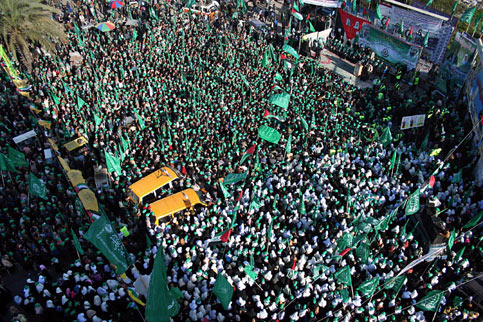
Hamas knows how to organise

Avedon:

One reason why a lot of Democratic Party insiders have a lot of contempt for bloggers is that we are sitting in front of our computers getting fat rather than getting out where it becomes a public affair. It’s all very well to phone and mail legislatures (and you should), but you need to be out there where people can see you.

Yes, I know people are still shy about being associated with the circus, but visibility matters. It’s a lot harder for the talking heads to pretend that Bush is still popular and people don’t mind the destruction of the Constitution if they’re being deafened by protests.

And 2007 is not 1968. The public isn’t freaked out by hippies anymore, it’s freaked out by losing a major American city, and being known as a nation of torturers, and having our money sucked away by an illegal war and assorted con-men in expensive suits.

Thom Hartmann often points out that neither of the Roosevelts ran as progressives, and Lyndon Johnson certainly didn’t run on civil rights. When progressives came to FDR with their program he let them know that he was convinced, but he needed one more thing: “Make me.”

They did it because we made them. It wasn’t done just by people sitting at home and writing.

Avedon is right. Blogging is a great way to write away your frustrations about politics, but in itself it has a limited capability to change things for the better. Blogs are good at getting you informed about things not covered much in the mainstream media or helping likeminded people discover each other, not to mention help people realise that they’re not alone. But becoming aware and informed is only the first stage of becoming political active. After that, you need to act. Unfortunately, blogging is seductive and you do get the feeling of having achieved something from just having written about something, so it’s easy to keep blogging instead of taking that next step.

For the rightwing this doesn’t matter, as to them blogs are just another part of the noise machine, but us lefties have to be aware that blogs are just one tool we need to use if we want to change things.

David Price: superhack

This is the most hackish thing Dean Esmay David Price ever wrote, until the next thing EsmayPrice writes, (to paraphrase a certain sarky blogger:

Little noticed this month was the news that Iraq’s electricity production has set a new all-time high in September of around 6,860 MW, including 2,000 MW or more of non-public generation (p40), illegal under Saddam (because like any good national socialist despot, he outlawed private generators). Oil revenue also set a new record of $3.79 billion (p39).

When he’s talking about “non-public generation” he means people with diesel generators people! He thinks his readers are stupid enough to read that and go “Whoo! Power to the free market!”. Well, perhaps he’s right; every writer gets the audience he deserves. But does he really believe anybody else will not realise that, you know, having to rely on your own generator to get electricity is not a good thing? Especially when you’re not living in some shack in Alaska five hours from the nearest village, but in a multimillion city? Or would David be happy to trade in his state controlled electricity for some free market solution?