Art and politics

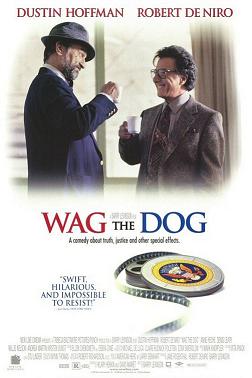
Wag the Dog movie poster

I don’t know if any of y’all read Roy Edroso at all, but Roy specialises in making fun of the kind of rightwing meathead who only appreciate any kind of art if it’s propaganda for their cause. There’s a whole army of lowrent rightwing cultural commentators making a living by telling fellow wingnuts how conservative a movie is or not, who only value art for how well it adheres to their own political positions, and Roy is very good at showing up the absurdity of this. Roy’s basic position seems to be that when politics are put above art, art suffers, so only fools want art to be nothing more than propaganda. And he’s right of course,there’s nothing quite as awful as art that is mindlessly political (Ian McEwan’s Saturday springs to mind).

But at the same time, art, good or bad, always has a political dimension. Even art that says it’s apolitical has one, if only in the refusal to engage openly with politics. How an artist, a novelist sees the world informs their art and politics is always a part of it. And it’s the subconscious politics that are the most interesting, when it’s not put in there for purpose, but because that’s the way the author thinks the world works.

An example, Wag the Dog, that 1997 film about a president who two weeks before the elections get involved in a sexual scandal, for which his advisors fake a war to get him out of. It’s surface politics are trite and predictable: you can’t trust politicians, they will do anything to keep their job, you can’t trust the media because they fake everything blah blah blah. But behind that surface lie much more interesting politics. This is a movie that wants to present itself as cynical and knowning, but seen with a decade of hindsight, it just looks incredibly naive and, well, dumb.

Dumb because the cynicism at the heart of it is fake, a Hollywood idea of how politics work. A war with Albania is faked to distract attention from the president being accused of sexual assault. How is this done? By getting a movie producer to fake this war, who gets in a lot of other people to do this with them and it’s all swallowed by the great unwashed. In the end the producer, once he wants the credit for his success of course has to die to keep it all a secret, but the president gets re-elected and nobody is any the wiser… Nobody innocent dies, the phony war is so phony that nothing happens outside a television studio and it’s all smug bullcrap. We’ve seen what really happens when wars get faked and the endresult is a lot less neat than this movie suggests. We’ve seen that presidents do not hesitate to kill thousands of innocents for the sake of their own career, without the need of Hollywood advisors to help them on their way.

That’s right, Wag the Dog actually sugercoats the real truth, its cynicism is fake. And I think it is because it’s actual target is not the corruption in Washington, but corruption in tinseltown. It’s all about a bunch of Hollywood liberals playing around with things without once considering their impact on the real world. It is in fact a very conservative criticism of Hollywood, despite the fact that supposed liberals like David Mamet have worked on the movie.

And that’s what I mean with the subconscious politics of a piece of art.

“failing to provide for the health, safety and welfare of Jean Charles de Menezes”

Jean Charles de Menezes, murdered

That is the charge against the Metropolitian Police in the trail for their murder of Jean Charles de Menezes two years ago: “failing to provide for the health, safety and welfare of Jean Charles de Menezes”. No individual police officers have been charged, just the Met as a whole. It’s not verys atisfying isn’t it, that the police can gun down an innocent man in the middle of London with the worst that they can expect for it some slap on the wrist for violating health and safety laws!

If you want to follow the trial, the Guardian has a good set of reports available, something they’re reasonably good at. Myself, I’m not sure I will bother, as the usual excuses are trotted out once again for the inexcusable:

“I have, since that time, constantly thought about what other potential tactics or strategy might have been available to me because of the outcome of this tragic set of circumstances,” Mr McDowell told the jury.

“I have done that on a weekly, if not daily, basis. “I remain of the view that I and we did our best that morning to mitigate what was clearly a threat to the public in very difficult circumstances.”

It’s the talk of a “clear threat” that gets me everytime. Because if there’s one thing that is clear, it’s that there wasn’t a threat. Jean Charles de Menezes was just a guy going off to work, not a terrorist, not involved in anything even remotely associated with terrorism and he was shot down in cold blood. If it could happen to him it can happen to anybody, and the policy under which he was shot is still in effect…

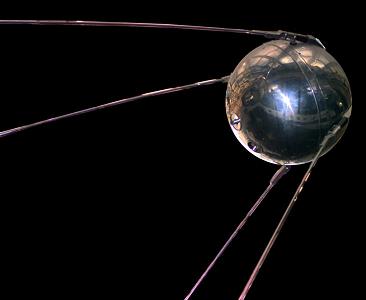
Happy birthday Sputnik

Sputnik 1

fifty years ago today the first manmade object reached orbit. Science fiction fans everywhere thought it would be the start of mankind’s thriumphant conquest of space, even if it was the Russkies who did it, but it didn’t quite work out that way. While we’re using satellites for all kinds of important stuff, that whole idea that humanity had to leave its cradle behind seemed a lot less attractive in reality than science fiction had made it seem — quite a lot harder as well. We’re struggling to get a space station capable of keeping half a dozen astronauts living there for a month or two up and running, let alone that we can get the million inhabitants L5 colonies O’Neill dreams up going. For now, the future seems to be Earth orbit satellites and unmanned probes to the rest of the Solar System, plus the occasional hype of a new Moon or Mars programme

Should we be disappointed with this? That we have no giant space colonies, no Moonbase, no exploration of Mars, no interstellar expeditions? Or should we be happy instead with the things we do have: a Solar System far more interesting and odd than anybody had ever imagined, Earthbound telescopes powerful enough to detect planets around other stars, extrasolar planets where nobody would’ve believed planets could exist, an universe fastly more wonderful than any science fiction writer ever imagined?

Me, I’d rather go for wonder than for disappointment; I just wish much of science fiction would do the same and embrace the universe we live in rather than the universe we wished we lived in. Too much modern science fiction wallows in nostalgia or tries to refit the real universe into the old cliches.

Iran, Israel and the Bomb

Avedon Carol quotes Israeli historian Martin van Creveld on Iran and nuclear weapons: “Since 1945 hardly one year has gone by in which some voices — mainly American ones concerned about preserving Washington’s monopoly over nuclear weapons to the greatest extent possible — did not decry the terrible consequences that would follow if additional countries went nuclear. So far, not one of those warnings has come true. To the contrary: in every place where nuclear weapons were introduced, large-scale wars between their owners have disappeared.”

Carefully not noted by Martin is a) the lack of evidence about Iran’s alleged attempts to create nuclear weapons and b) the fact that there is one country in the Middle East which unquestionably does have nuclear weapons which it has never admitted to: Israel…

Good liberal wars

In the middle of a good review of two rightwing revisionist books about the War on Vietnam, Rick Perlstein says something profound but obvious:

And yet, in his own confused way, Moyar is also onto something. Americans, even “neoconservative” ones, are prone to liberal sentimentalizing about the possibility of “good” wars. But war is not good. War is the attempt of one group to violently impose its will on another. Fields of blood and fire are no kind of workshop for Jeffersonian democracy.

Yet nonetheless quite a few people who would say of themselves that they are of the left, and I’m not just talking about Decentists, have this illusion that it is possible to wage war for democracy, or human rights. Hence Kosovo, Afghanistan and, to a certain extent, Iraq. In all cases war supporting leftists were not the ones who made these wars possible, but helped legitimise them by providing non-official (and non-binding!) motivations for supporting them.