Battletruck — Sci-Fi Sundaze

In a post-apocalyptic world where oil is more valuable than gold, a lone renegade saves a peaceful community from a gang driving exotic, armoured vehicles. But this is not Mad Max, this is Mad Max‘s New Zealand, worse budget, worse actors cousin: Battletruck.
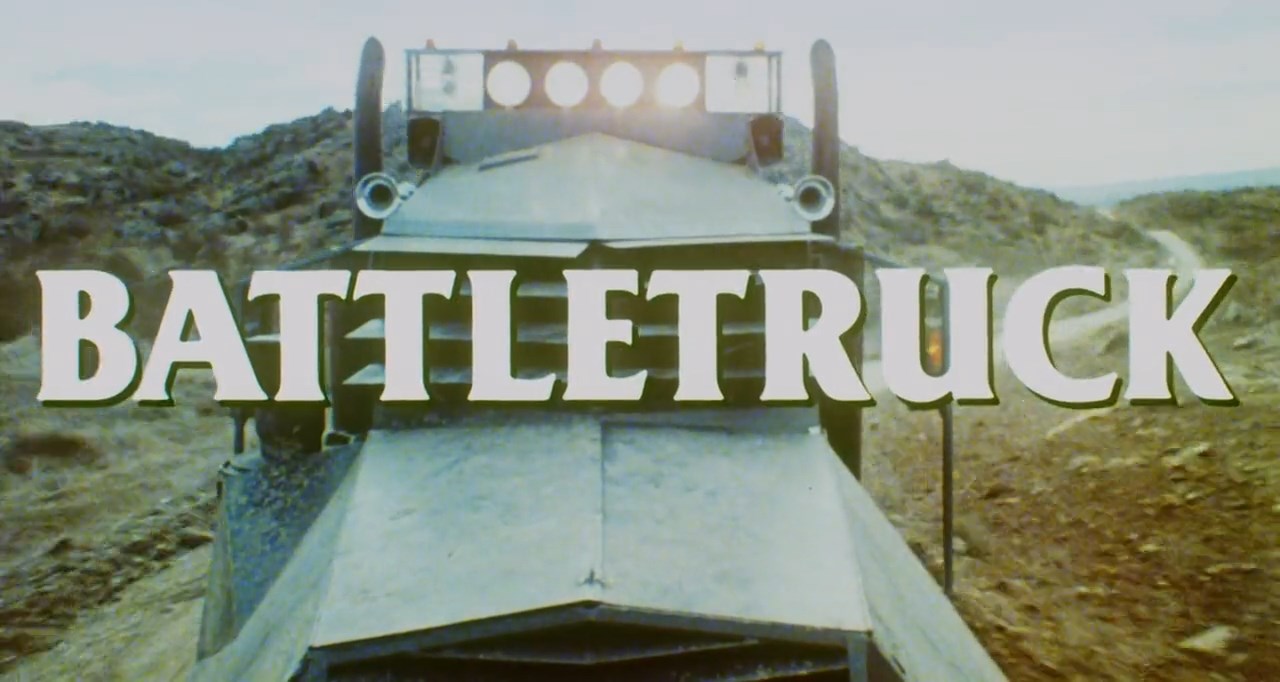
A head-on shot of the battletruck with armoured shutters over its windows all in black with menacing lights.

You have to love a movie with a title as straightforward as this. The main attraction is the Battletruck, so let’s name our movie Battletruck. Then the yanks came and renamed it Warlords of the 21st Century which sounds like it should’ve been one of those Italian redubbed in English sci-fi schlockers. If you’ve seen Mad Max II you know the plot of Battletruck. It all starts when the titular truck runs down a horse drawn wagon and discover diesel onboard. Killing one of the drivers, the other one tells the gang where to find a hidden storage depot full of the stuff. The gang’s leader, colonel Stracker decides this would make for a nifty new base. When he orders his daughter to kill the survivor, she refuses and sneaks out that night. Pursued by the gang, she’s saved when the motorcycle riding Hunter comes to her rescue. He brings her to Clearwater where she lives a peaceful life until Stracker and his battletruck attack. It’s up to Hunter to save them all…

Battletruck is supposed to be set in America, but with every supporting role done by New Zealand actors and with it being shot on location there, it makes much more sense to have the story take place there as well. Especially with a cast that looks as if they’d been cast for a socialist realist kitchen sink drama and got tricked into doing a post-apocalyptic actin thriller. It makes for a far more down to earth drama even if it’s the same plot as Mad Max II, when even the weapons are bolt action rifles rather than M-16s or Uzis. There’s a strange vibe to this movie because of those incongruities, which actually made it a bit more interesting than if this had been a schlick fully American production. A minus point is that the acting is often dreadful, though this is more the fault of the American mainliners than the New Zealand supporting cast. Hunter e.g. is played by Michael Beck, better know for his starring role in another futuristic motorcycle extravaganza, Megaforce. The actors playing Stracker and his wayward daugher are not much better. Not that you’re watching this for the action and the movie itself did kept my attention throughout.
Caption: After the Oil Wars...

The setting is interesting. A simple “After the Oil Wars…” followed by an expository news radio message talking about how the oil fields in the Middle East are now either radioactive or ‘still burning’, food riots have broken out, martial law declared in ‘greater Detroit’ and how the exodus from the cities is flooding the countryside where bandits roam but law enforcement is powerless as they’re dealing with the crisis in the cities. Unlike what you’d expect from the phrase “post-apocalyptic” this isn’t set after a full blown nuclear war, but society has still collapsed. It’s a setting Battletruck shares not only with Mad Max but also something like Escape from New York and other eighties sci-fi. A full nuclear apocalypse is too scary, too big for an action movie, but there’s also the feeling that it wouldn’t take that much to collapse (American) society anyway. That whole late seventies to mid eighties period there’s an underlying current of pessimism, the feeling that America is doomed even if the world itself isn’t. Gang violence, recession, losing the Vietnam war, inflation, it all seems as if America is crumbling from the inside and nobody cares. You see that feeling in a lot of near future American science fiction of the period. Not just movies, but also in comics like American Flagg! and Scout and novels like Neuromancer. It doesn’t really fit here because the feel of the movie itself is so very New Zealand, a country with its own problems but nothing quite like this.

A nice little entry into the post-apocalyptic action thriller genre. Not very original, not the best of acting but still worth watching nonetheless.

Anime Peaked in 2006

At least if you look at the number of anime minutes aired on tv per year, as Matteo Watzky explains over at Full Frontal:

This new set of data helps us put the previous one in perspective: while it may seem that 2008 represented a peak because of the amount of new works, it would actually have been 2006, which saw around 20,000 minutes more of animation air on TV. Actually, 2006’s record has not been beaten, even in 2018, which witnessed almost 50 more TV shows on air. The general shift from 2-cour to 1-cour shows may have inflated the overall numbers, but not the actual amount of content being aired. 

It feels counterintuitive at first because we seem to be flooded with more and more series each season, but even when looking at the number of anime produced the totals for 2006 (329) and 2022 (346) are not that different. And with series lengths themselves having become shorter, with the 12-13 episode series being the norm now, it is certainly possible that 2006 was anime’s peak.

But I’m still curious about the methology behind these numbers though. The sources used by Watzky are Japanese, the number of anime coming from the Japanese anime database, with the graph of minutes of anime broadcast coming from a study on animator’s experiences, not linked to. Watzky doesn’t discuss how these two sources got their numbers, which is a pity as the original sources will not be accessible for many people, including myself. Methology is important, especially when comparing multiple sources like here. For example, the second source talks about minutes of anime broadcast on television, while the number of anime is for all anime, including shows or movies never broadcast there. Another being what is counted as broadcast on television in the first place: over the air, cable, internet based streaming services and which are counted as such. What counts as a separate anime is up for debate as well of course. Anidb e.g. usually puts specials and bluray extras under their parent series, while MyAnimeList splits everything up.

In other words, there is some room for dobut here that it really is the case anime peaked in number of minutes broadcast back in 2006, or in number of individual anime produced in 2018. I do believe these numbers are roughly correct, even if it doesn’t feel that way. It may just be that we’re just that much more aware of all anime created as almost everything these days gets a release for an English language audience now, being able to watch at the same time as the original audience, which wasn’t the case in 2006. It’ll be interesting to see what the rest of the decade will do.

Makoto Best Girl — Rewatching IdolM@ster

The eight episode of The IdolM@ster (2011) is what you get when you take an old fashioned Hollywood comedy caper and condense it into a 22 minute anime:

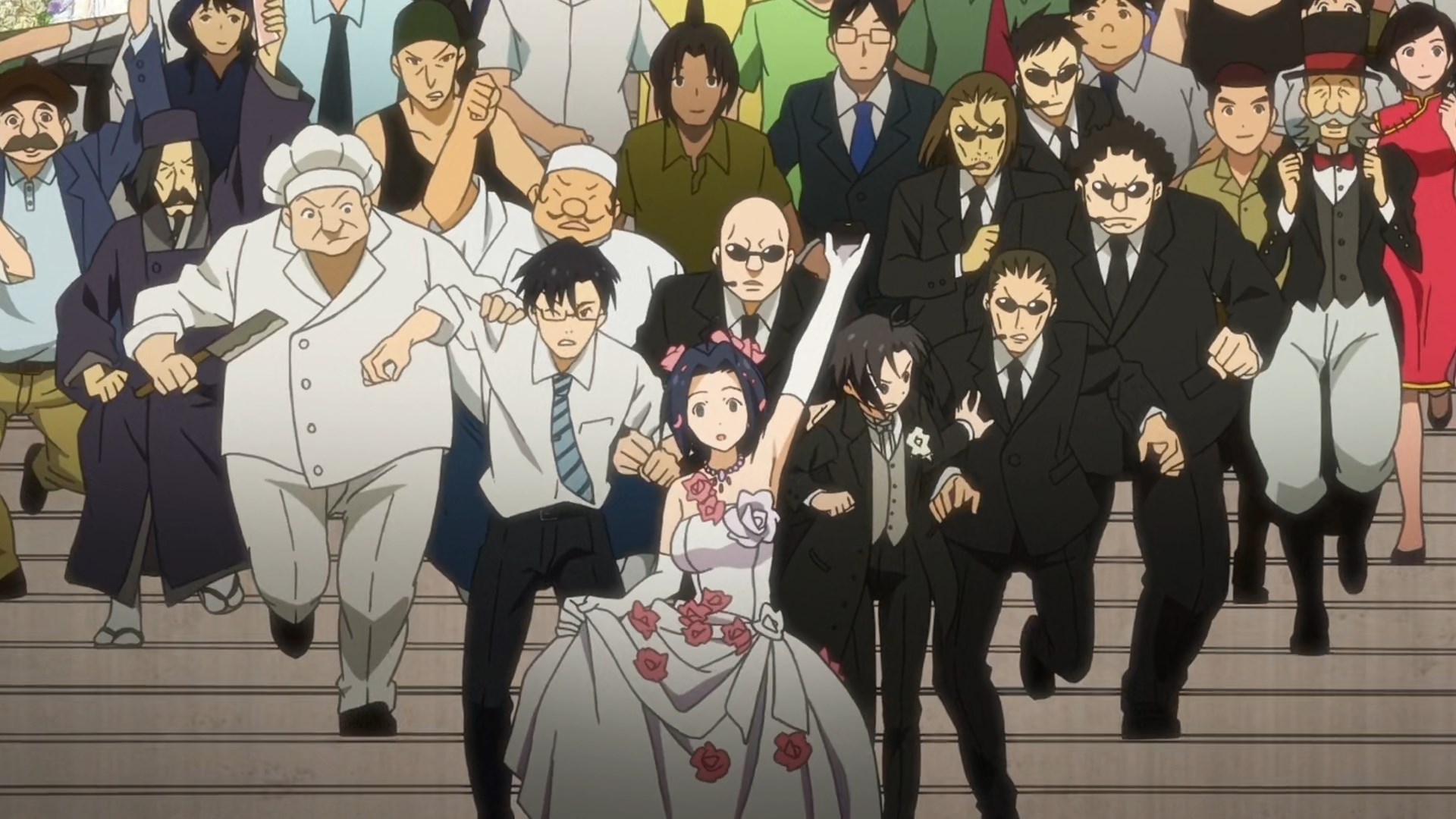
Everybody is chasing Azusa in her bridal wear

IdolM@ster started out as an arcade video game which developed into an entire franchise of arcade and console games in which the player usually takes the role of an idol producer who has to make a range of idols famous by guiding them through lessons and live shows and such. It’s been popular enough that the series has gotten multiple anime adaptations. The first was an utterly bizarre mecha show, but the 2011 series, based on the IdolM@ster 2 is one of the best idol anime shows ever released. 765Pro is a small idol agency with twelve idols under its wings and with the protagonist being their new producer, though the focus really is on the girls. It’s a really fun series with the agency at first struggling for success, then struggling with success. I first watched it in 2015 and have rewatched it a couple times since, but this time I just wanted to this particular episode. Why? Well, for scenes like this:

It all starts when three of the idols have a wedding themed photo shoot in a church. Azusa, the one playing the bride takes a selfie to tease a friend of hers with and when the friend calls back, she wanders out of the church only to collide with an actual, runaway bride, on the run from the henchman of an oil baron who wants to marry her. Of course Azusa is promptly mistaken for her and kidnapped by said henchmen, but who led her go once she convinces them she’s not. All’s well that ends well, if not for two problems: a) she has no sense of direction whatsoever and b) she’s still carrying the wedding ring the actual bride dropped. Meanwhile Makoto, the idol playing the groom saw the kidnapping and dragged the producer along to free Azusa. So we now have the runaway bride, the henchmen and Makoto and the Producer all running around town looking for Azusa, who herself is aimlessly wandering around and getting asked for help from various people. It all culminates in the chase scene above, as every party comes together and a happy ending is reached for all…

Makoto reading a shojo manga with big sparkling eyes and flowers popping up around her

It all works because Azusa is such a natural airhead as well as kind enough to help lost children find their mum or an old lady look for her son. This sort of thing can be immensely irritating as a plot but here it works because of her charm. Still, the reason I watched this in the first place was for Makoto and the scenes of her fighting those goons. A proper tomboy, raised by a father who’d rather had a son, forbidden anything girly, she’s 765Pro’s Prince, putting maidenly hearts aflutter everywhere. Knight on a white horse for all her female fans, she’d sometimes rather be a princess herself, as she complains to the producer in episode seventeen. It’s a familiar character type, the cool girl who wants to be more girly. The grass is always greener on the other side after all. It can be a bit problematic, reinforcing outdated gender stereotypes, but that’s not the case here. Even when Makoto decides to dress more girly for her ‘date’ with the Producer e.g., the skirt she chooses matches what she’d normally wear. In the end and with the encouragement of the Producer she also comes to terms with how her fans she her, as the only idol who can play their prince, makes them feel princesses like she herself also would like to be. It’s this what makes me like her so much and why she’s perhaps my favourite IdolM@ster character.

Scooby Doo without Scooby Doo is just pointless.

With all the shows HBO cancelled without ever airing just for tax purposes, why couldn’t this be one of them?

I first learned about this show three months ago when Polygon previewed it and it sounded so horrible already:

The show introduces Velma in her high school years as a bespectacled loser. If two cockroaches copulating in the opening scene doesn’t establish Velma’s tone, the next scene should do the trick: nude teenage girls partaking in physical violence in the gym showers (all while debating the ethical appropriateness and exploitation of blatant nudity in media). Later, the corpse of a teenager is found in Velma’s locker, making her the prime suspect in the eyes of two cops (Wanda Sykes and Jane Lynch). Of course, she has to solve the mystery to clear her name. One problem: Velma hasn’t really solved a mystery in a while, not since her mystery novelist mother vanished from her life. And whenever Velma tries to solve a mystery, she gets harassed by ghastly zombielike spirits.

Taking a kids show and making it all adult by upping the blood, tits and rampant cynicism is the oldest and most boring trick in the book. Going for an origin show is also a bit, ehh, unnecessary. Scooby Doo of all things does not need an origin. Four kids and their dogs traveling America in their own groovy van, in search of the supernatural and only ever finding fakes trying to cheat the local town out of its cash reserves is a formula that just works. You don’t need to dress it up. In this context making the cast somewhat less sixties whitebread is good, but even this seems suspect when everything else in the show is so damn cynical and it’s leaning hard into rightwing memes for its ‘jokes’. But the worst insult is this:

Grandy addressed the brown-spotted Great Dane (not) in the room by explaining that the team thought hard about what it could do to distinguish Velma as an adult show. “What made Scooby-Doo a kid show is Scooby-Doo,” Grandy said. “We couldn’t have a take on it, like how can we do this in a fun and modern way. [Our efforts] coincided with Warner Bros. Animation saying we can’t use the dog!” For Grandy, the omission of the iconic Great Dane accentuates the adult tone of Velma — though who knows what will happen along the show’s serialized journey.

Yeah, that makes sense, to remove the most iconic and recognisable element of the original because it’s nOt AdUlT eNoUgH. It does feel like somebody came up with an idea for an orginal show and the Scooby Doo brand (ugh) was forced upon it.

Executive producer Mindy Kaling meanwhile is if not an outright transphobe herself, certainly a tad too sympathetic to them, so that’s another reason not to waste your time on this show.

Tracking with Close-Ups: Anime

Let’s nick another nifty post title from John Brunner’s Stand on Zanzibar for this round-up of anime focused links. Considering the time of year we end with two best of twentytwo lists, but first there’s a look back at the 2000s cult classic Vandread, a review of Godzilla Singular Point, an indepth look at how the 86 series uses letterboxing and a neat little Spotify playlist for o.g. IdolM@ster tracks.

  • Vandread
    Vandread was an anime that came out in the year 2000 and it’s a bit tricky to introduce because everything it is it’s also not quite. It’s a harem anime, but not quite. It’s a space giant robot anime, but not quite. It’s a science fiction anthology anime, but not quite. It’s about genders, but not quite, about relationships, but not quite, and about identity, but not quite. In a lot of ways, Vandread is a really confused piece, a gem of its time.
  • The Jet Jaguar Show
    Godzilla Singular Point is a gorgeously designed, beautifully animated sci-fi show that often feels like arriving mid-lecture to a physics class. This, somehow, is part of the appeal. The 13-episode anime series is weird and dense if not weird because it is so dense, cramming a prodigious amount of information into a franchise that historically just kind of waves its hands around whenever the science comes up. Stories about stopping some rampaging giant monsters tend not to foreground this much math. But to summarize exactly how granular the series gets about concepts like the passage of time would require me to dive into ideas that I only half-understand myself, so to give a quicker and more digestible impression for just how odd, how left-field/galaxy-brain out there the first Godzilla TV anime is, we need to talk about Jet Jaguar.
  • Bringing Letterboxes To Life: Toshimasa Ishii, Tomohiko Ito & Eighty-Six Episode Twenty-Two’s Use Of The 21:9 Aspect Ratio
    Episode Twenty-Two is predominantly shot in the 21:9 aspect ratio or what some may call a 21:9 ‘letterbox’ since there are two horizontal bars that clasp the animation from above and below. 86 has opened up the door to experimenting with aspect ratios before. Fido’s flashback in 4:3 within Hirotaka Mori and Satsuki Takahashi’s episode (Episode Ten), as well as Ken Yamamoto’s use of 21:9 in the second cour’s opening, are examples of how they can be mobilised to add to the anime’s ongoing discussion on the multiple perspectives that are present during times of conflict. Shifting to a different aspect ratio represents a shift in worldview and provides viewers with an alternative lens to interpret what is going on in front of them. So what exactly makes Ishii’s experiment in ‘Shin’ different from the ones that preceded it? In my view, the use of 21:9 helps to express the pent-up emotions felt by the characters. The director breathes life into the bars and makes them responsive to the feelings of the subjects.
  • Million Live — Essenti@ls
    music from the idolmaster million live (アイドルマスターミリオンライブ) sorted in categorical, then chronological order! all songs are included except solo/unit mixes & off vocal. playlists will be updated frequently as new albums get released. WELCOME to 765PRO’s theater! | missing: VARIETY 02
  • Top Anime of 2022 (and Year in Review)
    “Alright, great, I can always count on you for cynicism about art and culture, but didn’t you say something about being invigorated in your anime viewing?” Sorry, yes, I got away from myself a bit there. I include all this doomsaying preamble merely to say that while I understand the industry’s situation isn’t great, my own year in anime has been littered with reasons to hope. I’ve leapt backwards across anime history, and discovered that the early shows of Miyazaki and Takahata are just as enchanting as their film work (to say nothing of the fantastic early Toei Doga films). I’ve rediscovered the unique joy of group watching, and have munched through hundreds of episodes with my housemates cheering beside me. Hell, I’ve even watched some currently airing anime; this year lacked a “this is what I watch anime for” production on the level of Heike Monogatari, but it’s made up for that with an altogether wider spread of commendable shows, alongside One Piece’s preposterously consistent adaptation of its most ambitious arc so far.
  • The Backlog, Year… 5? And a half?? A Hiatus in Review
    Counting everything together, I do only come to a mere 48 new shows to run down, barely more than half of my busier years, even though we’re counting almost six more months in here than I usually would. I can’t even bother to put the usual “watched in rotation”, “watched off rotation” brackets in, because there’s really only four rotation shows here, and I finished none of them! Yet. But you know what? I’m still gonna put my all into it. If there’s one thing this girl here cares about, it’s lists, right?