Can’t Get Fooled Again

Atrios is tired of being expected to take bad faith merchants like Chait seriously when they’ve always lied and helped lurch America and the world from disaster to disaster:

Chait lies and some of his lies are along the lines of, “MY CRITICS ARE NOT ENGAGING WITH THE ARGUMENTS SERIOUSLY,” a neat little debate trick which puts honest people (unlike Chait) on the defensive and encourages them to say, “yes, yes, I am, here’s an example of it,” but by then Chait, laughing, has moved onto the next bit of bullshit. It’s projection and a little trick that helps obscure the fact that he is the one not engaging honestly. No you’re not engaging with my very serious argument!!! Why won’t you stop punching yourself!!!

Tired of being expected to pretend their motivations are pure.

It’s just a game to these monsters. Chait cares about trans kids as much as he cared about Iraqis, which is, at best, not at all. “At best” is a generous interpretation given the number of deaths he encouraged.

I’m with him. Next month will be the twentyfirst anniversary of this blog and on every important subject people like Chait and Singal and Yglesias have gotten it wrong while knowing they were wrong. The only function of these centrists and pretend liberals is to lend cover to the rightwing, to drain the energy of well meaning but naive opponents of whatever disaster they’re cheerleading this time. Afghanistan, Iraq, Lybia, Syria, the Great Recession, Brexit, austerity, Roe v Wade, trans rights: for each and every one of those their eloquent and nuances arguments served evil. How many times must they get it wrong before you’re allowed to dismiss them out of hand?

On each of these subjects, any random protestor against them would’ve been a better guide than the people paid very well indeed to explain to us that we shouldn’t believe our lying eyes.

New PreCure looks promising

Not so much PreCure as ParCure, am I rite?

Last year’s PreCure was a bit of a disappointment for me, the first one since I started watching it seasonally that I did not finish. Neither the theme nor the characters interested me and honestly it was clear from episode one that it wasn’t one of the good PreCures. Not that I’m anywhere near the target audience of course. This year’s entry, Hirogaru Sky Precure, looks a lot more promisingly from the very start. Sora is badass even before she becomes a Precure as that parkour scene shows, not hesitating to put herself on the line for a stranger’s sake. Which means when the villain kidnaps the baby princess of Skyland just as she arrives at the capital, she immediately sets up in pursuit. The villain escapes with his hostage through a weird portal, Sora immediately follows him and rescues the baby, only to find herself, well, here:

A good PreCure series needs a good sense of humour as well being able to handle its action scenes and this was hilarious, a proper Loony Tunes moment. Sora is a great protagonist and her meet cute with Mashiro, literally dropping out of the sky on her, was great too. In most PreCure series Mashiro, the ‘normal’ girl, would be the protagonist, so having the outer worlder Sora be it instead will be interesting. Looking forward to seeing Sora and Mashiro interact in day to day life as well.

Mist

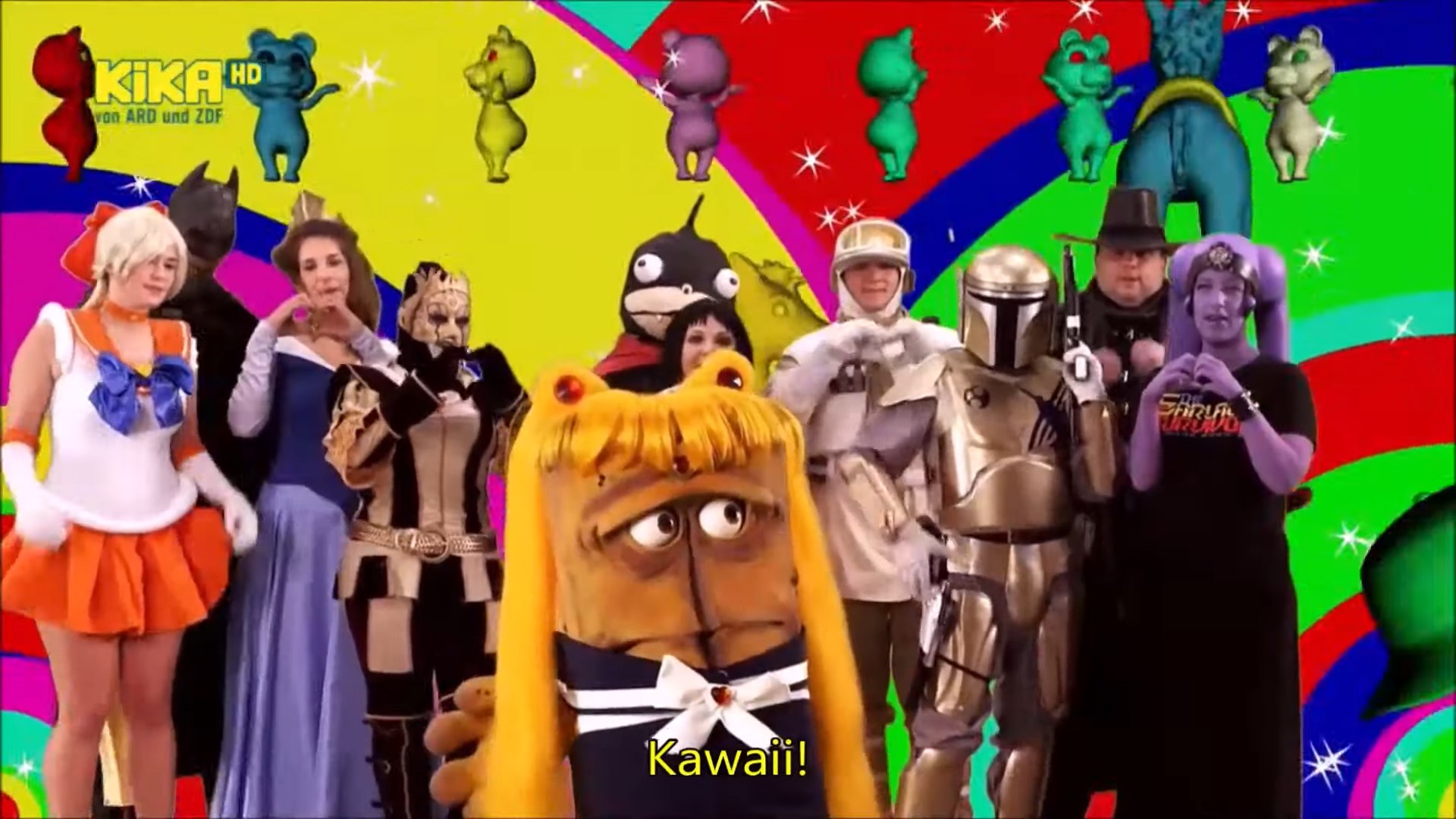
for those of y’all still claiming Germans don’t have a sense of humour, let me introduce you to Bernd das Brot:

An anthropomorphic loaf of bread with short, stumpy arms and a pessimistic, cynical personality, Bernd comes from a German children’s tv series and has become a bit of a mascot for KiKa, the channel this was broadcast on. KiKa is aimed at children and only broadcasts between 6:00 AM and 9:00 PM, which means there’s a lot of dead air. So they decided to fill this air time with short movies like the one above, in which Bernd is basically put through a series of psychological and existential torture in Der KiKa Lounge. His attitude with which he undergoes these trials is what makes it hilarious and this particular one had me especially giggling. It’s just all very…

(And for all the nerd mockery on display in this video, it’s in the end actually very respectable.)

So if you’re ever in a German speaking country and late at night you’re flicking channels and come across a boxy, stubby armed muppet undergoing strange tortures in a white room, you now know what it is and no, it’s not a hallucination brought on by too much bratwurst and dunkelbier.

The Watersnoodramp — seventy years later

Seventy years ago this day the worst disaster modern Holland would endure was on its way to the Dutch coast, to arrive that night in the form of storm swept waves overwhelming the coastal defences that for centuries had kept us safe. The results are seen in this video compiled of contemporary news broadcasts:

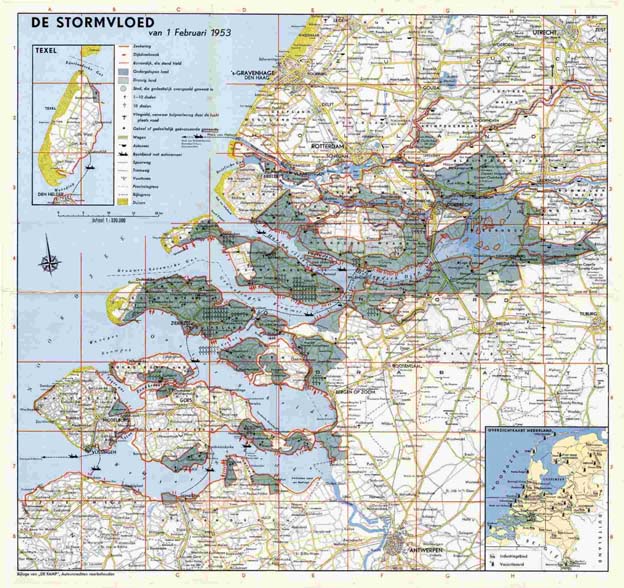
1835 people died, 750,000 people lost their homes, tens of thousands of cattle drowned alongside their owners. Whole villages, even whole islands swallowed by the water. The flood hit the south-west of the Netherlands, coming through the Channel into the North Sea, its narrow width pushing the water higher and higher until it hit the coast. On the map below you can see how the northern islands in the delta were hit the hardest, the water pushing its way into the mouths of the rivers Rhine, Meuse and the Schelde flowing into the sea there. This is land that has always lived with the threat of the sea, has been conquered from it, that thought itself safe behind the dykes created to protect us from the sea. What happened in 1953, the failure of the dykes to protect us is something that even now, seventy years later, still resonates in the Dutch psyche.

a map of the area hit by the flood

The reponse to the disaster is well known. Drastic measures were made to ensure that this disaster would never repeat itself. Instead of strengthening the existing dykes, something much more radical was done. If the delta was this vulnerable because of its long coast line, let’s just shorten this coast line by damming in the various channels. The idea was to close up all of them except for the routes towards Rotterdam and (grudgingly) Antwerpen. That this would be an ecological disaster was ignored; that it would destroy the livelyhood of centuries old fishing communities likewise. The country must be made safe and even if strengthening the existing dykes was good enough, it would also be far too expensive, so instead the cheaper option of damming up almost the entire estuary was chosen.

As the lesser inlets were dammed up one by one, the fishers and ecologists saw how much of a disaster it was for the wildlife and the fish in them as they became dead, brackish pools with little to no life left in them. I remember liking to swim in one of these blocked up inlets, the Veerse Meer, because there was never any chance of encountering anything icky like jelly fish, let alone any real fish. But for the fishers in Yerseke it was a sign. They were dependent for their jobs on an open Oosterschelde, which also was one of the richest wetlands in Europe, a natural treasure trove, full of wildlife including seals. That would all be lost if the Oosterschelde was to be closed, but the state, province and Waterstaat, the agency responsible for the dykes and water management were all firmly in favour of the closure.

Yet that one small village resisted. A group of fishers, enironmentalists and sympathisers started a resistance campaign. Their reasoning was simple. If the Westerschelde could be made safe by strengthening the existing dykes and be kept open, why not the Oosterschelde? With the former being the entry towards Antwerpen it made sense that it was kept open, while the latter was just not judged important enough for the expense. Thanks to their dogged resistance, their years long campaign to convince politicians, the public and scientists, the Oosterschelde was kept open and the Netherlands got one of the seven wonders of the modern world: the Oosterschelde Storm Barrier, the stormsvloedkering:

I was there when the Stormvloedkering was officially opened, in 1986, as two students from each primary school in Zeeland were invited to it. Back then the political struggle, the role the activists had played in forcing the government and Rijkswaterstaat to this compromise, was kept largely unmentioned. I remember it was all presented as just a normal change of policy, that it was a result of changing insights naturally arrived at by the state itself, not pressure from lowly fishermen and beardy weirdo environmentalists. The Storm Barrier as the ultimate symbol of progress and Dutch innovation, but had it be left to its own devices, an environmental holocaust would’ve happened. Thank god for those Yerseke oyster fishers!

I will Never Be as Excited for a Comic Again

I came across these again browsing through my comics collection and thought, I’d never be as excited for any comic anymore, no matter how good, as much as I was when I first got these as a thirteen or fourteen year old kid just getting into superhero comics.
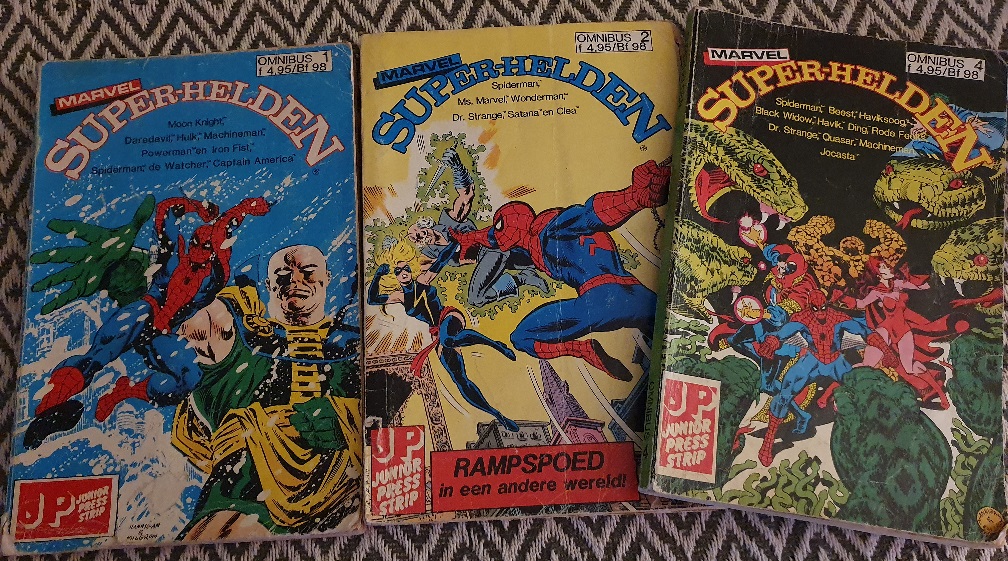
Marvel Superhelden Omnibus issue one, two and four

That was 1988 or ’89, not long after this Dutch Avengers reprint had made me a Marvel fanboy. Of course I’d read comics before, since before I could actually read even according to my mum. But most of those were the usual European comics everybody grew up with: Asterix, Tintin, Lucky Luke etc. Mostly bought for us by our parents, or given as birthday presents and such. American comics were rarer; I remember reading some Star Wars and the occassional Spider-Man comic, but until I saw that issue of Avengers, they had been low on my radar. Once I was interested in them, I caught up to them with a vengeance (sic) and bought everything I could get my hands on from my meagre pocket money. And these particular books were a godsend: cheap reprint collections with more superheroes than you could shake a stick at. And at that time, more was always better.

Some context: Juniorpress was the licensee for Marvel comics in the Netherlands during the eighties and nineties. They didn’t publish every Marvel title of course, rather sticking mostly to the Spider-Man titles as well as the big four superhero teams: Avengers, Fantastic Four, X-Men and Defenders, as well as Conan, both as floppy and in proper album form. Other series were also tried with greater or lesser succes: a series like Wolverine was a predictable success, but New Mutants only lasted 21 issues and heroes like She-Hulk, Spider-Woman or Cloak & Dagger never made either, sometimes because the original American series had been cancelled as well.

For Dutch superhero fans of my age Juniorpress holds a special place in our hearts. Not just because it was through their reprints we learned about all these bizarre heroes and their adventures, but also because they seemed to care about what they published. There had been earlier companies publishing superhero comics, but these never felt like much love had been put into them. For example, Juniorpress was the first to credit their own staff as well as the original creators and also the first to identify where the stories they reprinted actually came from. They were also the first to introduce an actual editorial page and letter column, on the inside front and back cover of their publications. Because Dutch comics were sold in the same format as the American originals, but without advertising, each 32 page issue needed about eight to ten pages of extra material. That had previously been filled by just adding the next issue’s first couple of pages, but Juniorpress instead introduced their Limited Series as backup. That took something like The Punisher‘s first limited series and published as a backup in one of the Spider-Man series, before reprinted it as a collected edition. That was one way in which the company also tried out new titles and characters.

The other way was through this very series, Marvel Super-Helden, the Juniorpress equivalent of Marvel Team-Up or Two in One and indeed reprinting a lot from those series. Never a one for one reprint, rather they picked and choose the best stories from these titles, or even stories from entirely different series. That first omnibus e.g. starts with two Moon Knight issues, followed by two Iron Man stories, one guest starring Moon Knight before moving to a Marvel Team-Up annual with Power Man, Iron Fist and Machine Man, ending finally with two regular Marvel Team-Up issues starring Spidey and Captain America. All of which is gold if you’re thirteen, barely know any of these heroes except Spider-Man and you think two superheroes are better than one.

What made these omnibuses possible is interesting. Like the originals, these comics were distributed mostly through what you might call the newsstand: chain bookstores, cigar shops, news kiosks etc. As in the US that made these returnable; unlike in America, unsold copies had to be returned whole rather than just the front cover. Which meant Juniorpress had (large) stocks of back issues and one of the ways they got rid of this stock was to take several issues, strip them of their covers and repackage them with a new cover as an omnibus. They also did something similar to the sealed bags of comics you could get in toy stores in America, by bundling random back issues into a “summer holiday fun bag” and selling these through the same bookstores. In this way Juniorpress earned some extra money from unsold stock and discerning consumers like me got their superhero fix, cheap. Considering that each of these contained three normal issues and the price was slightly more than a normal issue cost, these were a bargain.

Coming in mostly ignorant, every time I bought or got one of these collections as a present was exciting. Just seeing that list of (unfamiliar) heroes on the cover made my pulse race. Three decades later, much more jaded than I was then, it’s a rare comic that gets me even half as excited.