Inquiry in the Menezes murder is finished

Menezes lying in the carriage after his murder

The BBC reports that the “Independent” Police Complaints Commission has finished its inquiry into the murder of Jean Charles de Menezes, the Brazilian electrician mistaken for a terrorist and murdered by gung-ho Metropolitan police officers, though of course they don’t call it a murder. That it was murder proves the eyewitness report quoted by the BBC:

The BBC has obtained an eyewitness statement, given to the IPCC, which described how anti-terror
officers shot at Mr Menezes 11 times.

The statement read: “The shots were evenly spaced, with about three seconds between the shots
for the first few shots.

“Then a gap of a little longer. Then the shots were evenly spaced again.”

Mr Menezes, an electrician from Gonzaga in south-eastern Brazil, was hit seven times in the head.

On the six o’clock news, it was said that if prosecutions of the police officers were started, most if not all Metropolitan gun officers would refuse to carry them any longer, once more confirmed that the police think themselves above the law. Here’s hoping the prosecution services will not given in to this common blackmail.

Earlier posts about the murder of Menezes:

Good books read in 2005

Since I’m doing something complicated but not very interesting tonight, I’ll make it easy on myself and just list some of the good books I’ve read last year. I read some 78 books in 2005, slightly more non-fiction than fiction. As regular readers know, I try and keep track of what I’m reading on my booklog but unfortunately I still have to review most of the books I read last year. However, I still managed to scrape up ten books I think you all should read:

  • Forging a New Medium — Charles Dierick & Pascal Lefévre (editors)
    Proof positive that it is possible to write about comics without mentioning biff pow zap or even superheroes. Proof positive also that there were comics long before The Yellow Kid, even outside the US.
  • Stalingrad — Antony Beevor
    Perhaps the most important battle of World War II, the turning point of the entire war, treated by one of the best British warfare writers.
  • A Room of One’s Own — Virginia Woolf
    “But, you may say, we asked you to speak about women and fiction — what has that got to do with a room of one’s own?” Virginia Woolf spents the rest of this slim volume answering this question. Despite its age it’s still relevant today.
  • Lord Kalvan of Otherwhen — H. Beam Piper
    This might not be the best science fiction novel I’ve read this year, but it was certainly the most enjoyable. All modern military science fiction is just a pale imitation of this.
  • Jonathan Strange and Mr Norrell — Susanna Clarke
    The adult literary equivalent of the Harry Potter craze perhaps, but also one of the best fantasy novels I’ve read in a long time. Also look up Crooked Timber to see why it is such a good book.
  • War Stars — H. Bruce Franklin
    How science fiction helped shape the nuclear arms race, long before Arthur C. Clarke and Robert Heinlein came to blows about SDI.
  • Call for the Dead — John Le Carré
    The novel that introduced George Smiley to the worl is a detective novel rather than a spy novel. Very sombre, very much of its time.
  • A Problem from Hell — Samantha Power
    The history of genocide in the 20th century, as well as the history of the concept itself and America’s responses to genocide. Not a cheerful book.
  • Ordeal — Nevil Shute
    What happens when a future war novel is published just as the war it predicted started…
  • The Mediterranean in the Age of Philip II — Fernand Braudel
    Best history I read in years, but very very dense and not exactly the right sort of light Underground reading.

Will the US attack Iran?

Back in March-April 2003, when it looked like the US/UK coalition had won the war on Iraq relatively quick and easy, there were well justified fears that the Bush regime would take this easy victory as an incentive to go on other adventures in the region. At the time it looked like Syria would be the next target, with Iran a close second. Fortunately, the US “victory” quickly turned into a quagmire and the threat of further attacks receded into the background. However, we might have been too complacent in assuming that with the greater part of its army stuck in Iraq the US would be unable to indulge in further adventurism, as Ken MacLeod makes clear.

The war drums have certainly not been silent this past year, with threats against Iran coming not just from the US, but also from its pilot fish in the Middle East, Israel, with both nations making noises about taking out Iran’s alleged nuclear weapons program. The situation is not helped by Iran’s new president and his rather stupid remarks about Israel.

It is probably true that Iran is in pursuit of an a-bomb of its own; it only makes sense, what with Iraq next door as the perfect example of what happens to annoying countries without nuclear weapons, not to mention the threat of the Israeli atomics. However, Iran’s nuclear program is as much excuse as it would be reason for any US attacks. If Bush attacks Iran, it is as it was with Iraq, because he had wanted to do so from the start.

The question now is not does the US want to attack Iran, but can it? At first glance, it looks unlikely, what with the massive overstretch the US army find itself in in Iraq, but then again, it’s the army that’s overstretched, much less so the US navy and airforce. The US does not necessarily need to invade Iran to get what it wants; a series of well chosen airstrikes may do. Especially when the option to make those strikes nuclear is on the table…

Drawing Iran into the war might actually alleviate the US’ troubles in Iraq. Rightly or wrongly, the US thinks Iran, as well as Syria, is behind much of the resistance against the Occupation. In the best possible case for the US, military action or the threat of military action would lead to the overthrow of the Ayatollahs’ regime in Iran and the subsequent collapse of much of the resistance in Iraq, as well as keep any other troublesome Middle Eastern country nice and fearful. In one fell swoop, the fortunes of the US would’ve been transformed from near-failure into succes.

It is a strategy the Americans have used before, in Vietnam. When the US became involved in what was until then a relatively straightforward war of national liberation, the US took the deliberate step of first drawing North Vietnam into the war and when that did not solve its troubles, by extending the war into Laos and Cambodia. Though the US still lost Vietnam, as well as Cambodia and Laos, it succeeded in so far that it kept its other client states — Thailand, Taiwan, Indonesia, South Korea — under control, kept the dominos from falling and kept its loss from being Vietnam’s win, as the country was left devastated by the war.

Of course, the chance that everything will actually work out in the US’ favour if it would attack Iran are vanishingly small and rational sane people would never take that chance, but the people in charge of the US at the moment are far from rational and sane. For Bush and co, the clock is ticking; with now only two more years before the next presidential elections, this might be the last best throw of the dice. In their view, even a slim chance might be better than just muddling through.

A new climate of union militancy?

It might just be that I’m paying more attention to it, but it does seem to me that 2005 saw a rise in union militancy, at least in the Netherlands. There were several big strikes this year and even better, several union victories as a result. In this context, 2005 may have seen the end of union complacency, after more than a decade of compliant negotiating and ever crumbling workers rights.

  • Ongoing throughout the year and continuing from last year were the municipality workers strikes for a
    better collective working agreement, with as highpoint the garbage collectors’ actions in Amsterdam
    during SAIL 2005, the biggest tourist event of the year. Keeping the municipalities under pressure
    throughout the year worked in forcing through a more generous agreement.

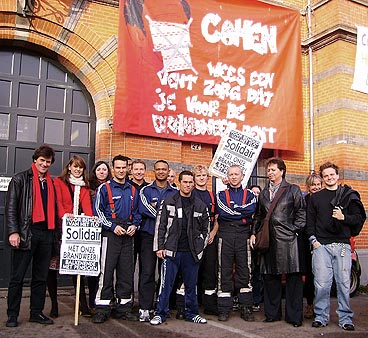
striking firefighters in Amsterdam

  • After the unions and the municipalities finally reached an agreement, there was still one sticking point:
    mandatory retirement at 55 for workers in high risk jobs like firefighters or ambulance staff. The unions and municipalities had agreed to end this, but the firefighters themselves went on a wildcat strike to protect this right. They won a modest victory by forcing through partial retirement at 55 and full retirement at 59, rather than having to work fulltime in “a low risk function” after 55.
  • The restructuring of Avebe, an agricultural company specialising in potato products, which had been in
    trouble for some years now, led to one of the longest continuing strikes of the year. The restructuring
    would lead to loss of some 150 jobs. The dispute was not about the job loss perse as it was about how
    it would be achieved. The two and a half week strike resulted in a more generous social plan for the fired employees, with 15 months of continued employment instead of six. What is more, the company
    lost the lawsuit it had filed against the union in order to force an end to the strike. If the company had
    won the suit, it would’ve made it that much more difficult for unions to strike elsewhere.

strikers at Shell

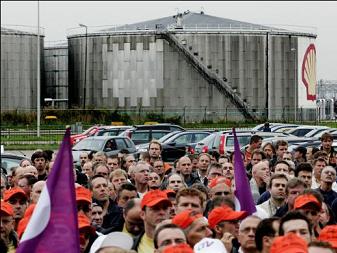
  • At Shell, the strike for better pension rights, achieved a partial succes. The retirement age for current workers stays at 60 like the unions wanted, but will still be set to 65 for new employes; however, the unions managed to get Shell to still (partially) pay for workers who want to retire at 60. Thanks to this strike the union also managed to get similar results for the workers of the Total and Nerefco oil refineries.
  • At Smit Tak, perhaps the world’s biggest salvage and harbour towage company, three strikes were
    necessary to get better deals for both salvage and towage workers. This included not just an above
    inflation wage rise, but also better compensations for working abroad, overtime and a better disability
    compensation scheme.
  • Finally, harbour workers in general have been in action several times this year to protest against the
    abandonment of ILO convention 137, whicharranges that only qualified, registrered harbour workers can load and unload ships. Both government andemployers have declared to be no longer committed to this convention, to “ensure a better competitive position for the Dutch harbours”. At the same time, the harbour workers are also
    resisting the EU Port Package 2 directive, which again would weaken the strong position of harbour workers throughout Europe. Historically, harbour workers, thanks to Europe and even worldwide conventions have not had to engage in the kind of “race to the bottom” competition their employers would like to see, so it is no wonder they are now forcefully resisting attempts to instigate this through European law.

So will this newfound militancy last and have consequences beyond the immediate improvement of some workers’ rights? The Netherlands is still ruled by a rightwing, neoliberal government bent on enforcing a “sound business climate” on the country and the same holds for the European Union. Its encouraging to see the unions think beyond the short term and to fight for more than just immediate benefits for their members, but a hell of a lot more needs to be done both nationally and internationally, will they be able to cure the rot that set in during the last decades. At the moment the unions are still largely defending previously won rights, not gaining new ones.

Victory to the firefighters?

striking firefighters in Amsterdam

For the past two years the public service unions have been in negotiation with the council of Dutch municipalities for a new collective working agreement. The process has been acrimonious to say the least, with several high profile strike actions by public transport workers, harbour employees and even sanitation workers during Sail 2005. The negotiation point that caused the most difficulties, was the ending the right to retirement at age 55 for those workers in professions which are recognised as being risky and strenuous, workers like firefighters or ambulance crews. Back in the summer, the council of municipalities, which had been dragging its feet on the negotiations, made further negotiations conditional on the unions giving up this right. This was not appreciated, to say the least…

As a result the negotiations dragged out until last week –and the previous agreement terminates this month. The council of municipalities held firm to its desire to scrap the right to retire at 55, partially because it was pressured by the national government to do so, because according to the new age discrimination laws coming into action in January 2006, this sort of arraignment is illegal..

Last week a new agreement was finally reached by the union negotiators and the municipalities, in which those employees who would’ve been able to retire at 55 under the old rules and who had worked for more twenty years would still be able to do so, but everybody else would have to stay on after 55. Workers with less than twenty service years would be forced to trade their job for something less strenuous.

The unions might have agreed to this, but the workers, especially, the firefighters, were less than impressed and started a series of wildcat strikes. The good news is that the pressure of these forced the unions to renegotiate to reach a less onerous settlement. In the new agreement, those firefighters with less than twenty years of service now will be able to partially retire at 55 and fully retire at 59, rather than being forced to work fulltime until 59. A modest victory, as this is still worse than what the firefighters had, but a victory nonetheless.

There are two things that we can learn from this whole fiasco. The first is the dubious role the central
government played in the negotiation process. It is clear that a large reason why the unions failed to keep the right to retirement at 55 was the pressure of the new age discrimination laws, which allegedly would make this agreement illegal. The municipalities made grateful use of this to pressure the unions, but it seems to me this agreement could still be kept by making it voluntary rather than a mandatory retirement. I’m not a lawyer though. At the same time, the central government helped pressure the unions even more by making it financially less attractive for both employer and employees to keep these sort of arraignments in place. All this is not surprising, as the Balkenende government has made a fetish of keeping people working longer.

The second, more hopeful aspect iof this is that it is still possible for workers to put pressure to employers and unions, by not going meekly along with what the union bosses think is good for them, but striking for their rights. It does show the enormous gap there is between the union and the workers though, as you would expect it would not be necessary for the workers to have to do this.