War lies: there is little support for the Iraqi insurgency

The resistance in Iraqi against the US occupation is still being described as consisting mostly of foreign Jihadis and Al-Quida supporters, as well as disgruntled Saddam supporters. Therefore, so the reasoning goes, it has little support amongst the Iraqi population. Simultaneously, the Iraqi people are forever intoned as supporting the coalition, with the US/UK coalition working in their interests. The truth is different, as even a secret British military poll, recently revealed, made clear:

The survey was conducted by an Iraqi university research team that, for security reasons, was not told the data it compiled would be used by coalition forces. It reveals:

  • Forty-five per cent of Iraqis believe attacks against British and American troops are justified – rising to 65 per cent in the British-controlled Maysan province;
  • 82 per cent are “strongly opposed” to the presence of coalition troops;
  • less than one per cent of the population believes coalition forces are responsible for any improvement in security;
  • 67 per cent of Iraqis feel less secure because of the occupation;
  • 43 per cent of Iraqis believe conditions for peace and stability have worsened;
  • 72 per cent do not have confidence in the multi-national forces.

News surprising to no-one but the “pro-war left”, I’m sure. Yet still the various news media tend to report about Iraq in terms defined by the occupiers, describing the resistance as Al Queda supporters, or talking about various US activities as being in the interests of the Iraqi people. It just seems there’s this increasing gap between reality and the officially sanctioned version of it, even with people or institutions not beholden to Bush ‘n Blair.

CIA flights via Schiphol?

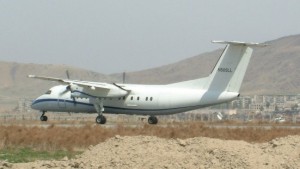
Last week, the Volkskrant reported (link in Dutch) that an alleged CIA plane had been stationed on Schiphol for two days, on 17 and 18 November, before leaving for Rekjavik. The plane in question is a DHC-8 or “Dash-8” plane, with registration number N505LL and owned by the Path Corporation, allegedly a CIA front.

picture of the DHC-8 N505LL taken in Afghanistan in 2002
The airplane in question, photographed in afghanistan in 2002

On the Spyflight website, the same plane that visited Schiphol two weeks ago is identified as having been stationed in Kabul, Afghanistan. According to Spyflight it is “used to transport US SF personnel around the country to various small airstrips”.

So what was it doing at Schiphol? This report says it had arrived from Istanbul and had previously visited Baku, in Azerbaijan, which could point at its origin indeed being Afghanistan. It wasn’t supposed to have any passengers when it landed at Istanbul, but that information could be wrong. All of this might very well be benign, but could also fit the extraction and movement of prisoners from Afghanistan to parts unknown…

CIA admits it has secret prisons in Eastern Europe

Current CIA director Porter Goss admitted in the Washington Post yesterday that the CIA does indeed have a secret prison system outside the USA, including on locations in Eastern Europe:

Goss did not deny the existence — reported earlier this month by The Washington Post — of a secret CIA prison system overseas that has included sites in Eastern Europe. Asked why the United States needed secret prisons, Goss said: “We’re fighting a war on terror. We’re doing quite well in it. Inevitably, we are going to have to capture some terrorists, and inevitably, they are going to have to have some due process, and inevitably, that is going to happen, and it’s going to be done lawfully and under all of the law and order and protections of due process that this country affords.”

In the same article, Condi Rice is also quoted, displaying the same historical insight and intelligence that made her Secretary of State:

In an interview published today in USA Today, Rice indicated she intends to remind Europeans that “we are fighting a war on terror” and that the United States must take certain actions “in order to protect not just ourselves but to protect others.”

She added: “We haven’t ever fought a war like this before. We’ve never fought a war before . . . where you can’t allow somebody to commit the crime before you detain them, because if they commit the crime, then thousands of innocent people die.”

Meanwhile, the European Union is less than happy with this situation, as it is hinted that one of the countries in which these prisons are located is a memberstate (Poland) and one is a candidate member state (Romania). So unhappy in fact, it’s threatening sanctions against any memberstate involved in this:

Franco Frattini, the European commissioner for justice and home affairs, warned that any countries found to be allowing the CIA to operate the detention centres – part of a global secret gulag used to hold al-Qa’ida suspects and other “ghost detainees” – could have its voting rights suspended.

It’s uncertain how real these threats are, but Romania at the very least could see itself stuck outside the EU for considerably longer than otherwise would’ve been the case. Smartarses can of course wonder what exactly the difference is between these CIA prisons and something like Belmarsh Prison… Poland could at least strike back by demanding inquiries into which EU countries participated in extraordinary rendition.

Meanwhile, closer at home, all the furore about how exactly the US is treating its detainees has caused problems for the Dutch government. Dutch forces are still active in Afghanistan as part of the peace force there and the Netherlands has been asked to extend its mission for at least another two years, to form part of a stablisation force in the province of Uruzgan, not the most safe of provinces. Already wary of becoming embroiled in internal Afghan conflicts, which may lead to numerous Dutch casualties and resulting political fallout, parliament has also become wary of the American treatment of Afghani prisoners.

And not just parliament. The minister of Foreign Affairs, who had earlier said he thought the war on Iraq was a “mistake”, also has his doubts about this. Granted, for many parliamentaries the risk of Dutch casualties will be the main reason to vote against extending the Dutch mission in Afghanistan, but at the very least the concern about American treatment of prisoners will make a good excuse to refuse.
War lies: we were mislead into the war

Compare and contrast, Democratic senator John Edwards, recently acknowledging his fuckup in voting for the war on Iraq:

Almost three years ago we went into Iraq to remove what we were told — and what many of us believed and argued — was a threat to America. But in fact we now know that Iraq did not have weapons of mass destruction when our forces invaded Iraq in 2003. The intelligence was deeply flawed and, in some cases, manipulated to fit a political agenda.

It was a mistake to vote for this war in 2002. I take responsibility for that mistake. It has been hard to say these words because those who didn’t make a mistake — the men and women of our armed forces and their families — have performed heroically and paid a dear price.

With Democratic senator Robert Byrd, in his speech explaining why he voted against the war:

So where does Iraq enter the equation? No one in the Administration has been able to produce
any solid evidence linking Iraq to the September 11 attack. Iraq had biological and chemical
weapons long before September 11. We knew it then, and we know it now. Iraq has been an enemy
of the United States for more than a decade. If Saddam Hussein is such an imminent threat to the
United States, why hasn’t he attacked us already? The fact that Osama bin Laden attacked the
United States does not, de facto, mean that Saddam Hussein is now in a lock and load position and
is readying an attack on the United States. In truth, there is nothing in the deluge of Administration
rhetoric over Iraq that is of such moment that it would preclude the Senate from setting its own timetable and taking the time for a thorough and informed discussion of this crucial issue.

As I’ve said before, it’s simply not true that, as John Edwards wants us to believe, everybody though Saddam had Weapons of Mass Destruction. The evidence presented for it was so flimsy anybody willing to look at it clearly could see that it was untrue even if, like me, they had to rely on newspaper reports rather than intelligence briefs. It’s just pathetic to suggest that as a US senator John Edwards could not have known this intelligence to be flawed; if he was mislead it was because he wanted to be mislead. Senator Byrd in his speech before the vote, which as you know was taken just before the 2002 elections, said that “Democrats favor fast approval of a resolution so they can change the subject to domestic economic problems.”

Which explains why the war issue was never raised during the 2004 presidential elections. Most of the
Democratic Party establishment wanted the war as badly as Bush did, for a mixture of reasons: they wanted to get back to “normal” politics, didn’t want to be seen as weak on defence, perhaps thought that Bush could genuinely pull it off, or similar dumb reasons. Now that it has blown up in their faces they’re trying to reposition themselves as skeptical of the war, but without great conviction.

So now we have the sorry spectacle of an opposition party unable or unwilling to actually provide opposition on the most important issue of the day, a party hopelessly compromised by its past support for this issue. Is it any wonder the Democrats can’t gain any traction against Bush?

War Lies: Saddam had ties with Al Queda

Apart from the lies about Weapons of Mass Destruction, the most used lies to be used in the runup to the Iraq War where the lies about Saddam Hussein’s ties with Al-Queda. Though these were all disproved fairly quickly, these are still being used now by mislead Bush supporters and the Bush administration both. Even at the time it seemed clear to me that people like Cheny and Rumsfeld were lying rather than just using flawed intelligence and now new revelations prove that I was right:

Ten days after the September 11, 2001, terrorist attacks on the World Trade Center and the Pentagon, President Bush was told in a highly classified briefing that the U.S. intelligence community had no evidence linking the Iraqi regime of Saddam Hussein to the attacks and that there was scant credible evidence that Iraq had any significant collaborative ties with Al Qaeda, according to government records and current and former officials with firsthand knowledge of the matter.

The information was provided to Bush on September 21, 2001 during the “President’s Daily Brief,” a 30- to 45-minute early-morning national security briefing. Information for PDBs has routinely been derived from electronic intercepts, human agents, and reports from foreign intelligence services, as well as more mundane sources such as news reports and public statements by foreign leaders.

One of the more intriguing things that Bush was told during the briefing was that the few credible reports of contacts between Iraq and Al Qaeda involved attempts by Saddam Hussein to monitor the terrorist group. Saddam viewed Al Qaeda as well as other theocratic radical Islamist organizations as a potential threat to his secular regime. At one point, analysts believed, Saddam considered infiltrating the ranks of Al Qaeda with Iraqi nationals or even Iraqi intelligence operatives to learn more about its inner workings, according to records and sources.

[…]

The Senate Intelligence Committee has asked the White House for the CIA assessment, the PDB of September 21, 2001, and dozens of other PDBs as part of the committee’s ongoing investigation into whether the Bush administration misrepresented intelligence information in the run-up to war with Iraq. The Bush administration has refused to turn over these documents.

Indeed, the existence of the September 21 PDB was not disclosed to the Intelligence Committee until the summer of 2004, according to congressional sources. Both Republicans and Democrats requested then that it be turned over. The administration has refused to provide it, even on a classified basis, and won’t say anything more about it other than to acknowledge that it exists.

You might object that later evidence may have validated Bush and co, but the article makes clear this is not the case. Which means that a prevelant postwar lie, that Bush and Blair were not lying to get their war, but were just mislead by faulty intelligence –in other words, the war is the fault of the CIA and MI5, not Bush and Blair — is wrong. Even at this early stage Bush knew that there were no ties between Saddam and Al-Queda, but his administration still chose to trumpet those non-existing ties as reasons to go to war. That is his responsibility, not the intelligence services. In fact, the article makes clear that the Bush partisans set up their own intelligence handling group to provide the intelligence they wanted, rather than the truth:

One reason that Bush, Cheney, and Rumsfeld made statements that contradicted what they were told in CIA briefings might have been that they were receiving information from another source that purported to have evidence of Al Qaeda-Iraq ties. The information came from a covert intelligence unit set up shortly after the September 11 attacks by then-Undersecretary of Defense for Policy Douglas J. Feith.

[…]

The Pentagon unit also routinely second-guessed the CIA’s highly classified assessments. Regarding one report titled “Iraq and al-Qaeda: Interpreting a Murky Relationship,” one of the Naval Reserve officers wrote: “The report provides evidence from numerous intelligence sources over the course of a decade on interactions between Iraq and al-Qaida. In this regard, the report is excellent. Then in its interpretation of this information, CIA attempts to discredit, dismiss, or downgrade much of this reporting, resulting in inconsistent conclusions in many instances. Therefore, the CIA report should be read for content only-and CIA’s interpretation ought to be ignored.”