I was on a summer holiday in Austria with the family last year and the house we stayed in had a good enough internet connection I could watch anime from my Plex server in Amsterdam. So each day we went out to climb mountains and look for four leaf clovers and each evening I would spent a couple of hours watching stuff. One of the series I watched there was Mushishi and boy was its opening applicable to me:
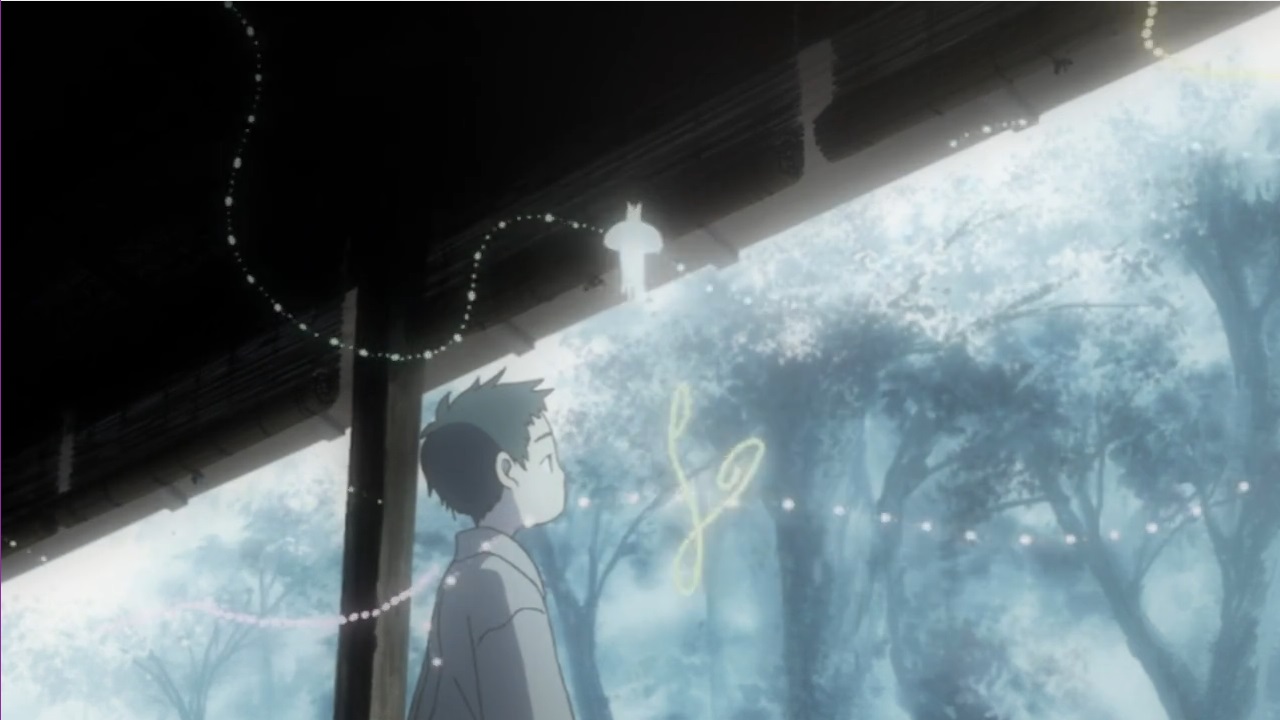
Personal circumstances aside, Ally Kerr’s song is the perfect way to open this series with, as gentle and melancholic as Mushishi itself. Mushishi is on a manga by Urushibara Yuki. Set in a pre-modern, still closed off Japan that seems to consist of mostly mountains and forest with the occasional village in it, Mushishi follows Ginko on hsi travels through the country. Ginko is one of the few people able to see ‘Mushi’, primitive lifeforms that are neither plants, animals, fungi or bacteria, but which live almost unpercieved among us. Ginko can not only see them, but he attracts them, hence his travels. Too long in one place and it becomes infested with Mushi. And while most people cannot see them, that doesn’t mean Mushi cannot interact with them, for good or bad. When that happens, Ginko, as a Mushishi, is one of the few who can diagnose and cure those afflicted.
Mushishi then is twentysix episodes of Ginko wandering across rural Japan getting involved with whoever is tangled up with Mushi this week, sometimes able to bring about a happy end, sometimes not. It’s clear throughout the series that the Mushi itself are not some kind of evil monster, just creatures living their own lives, with no real intelligence behind their actions other than instinct. Nor are most of their victims evil or bad; just unfortunate. At worst there’s the occasional person ignoring local superstitions and suffering the consequences. There’s little continuity in the series, it’s mostly a series of oneshot stories, but gradually a little bit does get revealed about Ginko and his past.
Ginko isn’t an action hero and the Mushishi themselves are not the sort of monsters that lend themselves to lavishly animated fight scenes. The pace is slow and scenes are drawn out, with lots of slow lazy pans of the scenery Ginko moves through. Lots of closeups of hands in motion as well, something I started to notice after the first few episodes. Conversation is slow too and the end result of all this is soporific. Not to be honest a series that you can easily binge. Two, maybe three episodes at a time is ideal. Very much a series to calm you down. If you liked Natsume’s Book of Friends, this is a series you’d enjoy as well.
American Tanks & AFVs of World War II
Michael Green
376 pages including notes & index
published in 2014
It’s a fact of life that interest in World War II armour tends to focus on Nazi Germany, with Soviet vehicles perhaps a distant second. Understandable, considering how many interesting and downright strange types made it into production or had at least a prototype created. It’s always tempting to think about what if those potential wunderwaffen had made it into service, whereas the realities of western allied armour are always much more mundane. At least the French and to a lesser extend, the British, had some cool but impractical dead ends available in the early war, but American armour was just relentlessly pragmatic. the answer to any problem encountered seemed to be let’s build more Shermans, rather than creating some new exotic prototype.
American Tanks & AFVs of World War II does nothing to disabuse you of those preconceptions. Yes, there are some what ifs to be found, but in case after case what Michael Green documents here is the ruthless pragmaticism of the US army during world War II. It’s not just that the whole design and procurement process was much more centralised and efficient than that of Nazi Germany — but it certainly helped that there was no Hitler type mucking about on the US side. It’s also that the first instinct was always to look for solutions through modifying existing vehicles, rather than creating new ones. A determination not to let the perfect be the enemy of the good or even good enough. If it worked, why replace it just because there was a better option? That’s the attitude that comes across reading this book.
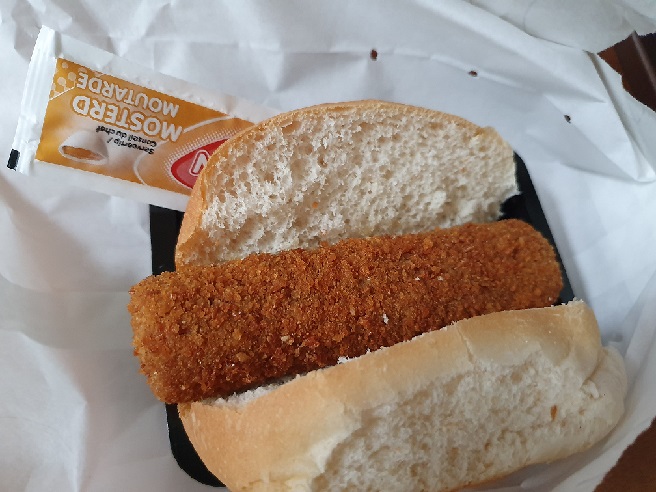
In fact, despite this irreverent and slightly louche introduction, the history of the broodje kroket is intertwined with the brutal history of its homeland. Most of the sandwich’s ingredients are bog-standard European, from the chopped beef to the béchamel to the spicy mustard. Today, the kroket can be filled with almost anything (stir-fried noodles, mashed potato, liver and rice, goulash.) But in the recipe I found, the glaring exception to the European-centric ingredients was the teaspoon or so of kecap manis, sweet soy sauce—the most popular condiment in Indonesia. Kecap manis is popular in the Netherlands because the Dutch East India Company conquered what is now Indonesia four centuries ago, and its parent nation held on to the so-called “Spice Islands” for more than three hundred years. That’s why kecap manis is in the broodje kroket, and other Dutch dishes, like zeeuws spek, a marinated bacon.
I didn’t actually know that we used ketjap in kroketten, but it’s not surprising. Indonesian food, often thoroughly altered to suit Dutch tastes, is one of the staples of our national diet and as Lavin notes, impossible to decouple from our violent colonial history. If there’s one thing the Dutch are good at though it’s ignoring painful realities. For decades after the liberation of Indonesia any debate about our colonial past was steeped in deep nostalgia for a world in which ‘we’ were still important. It took until February this year before the Dutch government officially acknowledged and apologised for the brutal attempts to suppress Indonesian liberation in 1948. Though, as Reza Kartosen-Wong notes in Het Parool, the excuses are limited purely to the “exceptional violence” used in the war, not for waging a war to re-enslave a nation itself, let alone for the Netherland’s wider colonial past. We still want to pretend our colonies just accidently happened to be ruled by us, that we did that out of the kindness of our own hearts and not that rape, murder and genocide are the foundations of our wealth.
Last Monday Henny Vrienten, frontman of the Dutch pop group Doe Maar, passed away and with him a little bit of my youth.
If you’re not Dutch, you’ll likely have never heard of him or Doe Maar, so it may be hard to understand how insanely popular the band was from 1981 to 1984. Every single was a hit, every album went paltinum and every concert had thousands of teenage girls screaming their heads of. Comparing it to Beatlemania would be an understatement. When the band announced they would stop it was the first item on the main television news broadcast that day. I was not even ten when they split up, but I had the buttons, the pink/green scarf and everything. Everybody in my primary school was a fan, not just the girls, the boys too. If you were a child in the early eighties, Doe Maar was the sound track to your youth.
In hindsight the popularity of Doe Maar is utterly bizarre. This wasn’t a manufactured hype, but something that sponteneously erupted at a time the band had almost decided to quit already. Doe Maar was founded in 1978 by a group of musicians in their late twenties, each with a history of playing in other bands; when Vrienten joined in 1980 he was already thirty. Their first hit with him as singer, sinds een Dag of Twee, was about him how strange it was to be falling in love again when you’re thirtytwo. Hardly the stuff that makes teenyboppers swoon. Furthermore their record company at the time had so little faith in them it had shelved their second album. It was only by accident that Dutch radio diskjockeys started playing the single and promoting the album, but it was enough to start the Doe Maar hype. From that point onwards they would become the most popular Dutch band of all times.
What made Doe Maar’s success even more improbable was that at the time, serious Dutch pop music was just not done. Sure, there were people singing in Dutch, but these tended to be either serious folk singer types, or people from the light entertainment world. But if you wanted to be taken seriously as a pop or rock musician, you had to sing in English. Doe Maar never did this. In fact, they’d made their debut on the legendary compilation album Uitholling Overdwars (1979), put out by the Stichting Popmuziek Nederland to promote Dutch language pop music, which also included several other groups that would make it big in the early eighties alongside Doe Maar. That may be Doe Maar’s biggest legacy, making Dutch language pop music respectable and relevant. What made Vrienten’s singing also important was the distinctive Brabant accent in his voice, rather than using the somewhat artificial standard Dutch of your usual light entertainment singer. ‘Provincial’ voices were rarely heard until then, unless in purely regional bands with little national appeal.
What made this small revolution possible was of course punk. The D.I.Y. aesthetic and attitude of punk rock meant there was space to break with the established traditions of ‘serious’ rock and all over Europe you saw bands move away from English towards their own language; most well known being the Neue Deutsche Welle movement of the same time. Nevertheless Doe Maar was never a punk rock group, even if some of the songs on their first eponymous were at least punk in style, like Wees Niet Bang Voor Mijn Lul. No, the secret sauce of Doe Maar’s success was something else entirely: ska and reggea. While on that first album it was all a bit Kinks’ Apeman style parody including dubious accents, from when Vrienten joined Doe Maar it was taken seriously. As a bass player Vrienten himself contributed a lot to the new Doe Maar sound. He even produced an actual dub version of their third album, Doe de Dub in 1982.
I can still remember the frustration and sadness of Doe Maar just deciding to stop at the height of their fame. It was the only thing we talked about on the playground next day: why did they have to stop, why now, why. It didn’t make sense to me then, but it was the best decision they could’ve made at the time. That popularity must’ve been incredibly scary, night after night seeing 13 and 14 year old girls screaming themselves hoarse at you to the point of fainting. Vrienten himself had said that he feared that one day it would all go horribly wrong and somebody would be killed in the crushes that happened during their concerts. The pressure of so much popularity didn’t help relationships within the band itself either and when Doe Maar realised they could just …stop, it must’ve come as a relief.
At the time Doe Maar quit, Vrienten had already brought out his first solo record. Post-Doe Maar he would not only record, but start a new career as a writer of movie music, having been one of the two composers within Doe Maar as well. Movies and musicals would be the main focus of his music, but he also featured in various side projects with other famous Dutch musicians over the years. Doe Maar itself would re-unite in 2000, just as the generation of teenyboppers that were their fans in the early eighties were now in their thirties themselves. It was never quite the same as before, but they did release a new studio album and held regular new tours ever since. In fact, Vrienten’s illness led to the cancellation of their last tour, which would’ve been held last year.
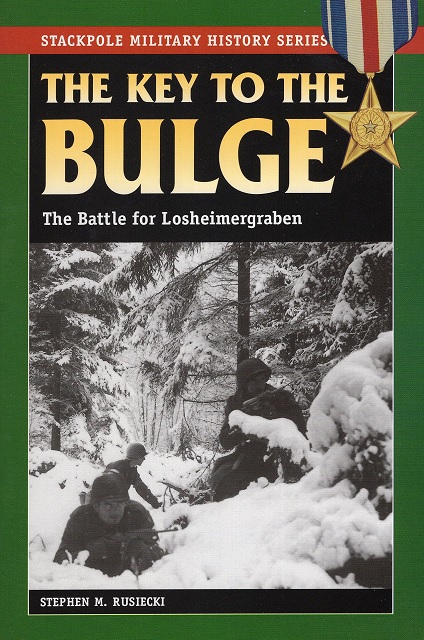
The Key to the Bulge: The Battle for Losheimergraben
Stephen M. Ruseicki
195 pages including notes
published in 1996
A visit to the Bastogne War Museum when I was on a holiday in the Ardennes last October got me interested in the Battle of the Bulge again, as did the series WW2TV did on the campaign in December. Their interview with Peter Caddick-Adams on 10 Facts about the Battle of the Bulge everyone should know led me to read his excellent book on the campaign as a whole. Which in turn whet my appetite for more on the individual battles within the Ardennes Campaign. Military history like all history is fractal after all. You can get a broad overview but if you zoom in you get a lot more detail, new insights. Which is where this book comes in. With Snow and Steel I got the broad strokes of the Ardennes Campaign, with this I got an overview of one of the most important of the early battles in it, one that could be argued determined the outcome of the entire Ardennes Offensive…
That battle was the battle for Losheimergraben, then, as now, a small border crossing between Belgium and Germany, too small even to call a village. In December 1944 this was the front line, the furthest point reached by the great Allied breakout from Normandy earlier that year. Since then the front line in the Ardennes had been largely static; the real fighting continued further up north, in the Netherlands and around Aachen. The Ardennes itself was quiet, an ideal sector to introduces green troops to life at the front and blood them before they got thrown into real battle. Losheimergraben and neighbouring places like Lanzerath were held by such troops, the 394th Infantry Regiment of the 99th infantry Division. It was these troops that would hold out for thirty-six hours against the Sixth Panzer Army starting on the 16th of December, denying it the quick victory it needed to comply to its already impossible schedule.