How to change the oil on your Super Cub: an anime tutorial

“So what was episode four of Super Cub about?”

“Well, Komagu got herself a part time job couriering documents between her school and another one in a different town and we spent most of the episode watching her ride her Super Cub between the two. At one point she got caught in the rain and had to buy a raincoat that cost her a day and a half of salary, roughly. Oh, and she learned to change the oil on her bike”:

Gods I love this series. Twentytwo minutes of the most mundane shit possible, sold entirely through body acting and animation. It’s not even particularly spectacular animation that’s on display here, just solid craft. Nothing that makes your eyes go pop if you’d watch it on a monitor at an anime con, but when you give it a chance an episode is over before you notice. If you like Yuru Camp, you’ll love this.

Your Happening World (Too many anime tabs open)

Ever have too many tabs open with interesting links you “want to do something with” but never get around to? No, me neither.

  • Maxy Bee vibe checks manga magazines
    What follows is a thread vaguely defining as many manga magazines as I can, for reasons. This is not scientific, just a “putting names to faces” thing.
  • The Old Soul of Tsukikage Ran, or how to review an older, not very memorable series
    Thing is that Tsukikage Ran, while good, isn’t particularly good. In fact, it’s one of the most average shows I’ve seen in long while. There are definitely aspects of it I like, such as the series following two independent women of varying degrees of goofy, but looking at it as a whole, I have a few issues, and the biggest is that this is a show clearly made from an Old Japanese Man perspective.
  • Yuri made me human, an interview with Iori Miyazawa, author of Otherside Picnic
    The author lowers her arm into the water tank, the octopus approaches her. The author’s monologue goes on top of it, but the octopus can taste her with her suction pads, and since female octopuses, like humans, possess estrogen, she says “It is possible that this octopus, in fact, knows I am a female”. She then adds, “her embrace is an experience unlike any contact with a human”, and so on — her immense feelings are flowing onto the pages.
  • Yuri made me human part 2, featuring Gengen Kusano mentioned in part 1
    That’s right. Like when you read a sentence in a book and logically assume that “there must be a feeling of sadness here”, you see someone’s facial expression and logically interpret it as “there must be a feeling of sadness here”. In “Weak Yuri” taken to the utmost extreme, in “Radical Weak Yuri”, even the relationships between real people become imaginary. Basically, the extremes of both “Strong Yuri” and “Weak Yuri” places real beings and fictional beings on the same ontological level. The Ouroboros comes full circle.
  • Red Hair in a Global World: Michael B. Pass looks at the Japanese fascination with Anne of Green Gables
    Today, Japan’s fascination with Anne and the Island is an unremarkable and long-accepted fact; rarely does a tourist season go by without at least one Canadian newspaper commenting on and seeking to explain the now ubiquitous phenomenon.
  • 40 Seasons in 40 Weeks
    Veteran anime blogger Scamps did a forty post decade overview of the 2010s in 2019, which means I got this tab open for over two years now.

Also, some new (to me) blogs I’ve added to the blogroll:

  • Full Frontal
    Full Frontal is a temple devoted to passion. Created by a team of devoted fans we want to share our love for animation, manga and other subcultures and reach people’s hearts. You will be able to find chronics, analysis, interviews, and translations striving to understand the big picture of otaku culture as a social phenomenon.
  • Animétudes
    This blog came out of my need, as a fan, to talk about anime, and to understand it better. I hope that my writing can relay at least some of this understanding and love for the medium of animation that I love so much.

Risu: “I’m still okay” *knock knock* “I’m not okay” — Hololive showcase

Posted because I fell from my chair, laughing when I watched this earlier today. What happened when squirrel girl Risu stole mamah Moona’s piggy bank to count the coins in it:

It’s fairly normal for popular media franchise to be exported from Japan to other Asian countries, establishing branches there. And while Hololive’s foray into China wasn’t succesful, it was a logical move considering the potential size of the vtuber market there. Much more unexdpected was the establishment of an Indonesian branch, rather than say a Korean one. Ayunda Risu is one of the three first generation Indonesian Hololivers and she’s just as she appears here, a mischievous squirrel. Her generation mates are Moona Hoshinova, whose piggy bank she stole and Airani Iofifteen, heard late in the video offering seasoning to Moona to make squirrel satah. The first generation of Indonesian Hololivers all live together you see, with Moona being the mother and Iofi the father and Risu as their unruly child. A setup that works well, producing hilarious videos like this. What also makes HoloID stand is that before the English language branch of Hololive was established, these three were the sole Hololivers regularly streaming in English, often doing trilingual streams even, using Japanese, English and Bahasa Indonesia.

Clip created by Holoclip.

He’s only shit and soil now like anybody else

It turns out disgust at enforced mourning is something of a British tradition:

After the death of George VI, in a society muc more Christian and deferential than this one,  Mass Observation survey showed that people objected to the endless maudlin music, the forelock-tugging coverage. 'Don't they think of old folk, sick people, invalids?' one 60-year old woman asked. 'It's been terrible for them, all this gloom.' In a bar in Notting Hill, one drinker said 'He's only shit and soil now like anyone else,' which started a fight.

If the mass hysteria about the death of the nation’s racist grandpa is this bad already, imagine what happens when Beth pops her clogs. Eight days of mourning, BBC with wall to wall coverage on both BBC One and Two, the shutting down of BBC Four yesterday, all the pious assholes who couldn’t say anything as covid racked up 150,000 deaths due to Tory complacency now scolding anyone not in the mood to mourn… All the things that the British public was accused of after Diana died, now enforced by the government, the media and an army of finger wagging neighbour watch types on Twitter and Facebook.

But in the end nobody cares but the sort of royalist simp who thinks it’s understandable to be worried about the colour your grandchild will be born with.

Super Cub is a master class in visual story telling

The sheer audacity to start your new anime series with over three minutes of no dialogue, no plot, no story made me fall in love with Super Cub the same way the opening minutes of Wonder Egg Priority did last season.

It’s early morning and we’re in Hinoharu train station on the outskirts of Hokuto City –west of Tokyo, south east of Nagano–, with only bird song audible. As a train arrives, we move out from the station and see how rural the setting already is. Light classical music starts playing as we move away through the town towards a small nondescript apartment building at the out-most edge of town, taking a full minute to get there. We don’t know it yet, but this mirrors the daily commute of our protagonist to her school, during which she will tells us that the road to school has a bit of an incline near the station, as we see her struggling to get up the hill. She’ll also tell us that she doesn’t parents, friends or hobbies. For the moment though we don’t even know she exists, as we make our journey through her town.

This is what Scott McCloud, in Understanding Comics called an aspect to aspect transition: “(it) bypasses time for the most part and sets a wandering eye on different aspects of a place, idea or mood”. In anime this sort of transitions are often done the way they are done here, by showing a series of essentially static (landscape) shots, the camera travelling through them, but with little no motion visible, nor people. It’s a way of slowing the viewer down and is most often found in socalled iyashikei, or ‘healing’ anime. Landscape and setting before plot or characters.

The first shot inside the apartment is a classic Japanese ceiling light, ugly and cheap. The apartment is in shadow, no light visible, the walls and ceiling beige and slightly grungy. There is morning light coming in from the kitchen window. The kitchen itself is as utilitarian as the ceiling light: two gas hops, a sink and a fridge, with stainless steel racks hanging from the ceiling with a few cooking pans. The camera turns and shows a microwave and rice cooker on a side table, with the dining table visible in the foreground. The camera moves on to a set of light blue curtains through which a bit of light is showing. School books on a desk are shown as we hear an alarm clock going off. The alarm clock is shown on a bed side table, with a hand coming into frame to shut it off. As it’s stopped, the music stops as well.

Again, an aspect to aspect transition, giving us an impression of the place our protagonist lives in. It’s shabby, it’s small, with few amenities and no visible luxuries. The only real spot of colour in the whole apartment are the school books. The lightning is natural, subdued and of a quality we seldom see in anime. The detail and care with which the flat is rendered lends it a kind of beauty. These shots reveal a bit of the character that inhabits the apartment. Poor, but tidy, with everything in its place, no clutter, an ordered existence.

As our protagonist wakes up –who as of yet has no name– we follow her through her morning routine. We get a glimpse of her as she sits up in bed, then see a badroom door with the sound of a running shower. A glass is put down on table and juice poured in. A piece of bread is smeared with what looks like butter. Finally, a middle distance shot that shows a girl dressed in a school uniform, standing behind a small dining table, with only one chair. It’s the first shot both of our protagonist and her apartment, showing clearly that his is indeed very small, with the kitchen, living room and even the bedroom being all in one room, only the bathroom separate. When the fridge is opened to take out a jar of tea, you can see the light blue curtains that hang next to the bed in the background.
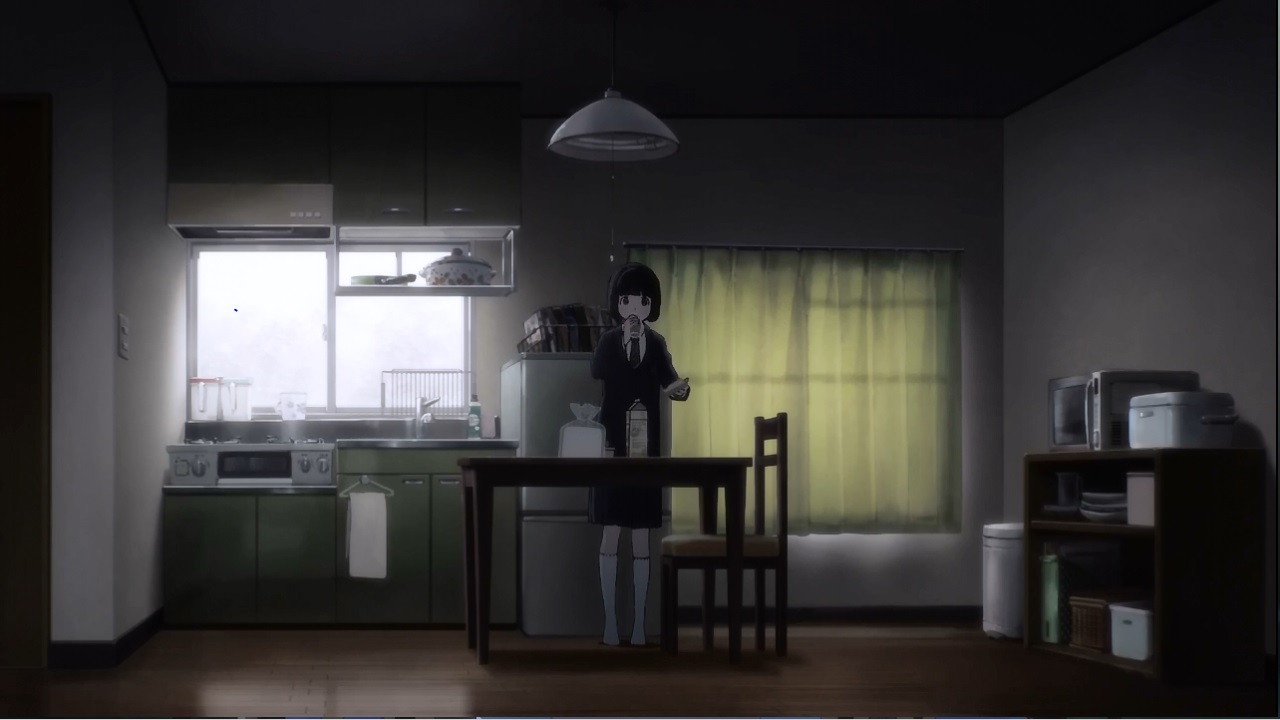
Super Cub: a small grey apartment with in the middle a small grey protagonist

Everything in not just the apartment, but also our protagonist’s routine, is utilitarian, sparse, simple, perhaps out of necessity, perhaps out of character, perhaps both. Her lunch is a simple bento of plain rice, a jar of tea and some sort of instant snack yto go with it. The way she efficiently puts together her lunch and puts it in her school bag shows how routine this is, that she has had to do this for herself for a long time. No elaborate side dishes here, because why would you if you’re just doing it for yourself. She makes her lunch because she has to eat something, not to show off. That is reserved for the animation itself: I could Feel that extra hard twist at the end as she screwed on the lid on her thermos flask. The animation is as understated as the rest of the episode, but simple little things as the way with which she scopes up rice is animated show a quiet competence, an eye for detail again.

Skipping ahead, some seven and a half minutes into the episode, is when everything changes. Seeing it in isolation like this, it’s an obvious trick, especially with that one music note to underscore it. When I was watching it last night though, I knew something had changed, but it registrered more subconsciously than consciously. The story had me fully entranced, all thanks to the confidence with which the animation told it. With a lot of series, we would’ve had flashbacks, or prologues establishing why our protagonist lives her life the way she does. Here we get one small internal monologue as our protagonist cycles to school, laments the incline leading up to it and matter of factly states that she has no parents, hobbies, friends or goals. Even the manga version had the obligatory scene establishing why she had no parents; the anime trusts the viewer to draw their own conclusions. We never even learn her name except that she has to fill it out on the receipt when she finally buys her Super Cub. It takes the original story and parses it down to tell it as economically as possible. The squashed, flattened aspect of the animation fits the squashed, flattened character of the protagonist. The fun is in imagining how the series will evolve from here, as she starts to develop and grow.