Ashes of Victory & War of Honor — David Weber

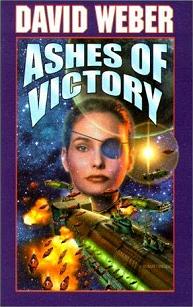
Cover of Ashes of Victory


Ashes of Victory & War of Honor
David Weber
Kindle editions
published in 2000 and 2002

Bear with me because this is relevant. This January, about a year or so after everybody else, I finally broke down and got myself a smart phone on a not too onerous subscription plan. The phone I got was a HTC Wildfire, a dear little thing with some annoyances, but nothing major and because it was an Android phone, it had a version of Amazon’s Kindle available for it. Earlier this month I got this, then was looking around for some free books to put on it. Got the usual set of the Classics from Project Gutenberg of course, but I also wanted something more modern, something light and preferably science fiction, something I could read on the tram without having to pay too much attention to it.

Enter David Weber and his Honor Harrington series. Back in the nineties I devoured those books, but even then I knew they were not by any measure good books: wish fulfillment war porn with a severe case of hero worship and occasional dodgy politics and more than occasional dodgy science. Even on a sentence and paragraph level Weber is often just not very good: awkward dialogue, oodles of infodumps just as the spacewars heat up and in general too much verbiage with stock phrases repeated over and over again. Yet for all that I kept reading. I was going to just read a bit of Ashes of Victory just to test Kindle on my phone, yet here I am having read both that and War of Honor. Weber must be doing something right.
Read More

Monday Night Linkage

I was going to post this yesterday, but real life interfered:

An evening with China Miéville.
Paul Wiseall interviews China on his first clear science fiction book. I’d argue that most of his novels from Perdido Street Station have been science fiction, but that’s a matter of taste as much as anything.

Paul Kincaid: Learning to Read Adam Roberts & Rich Puchalsky: On Learning to Read Adam Roberts
How do you solve a problem like Adam Roberts, a writer every book of which I’ve read I’ve disagreed with and/or disliked? Whom, despite this, I still keep coming back to every few years or so. Bad writers you can dismiss, writers that you dislike you can dismiss, even writers you like and enjoy you can often set aside more easily than a writer that irritates you, like a piece of sand in an oyster. With Roberts, I find that his view of what science fiction should be is different enough from mine to be challenging, while at the same time I often can’t believe either his characters or the situations they find themselves in. Paul Kincaid has a similar problem and his post is an attempt to deal with it, to which Rich Puchalsky has replied.

Martin Lewis reviews Arslan.
A review which does not make me want to read this any more than Abigail Nussbaum’s review did. Arslan is a novel that starts with a horrific rape scene in which a teenage boy and girl are raped by Arslan the warlord, which in itself is enough to squick me out, but what both reviews also made clear is that the setup of the novel is far from realistic. Arslan is a warlord out of a fictional country in the former USSR, who by way of nuclear blackmail becomes ruler of the world, only to end up micromanaging a small town in flyover country USA. It’s an absurd setup that Arslan‘s author needs to tell the story she wants to tell. I can deal with novels that rely on either of these two authorical tricks, but novels that use both need to be very good to end on my to read pile and so far nothing I’ve read makes me think Arslan falls in that category.

The History of Science Fiction as depicted in one crazily detailed artwork by Ward Shelley.
Too gorgeous to nitpick.

Absorption — John Meaney

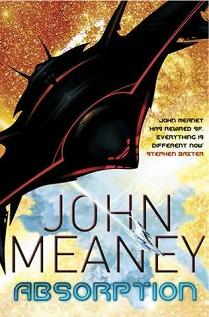
Cover of Absorption


Absorption
John Meaney
407 pages
published in 2010

Absorption is the first volume in John Meaney’s new Ragnarok trilogy. It seems to be set in the same future as most of his novels, from his first book To Hold Infinity onwards, have been set. You don’t need to have read those to understand this book, but if you have you’ll know roughly what to expect and will get certain references quicker than a new reader would. In general however it is enough to know that John Meaney is of the same generation of British writers like Richard Morgan, Alastair Reynolds and Neal Asher and writes the same sort of widescreen “hard space opera”, though a bit more cyberpunky.

But Absorption is more than just another space opera novel. You could in fact say that this is not science fiction at all, but fantasy dressed up as space opera. Because while one of the three main storylines is set in Meaney’s standard future of Mu-space pilots with jet black eyes and the computer upgraded Luculenti upperclasses of Fulgor around 2603 AD, the two other storylines are set in 777 AD and 1926 AD and both feature things that look a lot like magic… And with flashes of an even father future in which the main characters of all three storylines meet, as well as hints of magic in the main future storyline as well, who knows what’s really going on?

Read More

Sidewise in Links — sci-fi Sundaze

You know you’re not enjoying an SF novel when you keep stopping to read a really badly written academic text on international relations.
— Jonathan McCalmont.

A year of reading women:

More science fiction links:

Not science fiction:

Earth is Room Enough — Isaac Asimov

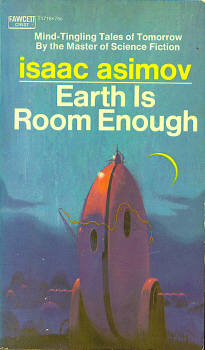
Cover of Earth is Room Enough


Earth is Room Enough
Isaac Asimov
208 pages
published in 1957

As the backcover blurb has it, “ANYTHING CAN HAPPEN and probably will RIGHT HERE ON EARTH” — which is why Earth is Room Enough for Asimov to set his stories on. This, with another Asimov collection, Buy Jupiter, is one of the books that made me into a science fiction reader and fan. It’s not so much that this is an outstanding collection — a good few of the stories here are amusing at best — but that Asimov is at any rate such an easy and pleasant writer to meet when you’re young. A clever ten year old can follow his stories but since they were originally written for adults, there’s no talking down here. Asimov might not be the best writer now to introduce you to science fiction, but he was for me.

Earth is Room Enough, originally published in 1957 and which stayed in print for at least twenty years is is a collection of stories written between 1951 and 1957 and somewhat of a grab bag, jokes and shaggy dog stories intermixed with more serious ones. As said, all stories were set on Earth and deliberately picked by Asimove for the collection, to prove he could do more than write galactic space opera. Mind, he cheats a bit by including two pieces of comic verse… It doesn’t make for a first rate collection, but it certainly wasn’t a chore reading this either.

Read More