Snuff — Terry Pratchett

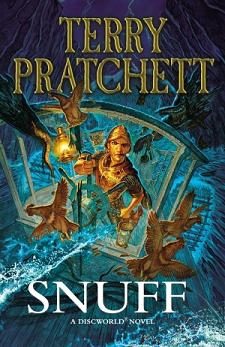
Cover of Snuff


Snuff
Terry Pratchett
416 pages
published in 2011

Wouldn’t you know it; you try to start writing a review and suddenly you can’t find the bloody book anywhere. Which is not just annoying because I want to get started but also because I’m now worrying I lost it somewhere. If I have I will have lost a piece of history, it being the last Discworld novel she and I read together before her death, as we did with all the new Discworld novels when we were together; usually she read them first as I could be slightly more patient. We not only were both fans of Pratchett, but we actually met thanks to him, through the dedicated IRC channel at lspace.org which had been set up for the alt.fan.pratchett newsgroup. What’s more, his documentary this year on assisted suicide and the dignity of choosing your own death helped Sandra make up her mind once she was convinced she couldn’t go on anymore.She had thought about it before, but seeing that really firmed up her conviction not to suffer if there was no point to it. Reading Snuff therefore was a bittersweet experience.

Snuff itself is a typical late Pratchett novel, good but not outstanding with few surprises for the longtime fan. Once again, as in Jingo, The Fifth Elephant or Thud to name but three, Samuel Vines is taken out of his element and has to maintain the peace outside of his jurisdiction and once again there are powerful forces who profit from the lack of it he has to conquer. This time Vimes is sent on holiday to his wife, Lady Sybil Ramsbottom’s country estate to play the laird, something he’s not good at nor likes much. Fun is had with city boy Vimes’ discomfort with country ways, again as in previous novels. Finally, there’s yet another fantasy race rescued from its stereotypes: after trolls, dwarfs, golems, zombies and vampires it’s goblins this time.

And in the Discworld, goblins are natural victims: too weak to be respected for their strength like trolls and dwarfs, lacking the aura of danger of a vampire and with no special powers. Instead goblins practise the religion of Unggue, collecting their bodily fluids: snot, tears, ear wax, toenail clippings and the like, saving them in special Unggue pots they keep from birth and which is their only artform.

They share their fascination with icky stuff with Vimes’ young son, five years old and into things that go plop and all that; he loves the countryside and approaches his interests scientifically. Much of which is encouraged by young Sam’s favourite author, Felicity Beedle, author of some 57 books, most of which have something to do with poo. Felicity Beedle turns out to be living nearby and to be a goblins rights advocate, attempting to teach them to read and write.

While as usual with the Vimes novels, society is the ultimate villain, but having another patented Pratchett psychopath, Stratford, as the bad guy Vimes has to beat personally, culminating in one of the best set pieces I’ve seen in the Discworld series.

Snuff is not an innovative or surprising Discworld novel — and if you were expecting it to be you really don’t understand Pratchett. The thing about the Discworld is that Pratchett has always build on what came before in the series, through evolution rather than revolution, that for the most part you know what you are going to get going in. What’s important is the story and I found Snuff to be as good as any late Discworld novel.

Since Terry Pratchett has been diagnosed with Alzheimers and this became public knowledge, it is tempting to speculative if this is or is not visible in his writing. One change that is visible is that he has started to dictate rather than write his last few novels; it’s slightly less focused, more flabby, in somewhat the same way that when you speak you tend to be more sloppy than when you’re writing the same sentences. But apart from that I can’t say I’ve noticed much of Pratchett’s Alzheimer problems…
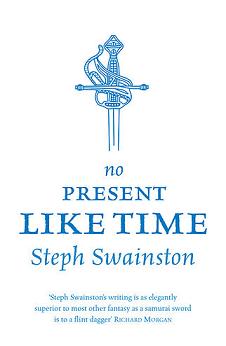
No Present Like Time — Steph Swainston

Cover of No Present Like Time


No Present Like Time
Steph Swainston
294 pages
published in 2005

I was quite taken by Steph Swainston’s debut novel, The Year of Our War, which I read from the library back in 2008. When I was looking over my bookshelves late last year to decide which books I was going to use for my Year of Reading Women project my eye fell on the omnibus edition of Swainston’s Castle series, of which The Year of Our War had been the first and I had the idea to save the second book, No Present Like Time for November as a treat. I knew I was going to like it which I wasn’t sure of with some of the other books I was going to read and I needed some incentive to keep me going.

Steph Swainston is one of the new breed of British science fiction and fantasy writers that rode to prominence under the ill fitting “New Weird” label in the first half of the noughties and one who got a lot of both commercial and critical succes. Unfortunately however she choose to stop writing to pursue her dream of becoming a chemistry teacher, which means that for the moment we’ll have to make do with the four novels she has written so far. A shame, as I quite liked both the novels of her i’ve read.

As said, No Present Like Time is the second novel in the Castle series, but this is not a proper fantasy trilogy and you can read this as a standalone; you’ll just miss a bit of context. It’s set a couple of years after the crisis of the first book, but moves into an entirely new direction. The Year of Our War had a fairly standard fantasy plot of the countries of the Fourlands being threatened by a unending horde of Insects which had already taken over the northern part of the Fourlands and which was only held in check by the powers of the immortal emperor San and his Circle of Immortal warriors only for political intrigue threatening their very existence. In No Present Like Time barely play a role, as a new, insect free island is discovered in the middle of the world ocean and the emperor sends out an expedition to persuade them to join his protection. Things quickly go wrong.

No Present Like Time starts with a duel, as one of the immortals of the Circle has been challenged by someone wanting to take his place. The Serein Gio, the greatest living swordsman has been in the Circle for hundreds of years and seen off challenge after challenge, but this time it’s different and his challenger takes his place: for the first time in centuries he starts to age. Most immortals replaced this way either slink off to die, or attempt to win back their places a year later, but Gio is a sore loser who leaves the Castle angrily to swear vengeance.

As in The Year of Our War, our hero and narrator is the emperor’s immortal messenger Jant, or “Comet”, the only winged human who can actually fly, as he’s a crossbreed of the winged Awia and the light boned and very fast mountain folk the Rhydanne — and he’s been damn careful nobody else like him is ever born. He’s also a drug addict, hooked to a drug called cat which if he takes to much of it transports him to the Shift, another world or dimension nobody else knows or believes in. He’s been clean for five years, but being ordered on the expedition to the newly discovered island of Tris, travelling for weeks over the ocean, frightens him so much he relapses.

The expedition is no success, as disastrous in its own right as in our world the Spanish discovery of the Aztecs was. Tris turns out to be an island paradise with gold common enough to be made into chamberpots and ruled democratically, with little difference in classes and a refined civilisation. The expedition having brought an insect along to demonstrate their danger, which promptly escapes and wreaks havoc. Which is the last straw for the senate and the expedition is sent home only to run straight into the rebellion set up by Gio….

Jant is who gives No Present Like Time its voice. Cynical, somewhat cowardly and inclined to mope about his love life, but on the whole with his heart in the right place, he may sound like another dozen fantasy anti heroes, but Swainston makes him believable and likeable in spite of or perhaps because of his flaws. What also helps to set the Fourlands apart is that while like in other series the technology and society is vaguely European and Medievaloid, it also has cigarettes, newspapers, t-shirts and professional football matches: it’s clearly not our Middle Ages. Swainston never tries to explain these incongruities; it’s just the way the Fourlands are and it works. In some ways her world building reminds me of China Miéville’s, only less gorey and incessantly baroque, though she comes close in the scenes set in the Shift, another element never fully explained or even understood by Jant, part hallucination but very real in its own terms.

Which is what I like about both The Year of Our War and No Present Like Time is the complexity of Swainston’s world building and effortless way it is presented to the reader. She never shows off and it always feels real, with new elements dropped in naturally. Her characters don’t know everything about their own world, may need time to understand the events they’re caught up in and most importantly, they rarely lecture the reader…

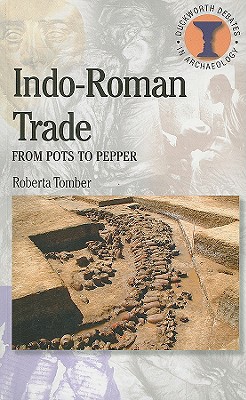
Indo-Roman Trade — Roberta Tomber

Indo-Roman Trade


Indo-Roman Trade
Roberta Tomber
216 pages including index
published in 2008

Indo-Roman Trade: From Pots to Pepper is less a history book than an overview of the state of archaeological evidence for trade between the Roman Empire and the Indian subcontinent. It’s short and very much a synopsis; I think for serious students of this subject much of the value lies in the extensive bibliography at the back. For me, it’s one of those books you take a punt on at the local library, which also leaves you wondering why it’s there, lost amongst a sea of pop history books.

I didn’t know much about Indo-Roman trade going into this book, other than vaguely knowing that the Roman Empire was aware to some extent of India as a country, if only through Alexander the Great’s campaigns there. What Roberta Tromper maked clear to me was how extensive the trade was, in both directions, with pepper from India becoming somewhat of a staple in the kitchens of well to do Romans, while Roman wine travelled the other way. It’s not just India Roman traders went to: they all along the Indian Ocean, from Ethiopia and Somalia to Sri Lanka and Arabia. This trade between at least the first century BCE and seventh century CE, though the Romans were of course not the first westerners to reach the Indian Ocean.

Roberta Tomber starts the book with a short history of Indo-Roman trade as well as the discovery of archaeological evidence for it. She opens the chapter with a quote from its first discoverer, the British colonial historian Mortimer Wheeler, who found Roman red pot shards “of the sort that any student of things classical could readily recognize” in a dusty display case in Pondicherry in southern India. Once she has given a short overview, she moves on to the textual evidence in both Roman and various historical Indian texts. These do not just included surviving books like the Periplus Maris Erythraei, a travel guide to the Red Sea and Indian Ocean, but also references in texts like Pliny the Elder’s Natural History and more mundane documents like merchants’ inventories and such. Finally, there is also graffiti, as the Tamil inscription found on a Roman pottery fragment at an Egyptian archaeological site, dramatic proof that some Indian goods moved to the Roman Empire.

From there on she moves on to the archaeological evidence itself, ranging from pottery, coins, tp traces of ancient spices like pepper. This combined evidence is then used in the next two chapters to sketch out the evolution of the Roman Red Sea, where the main ports for trade with India were located and what was going on beyond the Roman world — there are even some tantalising hints that Roman trade might have reached beyond the Indian Ocean into Indonesia and beyond. The final chapter looks to how this trade changed over the centuries.

I read this book in an afternoon, while babysitting my nephew together with my father. Sometimes it did take effort not to start dozing, but that was more due to the comfortableness of the couch I was laying on than any shortcomings of the book itself. This is the sort of book that looks dry, but isn’t; I enjoyed it quite a lot.

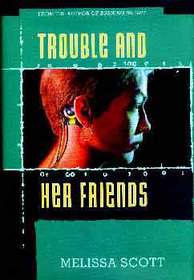
Trouble and Her Friends — Melissa Scott

Cover of Trouble and Her Friends


Trouble and Her Friends
Melissa Scott
379 pages
published in 1994

Trouble and Her Friends is the tenth book I’ve read in my Year of Reading Women project and the first and only cyberpunk novel in the bunch. It’s a book I’ve long wanted to read, having heard nothing but praise for it over the years and seeing it compared to e.g. Pat Cadigan’s cyberpunk novels. As I started reading it, there were two minor things that disappointed me: the first was the publication date, 1994, much later than I though, the second was the tendency of the covers to flake, something it has in common with other Tor books of that period. I’d always assumed Trouble and Her Friends had been published in the mid-eighties; certainly the setting is very eighties.

This matters because it means that not only is its future dated now, but it was already obsolete when it was first published. Trouble and Her Friends‘s vision of cyberspace is essentially an eighties one, where it’s important but largely unused by regular people, divided into discrete blocks owned by huge multinationals and hidden behind ICE (Intrusion Countermeasures (Electronic)) to ward off hackers, who seem to be the only people behind corporate drones to use cyberspace. It’s obviously inspired by the BBS scenes of the eighties and indeed the main hacker hangout is called the BBS. Yet 1994 was the year the internet fully broke into the public consciousness, when it should’ve become clear that it’s the openness of the internet and interaction with other people on it that are its greatest strengths, far removed from the lonely adventures of isolated hackers battling in virtual reality with faceless corporate ICE software that most cyberpunk, including Trouble and Her Friends, offers — it’s probably no coincidence that it largely died as a subgenre in the mid nineties. What saves Trouble and Her Friends from complete obsolescence can be summed up in one word: politics.

Most cyberpunk writers sort of took their politics from Neuromancer, which never was much concerned with plausible future politics (indeed, science fiction as a whole has always been a bit weak in this regard). So you got a lot of adolescent posturing of the heroic hacking underground versus the big bad megacorps out to rule the world. What Trouble and Her Friends does that few other cyberpunk novels do is to look at the internal politics of that hacking underground itself. And by doing so Melissa Scott is the only cyberpunk author that actually understood and anticipated the dynamics of online groups, of how even in groups that define themselves as outsiders there can be people who are outside the group as well, because for one reason or another they are different from the dominating members of a given group. Not a new dynamic of course, as any veteran of a socialist or anarchist splinter group can confirm. Even in progressive groups race, gender and sexuality play a role, but most cyberpunk authors assumed that in the bodiless worlds of cyberspace these things would no longer matter. Melissa Scott was clever enough to know that this is naive at best.

Her heroines — Trouble and Cerise — therefore because they are female, lesbian and use the brainworm implant disdained by the overwhelmingly male straight old programmable elite, are low on the totem pole in the semi-legal hacking scene and hence vulnerable once new US legislation outlaws hacking outright. Trouble flees and moves deeper underground, while Cerise goes legit but is still vulnerable because of her questionable past, which her immediate superior at the company she works for uses to manipulate her. Trouble herself is not safe either, hiding behind an alias that if it would come to the wrong people’s attention would not last long.

And then a new Trouble appears on the ‘net, who is not just doing all sorts of highly illegal things, but boasting about it as well. Which is enough to bring Trouble out of retirement and Cerise back to her old life to bring this newby to heel. The old gunslingers return to fight it out one more time with the cocky new bravo….

Despite Trouble and Her Friends‘s outdated even at time of publication view of what cyberspace would look like, what Melissa Scott was better in than even many respectable non-fiction authors writing about the internet at the time, in that she saw that cyberspace would not stay an unregulated jungle forever. The plot of the novel is largely driven by the introduction of harsh, bad law that made most of what Trouble and her friends did on the net illegal overnight, something a lot of Wired were convinced off would never happen in real life, despite warning signs like Operation Sundevil back in 1990.

This combination of realistic gender and sexual politics and being clueful enough to realise that yes virginia, governments can regulate cyberspace make Trouble and Her Friends worth reading. It helps that Scott can write well too, which keeps you reading though the plot is a bit thin.

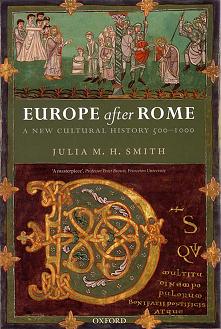
Europe after Rome — Julia M. H. Smith

Cover of Europe after Rome


Europe after Rome
Julia M. H. Smith
384 pages including index
published in 2005

To be honest I only took this book out of the library because there was little else in the way of good history books that day. Europe after Rome was a bit of a safe choice, on a subject I’d already read a lot about and if perhaps it would offer little new knowledge, I knew I would at least enjoy the refresher. I had no high hopes for this book, but sometimes gambles pay off — this was one of these cases. Because Europe after Rome is, as the subtitle makes clear, A New Cultural History of the period between 500 and 1000 CE, between the “fall” of the Roman Empire and the start of the “true” Middle Ages.

Traditionally historians have treated this period as a transitional one between this two high points of civilisation, as a story of collapse and rebound, when the seeds were laid for what would become the familiar nations of modern Europe: France, Germany, England. Europe after Rome abandons this teleological view deliberately in favour of an approach that follows three interpretative threads: the role of the Roman heritage in the formation of Early Medieval cultures/policies, the diversity of experience for these cultures — this is not a book about European culture, but about the cultures of Europe — and finally, the dynamism of these cultures, all changing a lot over this period, which Smith is careful never to imply as meaning that these were evolving towards a set goal. To help her with this approach, she takes care to look at a wide range of European experiences, both geographically by looking at a region that reaches from Spain to Scandinavia and from Italy to Hungary and by crosscutting between cultures within each chapter for her examples.

Before I go into the structure of Europe after Rome, I should point out another relatively unusual feature, the care with which Smith has made this a history of all the people who lived in the Early Middle Ages, women as well as men. It’s easy to slip into historical narratives that priviledge the male experience, if only because traditional histiography and contemporary sources both tend to this already. It takes effort to seek out and highlight female experiences as well and more so to incorperate them as naturally as Smith has done here. You almost need to have it pointed out to you to see how unusual this is.

Smith builds up her history from the bottom up, starting with the fundamentals: speaking and writing, living and dying, moving through affinies: friends and relations, men and women, to resources: labour and lordship, getting and giving and finally on to ideologies: kingship and Christianity, Rome and the peoples of Europe. The focus of Europe after Rome at first therefore lies squarely on the common people and their experiences, only slowly moving up the social scale to the kings and popes who are usually in the spotlights. Each chapter is divided into several subchapters, looking at specific aspects of the subject under discussion. So the chapter on friends and relatives looks at identity, friends by blood and honour and vengeance, while the chapter on labour and lordship in turn looks at servitude and freedom, peasants and lords and the search for status, each building logically on its predecessor.

In every aspect of Early Medieval life Smith examines, the influence of Christianity is clearly visible. What’s equally clear however is how diverse Christianity was in this period. Even apart from the differences between the “western” church of Rome and the “eastern” Byzantine church, there’s a lot of diversity in how people experienced Christianity. It quickly becomes obvious that much of what Christianity means to its followers was decided locally, often incorporating already existing traditions and rituals and sometimes based on no more than secondhand information about Christian beliefs. A far cry from the image I sort of had of an Europe ruled by Catholicism.

Though there is something of a broad chronological sweep in Europe after Rome, this is not a chronologically orientated history, so you do need to have some rough idea of what happened in the Early Middle Ages, of who the various players were, to get the most out of it. It is full of interesting little facts, asides and anecdotes, like the one about Boniface of Canossa on his way to pick up his bride, who shod his horse with silver shoes, deliberately made easy to lose so “people may know who he was”. Such a story is not just interesting in itself, it’s also a good illustration of, in this case, the important role gift giving and shows of generosity played in establishing a noble man’s power and worth.

So yeah, a good addition to all the other books about Late Antiquity/the Early Middle Ages and highly recommended to anybody. Sometimes a gamble pays out very well indeed…