The Last Valley — Martin Windrow

Cover of The Last Valley


The Last Valley
Martin Windrow
734 pages including index
published in 2004

Dien Bien Phu is the battle which as The Last Valley‘s front cover blurb succintly puts it, “doomed the French empire and led America into Vietnam”. An European army, equipped with the most modern weaponry it could field and superior in firepower was defeated by a peasant guerilla army in exactly the sort of standup fight all the experts said such a guerilla army could never win. It was proof that France could never win this war and all it could do now was withdraw with honour. At the same time Dien Bien Phu was both the proximate cause for the United States to get itself deeper involved in Vietnam as well as a terrible warning, a warning that was not heeded, that its involvement would not be succesful. Finally, for those so inclined, it was yet more proof of France’s inherent incompetence at waging war, the way its army allowed itself to be caught in a trap and destroyed. For all these reasons Dien Bien Phu is one of the few post-war battles that have stayed in the general public’s consciousness.

Which doesn’t necessarily mean that this image of the siege is accurate of course. As The Last Valley shows, Dien Bien Phu wasn’t a trap the French just blundered into, but part of a deliberate strategy to get an elusive guerilla enemey to stand down and fight. It was a strategy that had worked before and had been designed to make the most of the limited resources the French forces in Vietnam had available. Because unlike the Americans after them, the French neither had the money nor the men or material to go after the Viet Minh, so had to find some way to get them out where they could be got at. Dien Bien Phu wasn’t lost because the French were dumb or cowardly, but because the Viet Minh were smarter, had prepared better and had learned from their experiences at earlier battles.

Martin Windrow is a military historian who has been mostly working for the various Osprey series on war and warriors, contributing entries on the French Foreign Legion to the Men-at-Arms series for example. Anybody familiar with that publisher and its catalogue should therefore not be surprised that Windrow’s sympathies are firmly with the French and has written his history largely from their point of view. To be fair, this is partially forced on him, as French sources on the battle are more easily available than their Vietnamese counterparts, for a number of reasons. So while he relocates Dien Bien Phu the battle in the context of the French’s grand strategy in Vietnam, he is less able to do so for the Viet Minh, though he is careful to not present them as whollly reactive.

But the main focus remains on the French experiences in Vietnam and Windrow takes the long view in sketching the road that took them to Dien Bien Phu and to explain why this defeat was so conclusive, when it only involved a relatively small part of the French army in Vietnam. The battle itself therefore only appears more than halfway down the book, as Windrow first sets out the geopolitics of the conflict, the political background in France against which this war was fought, the composition of the French Expeditionary Force and the Viet Minh/People’s Army, as well as the development of the socalled air-ground base concept which led to Dien Bien Phu.

As Windrow gradually makes clear, while the French had far from lost their war before Dien Bien Phu, they were slowly starting to lose, having had to abandon large parts of northern Vietnam to the People’s Army already and lacking the strength to take them back. In France the war, mainly fought with professional rather than conscript soldiers, was unpopular and barely supported. Thanks to the instability of the Fourth Republic, with governments lasting on average only six months, there was no political leadership of the war, no context in which a military strategy could be developed.

Which eventually led to the development of the air-ground base concept. The idea behind the air-ground base is to develop a strong base on a strategic spot, which could be supplied by air, have its own artillery and tank support and function as a jump off point for raids against the Viet Minh, while being strong enough to not just survive a siege, but function as an anvil against which to smash the enemy. This concept was tried and tested at a base called Na San, where the Viet Minh’s commander, general Giap, first tried to fight the French on their own terms, and failed. This experience gave the French the confidence to try it on a much larger scale at Dien Bien Phu, in the Northern Vietnam highlands bordering Laos. This way they hoped to lure more of Giap’s forces to their doom and reduce pressure on Laos and the French delta heartland in Vietnam. In turn, the hope was that this would pressure the Vietnamese to be serious in their peace talks in Geneva and make peace on acceptable terms to France.

The French strategy at Dien Bien Phu worked in as far as Giap took the bait and went for it. Where it failed was in underestimating the forces Giap could put together for this. Giap had more units, more men, but above all much more artillery available at Dien Bien Phu than anybody could’ve guessed and the Viet Minh was as well or better prepared for the battle as the French were, building up their forces there at the same time as the French were building their base.

Though most of the French units and soldiers who fought at Dien Bien Phu — and French is a bit of a misnomer, as some of these units were Thai, some French Foreign Legion soldiers including German WWII vets, some from Algeria and other French African colonies– were qualitatively superior to most of the Viet Minh, the latter’s numerical superiority was telling in the end. Windrow is very good at describing the battles once he finally gets to them, switching from unit to unit as required, keeping track of what happened where and who were involved, leading the reader through the confusion of the battlefield as clearly as possible. He puts you in the thick of it and you have to be made of steel not to start feeling for the poor soldiers caught up in it…

Though there was a strategy behind Dien Bien Phu, it was one born of military necessity and a certain desperation as the overall sitution was not changing for the better from the French point of view. With its fall therefore went the last hope of the French to be able to get peace on their terms, even though objectively the strategic military situation in Vietnam wasn’t changed all that much by it. Dien Bien Phu made clear that the Viet Minh was now capable of defeating French forces in open combat, that the air-ground base concept was a failure, while the French no longer had the resources or will to come up with a new strategy. The Last Battle is excellent in explaining this, but just as good in showing the gory details of the battle itself and the heroics of the defenders of Dien Bien Phu. Remains only for someone to write the same history from the Vietnamese point of view…
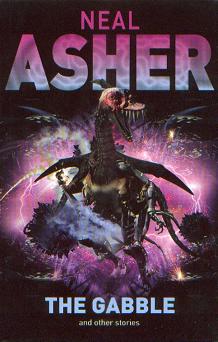
The Gabble and Other Stories — Neal Asher

Cover of The Gabble and Other Stories


The Gabble and Other Stories
Neal Asher
372 pages
published in 2008

I’m always a bit wary when I start reading a short story collection by a modern science fiction author like Neal Asher, who has made his name writing novels. It’s been decades since the short story was the dominant form of science fiction, so for most modern authors writing them is like doing finger exercises for pianists. Something you do inbetween serious projects. Which can be very unsatisfying for the reader, who sometimes just gets a slab of novel instead of a proper story, or just something slight and inconsequential with no real point to it.

With that in mind I got The Gabble and Other Stories from the library, Neal Asher’s collection of short stories set in his Polity series universe, all written between 2001-2008. Anybody familiar with that series will find more of the same here. Asher’s universe is one of violence, strange alien biotech and body horror, squelchy organics and baroque artificial intelligences, all of which are on display here as in his novels. The main difference between Asher the novel writer and Asher the short story writer is that in the latter he keeps his plots much simpler.A few do suffer from reading as extracts from novels, especially the longest story in the book, Alien Archaeology

For the dedicated Asher fan, there are a lot of cameos and shoutouts to earlier novels in these stories, which mostly went over my head I’m afraid. It was only thanks to Asher’s afterword that I realised that these were there. This was more my fault than Asher’s I fear; I’m not familiar enough with his work to have gotten those on my own.

For readers new to Asher, this collection does provide a good overview of what he’s all about. Not so much useable as an introduction, but more a crosssection of his work. You get all of his obsessions and recurring themes in one reasonable sized package. If you don’t like any of these stories, don’t even bother with his novels.

Softly Spoke the Gabbleduck (2005)
A Gabbleduck has six arms, a beak, looks like a massive fleshy pyramid and talks nonsense that almost, but not quite evokes language. Having it on the trail of your hunting party is bad news.
Putrefactors (2008)
An amoral mercenary in service of an even less moral interstellar company learns too late he’s been doublecrossed.
Garp and Geronamid (2005)
On planets where Polity law doesn’t run, things can get very nasty…
The Sea of Death (2001)
How was it possible that millions upon millions of aliens sleeping in cryosacrophagi made of ice could’ve survived the thousands or even millions of years they have been frozen?
Alien Archaeology (2007)
This really is a mini novel and as such best represents what an Asher novel reads like, only it’s slightly less complicated. Anb archeological dig on a small insignigicant planet finds an Atheter memory story, the Atheter being an extinct alien race. The guy left for dead at the dig goes after the thief to get it back.
Acephalous Dreams (2005)
A man five minutes away from execution is offered the chance to volunteer for a dangerous experiment instead, to be implanted with an alien cybernetic node and what happens. It turns out to be life of a sort.
Snow in the Desert (2002)
A hunted, immortal man on a desert world that ownes some depth to the sets of spaghetti westerns. This doesn’t quite fit in with the Polity background, but is apparantly an old story Asher reworked a few years later.
Choudapt (2008)
You want bodyhorror? This story got it in spades, as it’s about how the adaptions a particular strain of humanity uses to be able to live underwather start to break down…
Adaptogenic (2008)
A man left to die on an incredible hostile world where flood waters will drown everything very soon has to adapt or die…
The Gabble (2006)
A fun filled exploration of the incredible dangerous and lively fauna of Masada, with the gabble duck as the coup de gracie…

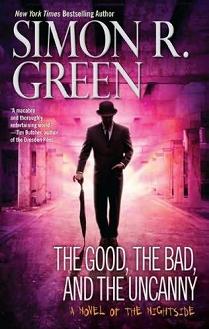
The Good, the Bad, and the Uncanny — Simon R. Green

Cover of The Good, the Bad, and the Uncanny


The Good, the Bad, and the Uncanny
Simon R. Green
275 pages
published in 2010

Simon R. Green is, in the best possible meaning of the word, a cheerful hack writer. He’s been writing professionally since the mid seventies and specialises in long series of easily digestable, fun adventure science fiction and fantasy, in commercially interesting subgenres. The Good, the Bad, and the Uncanny is a good example of this, the tenth novel in the Nightside series of urban fantasy. Which I didn’t know when I got it from the library, or I probably would’ve left it on the shelves. In the event it turned out not to matter fortunately; you needn’t have read the previous novels to understand this one, even if there are a lot of references to earlier adventures. It reminded me of when I first started to read Marvel comics way back in the eighties, trying to figure out a complex backstory that’s only hinted at.

The Nightside is the hidden part of London, where it’s always three a.m., magic is real, but so is super technology, demons and angels and nightmares cloaked in flesh roam the streets, time travel of one sort or another and all other sorts of crazy shit is commonplace. This is the world John Taylor works in, a private investigator in a pristine white suit, not quite a knight in shining armour but the closest equivalent. He’s cursed with awesome, having a magical gift that can get him out of trouble but which costs him to use it, not to mention can be a beacon to his enemies. He has powerful friends, but equally powerful enemies and the difference between the two is not always clear. The job he gets at the beginning of The Good, the Bad, and the Uncanny is simple but dangerous: escort a envoy from one side in the Elven civil war through the Nightside on his way to the court of the other side. There’s only one small problem, which is that Walker, the most powerful man in the Nightside, the one appointed by the Authorities to keep some sort of order, doesn’t want this envoy to reach his destination, as the civil war suits The Authorities fine…

But this is just the appetiser before the main action, like the teaser scene before the titles in a James Bond movie. The real story is about Walker and how he’s dying. He wants John Taylor as his successor, which John himself is wary about. Meanwhile one of his PI colleagues/rivals, Larry Oblivion, the Dead Detective (having been murdered by his former partner, then brought back as a zombie) wants John to help him find his dead brother Tommy, who bought it in a previous novel. Of course the two plot threads hang together as you’d suspect, with the fun being in how they hang together…

The Good, the Bad, and the Uncanny is high octane adventure from the very beginning, with Green making sure every scene is as badass as possible and the plot largely functions as an excuse to fit set pieces together. The end effect is a bit like watching a greatest fight scenes ever compilation video, but not unpleasant. Coming into the Nightside world in media res is a bit confusing, but much less than it could’ve been. The story is told in first person singular, with John Taylor doing most of the narration and Green is careful in letting him explain where yet another old friend/enemy first appeared. All in all this was a fun book, if not necessarily a good book. I don’t think anybody inclined to try this will mind very much though if this isn’t the literary sensation of the century.

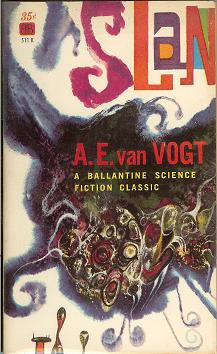
Slan — A. E. van Vogt

Cover of Slan


Slan
A. E. van Vogt
159 pages
published in 1940

“His mother’s hand felt cold, clutching his. Her fear as they walked hurriedly along the street was a quiet, swift pulsation that throbbed from her mind to his. A hundred other thoughts beat against his mind, from the crowds that swarmed by on either side, and from inside the buildings they passed. But only his mother’s thought were clear and coherent–and afraid.”

The opening sentences of Slan show why A. E. van Vogt was the most popular writer of science fiction’s Golden Age, somebody who in 1940 could not only be compared to an Asimov or Heinlein, but compared favourably. Van Vogt had honed his craft on writing “true confession” stories for the pulp market, then got into science fiction with a big bang in John Campbell’s Astounding Science Fiction with “Black Destroyer” — the story that would decades later inspire the Alien movie. For about a decade or so he was incredibly prolific, inventive and with an almost instinctive understanding of how to push his readers’ buttons, learned while writing sob stories for the romance pulps. All these qualities come together in Slan and if you want to understand van Vogt’s appeal, this is the best novel to try: short, focused and tense.

Slan is the story of Jommy Cross, a mutant, a slan, like all slans stronger and smarter than ordinary humans and equipped with two golden tendrils on his forehead which gives him the ability to read minds — but he’s only nine years old. And he and his mother are caught in the very centre of Centropolis, she sacrifising her own life to enable him to escape from the slan hunters, the secret police that shoots slans on sight, because slans are too dangerous to be allowed to life. Those slans who haven’t been murdered yet have to live in secret, hiding their abilities and their tendrils. Jommy does not know how many of them are still or if he’s the only one, but he knows that he is their last hope, that he has to survive to one day take on the might of the dictator of Earth, Kier Gray, as well as the chief of the secret police, the head slan hunter, John Petty. And then there’s the captive slan girl, Kathleen Layton, subject of a power struggle between the two men…

Kier Gray, though a dictator and hunter of slans is through the point of view of Kathleen revealed to be a noble man, fighting for a place for normal humans in a world in which the hidden superscientists of the slans are decades ahead in their research and mastery of science, locked in struggle with those like John Perry who are just out for their own power and glory. Jommy Cross meanwhile, who is the heir to much of the slan superscience, his father having been one of the most brilliant of the slan scientists, discovers that there are other slans, slans without the golden tendrils that give them telepathy, but who can shield their thoughts to him and who have been secretly manipulating humans and slans both…

There are more twists and revelations van Vogt adds in only 159 pages he has for his story; it’s a bit of an understatement to calll this a plot driven story. Characterisation is broad, making use of pulp shorthand, the prose is short, to the point but effective. What Slan really got going for itself are the ideas. It’s not the first novel about mutants — Olaf Stapledon’s Odd John was published five years earlier — but it’s the one that popularised and shaped the idea of a race of mutants superior to humanity in abilities and skills, hated and feared by normal people and having to hide their otherness. Everything The X-Men is about was first present in Slan.

And it has a huge impact on fandom in the 1940ties, with some fans taking it so seriously they set up fan houses called “slan shacks” and started trying to breed the coming race. The idea of a superior race evolving out of humanity of course fit in quite well with the general atmosphere of the times, what with all the ideas about eugenics and other much later discredited unpleasantness doing the rounds back then. The idea of directed improvement of the human stock was generally accepted and Slan spoke to science fiction readers, who more than most not just accepted but welcomed this idea. In fact, quite a few fans already suspected they themselves were to be the new super race, hence that whole “fans are slans!” idea. Sadly the truth is otherwise.

Looking back at Slan some seven decades later its appeal is much diminished, its revolutionary impact not quite understandable anymore. There have been newer and better novels about mutants and superhumans, while science fiction on the whole no longer believes in telepathy or mindreading and psionic powers and finds it all a bit embarassing even. Van Vogt himself is barely read, his reputation demolished both by his critics (e.g. Damon Knight’s devastating portrayal of van Vogt as a dwarf using a giant’s typewriter) and his own later work, rewriting and fixing up his old stories into “new” novels. His ideas, both for plot and for how to write his novels, would become increasingly outlandish while he lost his ability to focus his writing, making his work increasingly incoherent. Yet for a while he was perhaps the most popular and important sf writer in the world, and Slan his best novel.

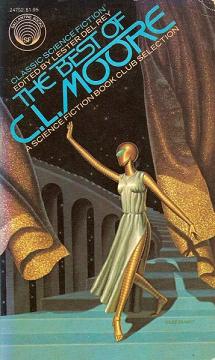
The Best of C. L. Moore — C. L. Moore

Cover of The Best of C. L. Moore


The Best of C. L. Moore
C L. Moore
372 pages
published in 1975

In the mid seventies Ballantine Books, just before it renamed itself into Del Rey, launched a “Best of” series of short story collections by classic science fiction and fantasy authors which I personally think is perhaps the best such series ever produced. Just at a time when science fiction was switching from being a short story, magazine orientated genre to one in which the novel is supreme, here were collections by all the old masters who had made their name in the pulp magazines of the thirties, forties and fifties. The series offered a sense of history to the genre just when science fiction was in danger of losing touch with its roots. It offered both a reminder to old fans of what had attracted them to the genre in the first place and to new fans a sampling of authors they may have thought oldfashioned or perhaps never had the chance to read in the first place.

One of such authors must have been C. L. Moore, who had made her reputation writing science fantasy stories for Weird Tales in the 1930ties. In the 1940ties, after she met and married Henry Kuttner she almost completely stopped writing on her own, instead collaborating with him (often under the Lewis Padgett pseudonym) on a series of classic sf stories, then moving on to writing crime stories and for television, both of which unfortunately paid better, in the late fifties. By the time The Best of C. L. Moore was published it had been the better part of two decades that she had written much new science fiction. Now that more than twice as much time has passed, this collection is still a great introduction to what C. L. Moore had to offer when not collaborating with her husband.

The story that first introduced me to C. L. Moore Vintage Season, was however originally published under both her and Kuttner’s names. I first read it in a Dutch anthology of crime and detective stories written by women, which sort of made sense as it can be read as a detective puzzle story. For years that was the extent of my C. L. Moore reading, until I read this collection. It was enough to realise how great a writer she was.

The Best of C. L. Moore is a well balanced collection, with most of the stories from before she met and married Henry Kuttner. Both of her best known heroes, Northwest Smith and Jirel of Joiry are represented but do not dominate. In general the stories here vary from outright fantasy to pure science fiction, but what they have all in common is the human touch. Her characters are fully human, three dimensional in a way that was rare for pulp science fiction. She builds her stories around the characters of her protagonists, even in the science fantasy of her Northwest Smith and Jirel stories. There are no clunkers whatsoever in here, as we’ll see.

Shambleau (1933)
This is the story that introduced both Northwest Smith and Moore herself to Weird Tales, her first published story. It’s space fantasy of the kind Leigh Brackett also wrote, with some of the cliches of that genre, but already with the same craft and power brought to all the stories here. It starts with a mixed race mob –Martians, Venusians, Earthmen — chasing a slim nutberry brown beauty in a radiant scarlet cloak down the streets of a Martian town and Northwest Smith rescuing her. But she’s shambleau and Smith does not know what this is and only finds out — almost too late.

Black Thirst (1934)
Another Northwest Smith story, about a Venusian castle where they breed beauty and its master who feast on it. Almost as good as the first story.

The Bright Illusion (1934)
A man dying of thirst in the great Saharan desert is set on a quest on a strange world by an intelligence so powerful it can only be described as a god, to meet this god’s priestess and fall in love with her, no matter her innate alienness. This should be schmaltzy as hell, but Moore’s skill as a writer make this work.

Black God’s Kiss (1934)
The first Jirel of Joiry story, a Medieval French swordwoman whose kingdom is taken over through sorcery, who manages to escape her capturer, then has to travel much farther than she could’ve ever imagined for her vengeance. As with the first Northwest Smith story this has an immediate impact: everything Jirel is, is here fully formed.

Tryst in Time (1936)
Another love story, where a man who has grown bored with everything the modern world has to offer, who has tasted all adventure and sensation that’s in it, volunteers to be the guinea pig for his genius friend’s time machine. He gradually realises that in all the historic scenes he witnesses one girl remains constant and falls in love with her — but does she know him and could they ever be together?

Greater Than Gods (1939)
On one man’s decision which of the two women he loved he wanted to marry rested the faith of the future. Hinging on this decision, Earth would become either a slowly dying, rural idyllic paradise, or it would rule the universe but at the cost of human happiness. Which alternative is better and is there truly no other option? As a story it does depend on a certain gender essentialism we’ve largely grown out of, but if you can swallow this, this is a clever, sentimental story.

Fruit of Knowledge (1940)
According to Jewish legend, before Eve Adam had another wife, Lilith, who refused to be dominated by him and therefore was cast aside. Normally I don’t like this kind of Biblical fantasy, but Moore manages to make this story interesting by making Lilith a sympathetic character without quite making either Adam or Eve into the villains of the piece.

No Woman Born (1944)
A woman, the greatest dancer of her generation, is caught in a horrible accident and given an experimental cyborg body, her brain in a metal shell. The male scientists and psychologists responsible for her transformation worry about her and whether or not she can remain human living like this. An interesting psychological story.

Daemon (1946)
A simpleminded Brazillian boy is shanghaied on a Yankee clipper as a cabin boy, but he has a secret: he can see the soul or daemon every person but he himself carries with him. It keeps him alone in a world full of people, until on a small remote island he discovers others like him…

Vintage Season (1946)
The best story in the collection, this bittersweet tale of how a group of strange foreigners hiring a house at the edge of an unnamed American city slowly are revealed to be timetravelling tourists with a penchant for the horrible and tragic. In this way Moore shows us the mirror image of how we ourselves treat historical horrors as entertainment, where whatever tragedy we’re witnessing can be dismissed as destiny, just as these tourist from the future dismiss what happens to the narrator and his city and world as something that happened long ago in their past…