Old Man’s War — John Scalzi

Cover of Old Man's War


Old Man’s War
John Scalzi
311 pages
published in 2005

John Scalzi’s debts to Heinlein in Old Man’s War are indeed obvious as he says in his afterword. Even without what looks to be a shootout to the opening scenes of Starship Troopers halfway through the novel it’s pretty obvious where Scalzi got his inspiration from. In structure, plot and protagonist Old Man’s War could fit in neatly with any of Heinlein’s coming of age stories like Space Cadet or The Tunnel in the Sky in which a young man is forced to grow up quickly to confront a hostile universe. The only difference is that John Perry is not a young man, but a seventyfive years old widower when he signs up for his stint with the Colonial Defence Forces.

Apart from that, John fulfills the same role as Rico in Starship Troopers, that of the new recruit who we’ll follow through basis training and combat, somebody who needs to be educated in the true nature of the world he lives in and who can function as a stand in for the reader. Where the two differ is that John obviously is not a callow teenager, but somebody who lived a long and fulfilling life, who saw a chance to regain his youth and took it, without knowing or caring too much about what he’s getting himself into.

Which turns out to be getting his consciousness transferred into a completely new body, adapted for combat, faster, better, stronger, tougher than a regular human body. It’s obviously also much younger than his old one and is fully functional biologically too, without any unpleasant side effects — cue the orgy as hundreds of seventyfive year olds who’ve gotten their youth back get it on. That’s all part of the leisurely introduction of the first part of the book, with things getting kicked up a notch when John and his mates finally get to proper training. Which thanks to their new bodies and especially their integrated onboard computer or “brainpal” as the CDF has named it, is massively accelerated.

Through his training and first battles with various alien species, John Perry learns how the universe really works. Habitable planets are rare in the universe and most species want the same sort of planet, which means that often they have to be fought for. The CDF is there not just to protect humanity’s existing colonies, but also to take over planets from weaker races when possible, while avoiding as much as possible the attention of stronger peoples. It’s a dog eats alien dog eat universe and CDF soldiers can’t allow themselves any illusions about the situation they’re in: their ten year hitch will likely see most of them killed. So far it’s still very much like Starship Troopers but Scalzi lacks Heinlein’s conviction that this is for the best: there are some hints that the situation in Scalzi’s universe isn’t as black and white as all that.

In the third and final part of the book John Perry gets involved into the big battle for Coral, a human colony attacked by the Rraey, one of the alien races most antagonistic to humans, if only because they like the taste of human meat… Scalzi here sets up the conditions for eventual sequels, which indeed were not long in coming, with three so far having been published. Old Man’s War however is a complete story on its own and doesn’t need them to be enjoyed.

But that will probably not stop you from reading them anyway, as Scalzi is such a fun and engaging storyteller that if you have any interest in mil-sf, you’ll want to read these stories. Old Man’s War is a familiar story well told, an updated Starship Troopers without the pseudofascist ideology of Heinlein’s original. Ideologically the idea of humanity versus an universe filled with hostile alien races who can’t be argued with but have to be shot at is still suspect of course, considering the implications of that sort of idea in actually existing history, but you never get the feeling as you do with Heinlein that Scalzi actually believes this stuff other than for the story.

Well written, entertaining, fastpaced and with some depth to it, Old Man’s War is one of the best mil-sf novels I’ve ever read.
A Civil Campaign – Lois Mc Master Bujold

Cover of A Civil Campaign


A Civil Campaign
Lois McMaster Bujold
534 pages
published in 1999

A Civil Campaign should have been the last novel in the Vorkosigan series. Starting with Brothers in Arms and continuing through Mirror Dance, Memory and Komarr Lois McMaster Bujold had constantly upped the ante for Miles, not just by giving him bigger challenges to overcome, but by forcing him to grow up and become mature, putting him in situations where his character strengths are useless or even counterproductive. A Civil Campaign is the culmination of that process, as Miles crashes hard against the realisation that his usual crisis management tactics are not suitable for trying to win the hand of the woman he fell in love with the first time he saw her. At the same time Bujold also ties up all the loose ends from the earlier novels, providing a proper ending for the series. It’s not a book for people new to the series.

In the previous book, Komarr, Miles had met Ekaterin, a duty bound Vor woman trapped in a loveless marriage, and fallen hard for her from the first moment. With Ekaterin now a widow, Miles sets out to court her, but with the best of intentions decides to do so without her knowning or telling her that this is what he’s doing. Surely the same tactics of deception that worked so well in his career as a galactic man of mystery will be good enough to win him a wife? Of course there’s also the small matter of the imperial wedding to prepare for, the return of his clone brother Mark with his Escobarian business partner and their somewhat too biological startup they’ve set up in Vorkosigan House, the blossoming relationship of Mark with Kareen, the daughter of one of Miles’ father’s — count Vorkosigan — oldest friends and various other minor complications and side issues Miless will have to deal with, but how hard can it all be?

In typical Miles style, on small deception leads to another and it all blows up in spectacularl fashion when the small and intimate dinner Miles planned for him and Ekaterin and some carefully selected guests grows out of control and everything that shouldn’t have come out in the open just yet, does. It’s then that Miles finally learns you can plan to conquer a woman’s heart like you can plan the conquest of a star system. It’s a brutally crafted, darkly funny comedic scene, excruciating in the way the best comedy can be. It makes me wince everytime I read it. For Miles, once he gets out of his funk, it’s the chance to do what he does best: damage limitation.

What makes A Civil Campaign so good are the characters, as Bujold has developed them over the course of the series. Miles, though he should know better by now, is still the same cocky little manipulator he always was going into the book, only to come acropper because of it, but is able to learn from his mistakes and grow up. Ekaterin, though angry at Miles’ deception is also able in the end to set herself over it. Most of the people involved in the various plots and subplots, the viewpoint characters, are confused to what they want and how they can get it, struggling even to get to a place where they can find out what they need to do. In the end it’s all set to rights of course, but it takes effort for everybody. And it’s only once the disastrous dinner party has happened and everybody’s dreams seem shattered that rebuilding can take place, helped by one of the greatest supporting characters in science fiction, Cordelia.

Despite the lack of galactic intrigue and worldshattering conspiracies this is the most compelling novel in the whole Vorkosigan saga and also the most entertaining and witty. You could call A Civil Campaign a regency romance in space, Bujold keeping the tone light even when Miles’ dreams are shattered. This light mood is sustained by the callbacks and references to earlier stories, making it something of a box of chocolates for a Vorkosigan fan, with something for everyone. It all helps to set off the darker parts of the plot.

Speaking of regency romance, this is more Jane Austen than Georgette Heyer, as the reality from Ekaterin’s point of view is far more serious than it is for Miles, no matter how bad he feels when he thinks he may just have chased away the love of his life. Barrayar is a primitive, conservative society and the role of women in it is not at all equal to that of men. She has to deal with the expectations of Barrayar society and her own family in addition to everything Miles has to go through and at one point she might just lose her son, Nicky, if she does the wrong thing. After Komarr it’s another example of how Bujold manages to sneak in some light feminism…

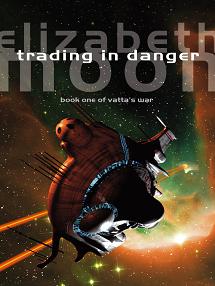
Trading in Danger — Elizabeth Moon

cover of Trading in Danger


Trading in Danger
Elizabeth Moon
506 pages
published in 2003

Reading Sheepfarmer’s Daughter gave me a taste for more Elizabeth Moon. Trading in Danger, the first book in the Vatta’s War series was what the local library had available. It’s science fiction rather than fantasy, but it’ll do. It’s still the same sort of adventure story even if the genre has changed. The other thing they have in common is familiarity, both are coming of age stories with few surprises, but sometimes familiarity is just what you want in a story.

Ky Vatta is a cadet at the naval Academy, an unusual career choice for a child of one of the great trading families. She’s an examplary cadet, but this doesn’t save her when an impulse to help a fellow cadet lands her in the shit. Expelled from the academy, she now has to face her family. Worse, because it’s a highly politicised mess she found herself in, she also has to leave Slotter Key, her home planet. Worst of all, the reputation she has in her family as a sucker for anybody with a sob story is once again confirmed, in the worst possible way. The solution to all her problems lies in an old Vatta family tradition, that sends any child wanting to join the family trade on a shakedown cruise first. She will captain the Glennys Jones, an old trading ship on its last voyage which will be sold as salvage at the end of it, as it’s too expensive to bring up to modern standards. This trading trip will take a couple of months and at the end of it Ky will be able to come home, having proven herself as a captain. As importantly, it will also get her away from her own humiliation.

Things don’t turn out to be quite that simple of course. At the first leg of her journey she runs into a trading opportunity that might just get her the money to save the ship, giving her a chance to prove herself to her family. When she explains this plan to her crew however it turns out that this is what everybody more or less expected her to do; apparantly it’s something most firstrun captains do…

So profiting from a rival firm’s failure to deliver agricultural equipment, she takes the Glennys Jones to Sabine, to buy the equipment again on spec, getting paid on delivery. It’s a bit risky, but the profit will be worth it. But when the FTL drive craps out completely when they reach Sabine and the machines they need to buy are much more expensive than Ky thought they would be, things cannot get any worse, or can they?

Course they can and Ky and the Glennys Jones find themselves in the middle of a warzone, with no way to get out of it. What’s more, the FTL communication station in the Sabine system is blown up by one of the parties in the conflict and nobody outside the system will know what happens inside. And then the ship is hailed by mercenaries, they board to inspect it and things go horribly wrong as Ky is almost killed when one young ship’s mate pulls a gun at the mercenaries.

Ky is cut from much of the same cloth as Paks in Sheepfarmer’s Daughter: young, somewhat naive, largely unaware of her own abilities, but with an iron will and potential that’s only fully realised under pressure. Like Paks, Ky’s shipmates see her worth much more clearly than she herself does; an old trick to make your main character not too concieted. She has her flaws though, a certain blind spot late in the book leaving her and her crew vulnerable to a betrayal I could see coming from a mile away. Again like Paks, Ky is also a bit more honourable than you’d expect most people to be.

As a novel, Trading in Danger feels a bit flabby. Elizabeth Moon takes her time getting the main plot going, taking well over fifty pages just to get Ky into space. The pacing in general is leisurely. There are a lot of side issues and little subplots not of direct relevance to the main plot that help up the page count; The minutia of trading life take up a large part of this. Moon also spends some time once the main enemy is defeated setting Ky up for the sequels, as well as having her deal with the aftermath of her adventure to see that her problems have not quite all disappeared. All this can be irritating to some readers. Myself I did not mind it this time, though it did annoy me sometimes. Moon has a knack for keeping me interested in the mundane, day to day details of her heroines’ lives even if they’re not directly contributing to the plot.

Trading in Danger is good, light entertainment, slightly better than it needed to be. Sometimes that’s just what you want.

Golden Witchbreed – Mary Gentle

Cover of Golden Witchbreed


Golden Witchbreed
Mary Gentle
460 pages
published in 1983

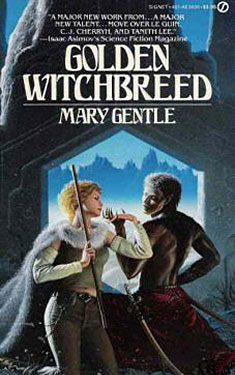
It was the beautiful Rowena cover that got my attention, a long long time ago when I was browsing the English shelves at my hometown’s library. Showing a blonde woman in jeans and fur cape, armed with a stave and linking fingers with an obviously alien six fingered man, two swords at his side. That intriqued me, it promised both adventure and romance and it got me to pick up the book and that was how I got to know Mary Gentle. I’m not sure how old I was, but I must’ve been no older than sixteen-seventeen and Golden Witchbreed was arguably the best novel of hers I could’ve started with, much more easier to get into than most of her novels would turn out to be. But though I loved it when I read it and remember it fondly, I haven’t read it since. Which was why I put it on the list for my Year of Reading Women project. I wanted to know if the book I remember was still as good as I remember.

Golden Witchbreed I remembered as a planetary romance, emphasis on romance. It starts with the cover with the two lovers holding hands. The woman on the left Lynne de Lisle Christie, envoy from Earth to the primitive, medievaloid world of Orthe, there to represent both Earth to the Ortheans and to judge Orthe on its fitness to trade and partner with. The Orthean she holds hands with therefore should be her alien lover, Falkyr. I remembered their romance as central to the plot, the circumstances in which it took place ultimately forcing Christie to go on the run and having to travel through most of the civilised lands of Orthe. Apart from that recollections were hazy.

And unfortunately, the part I did remember, though true in outline as far as it goes, was completely wrong. There was a romance between Christie and Falkyr, following the Orthean custom of becoming arykei, but it’s nowhere near as important as I thought it was. It happened relatively early in the book and at a crucial point in the plot, but that’s it. Instead Christie gets caught up in intra-Orthean politics, with the existence of otherworlders an intensely political question, with some not believing in them even when confronted with the evidence first hand, some wary of any contact with Earth, others looking for the potential in such trade. The romance is just a side issue, soon left behind; the real love story is between Christie and Orthe.

As such, on the surface at least it is a true planetary romance, eager to showcase and explore the world Mary Gentle has thought up, hitting all the highlights on the map in the back. What sets it apart from most other such explorations, both science fiction and fantasy, is the depth of the world Gentle has created. This is more than just a stage for the heroine to trek over. As such it reminded me both of Nicola Griffith’s Ammonite and C. J. Cherryh’s Foreigner. With the Cherryh it shares the confusion of alien political intrigue, with the Griffith its sense of a fully realised world in which gender is radically different from Earth norms.

On Orthe like Earth there are two genders, male and female, but Orthean children are ungendered until puberty, when they go through a crisis and emerge male or female. Gender and gender roles therefore are nowhere near as ingrained as on Earth, with a lot of female characters in roles traditionally male. Gentle makes no fuzz about this, never explicitely setting out this connection as I stated it here. As is the case with all her stories, the reader has to pay attention and figure things out for themselves. As a small example, in a throwaway scene one important male character casually mentions having been arykei with another named male character. Blink and you’ll miss it.

Next to the gender, the political systems of Orthe are what sets Gentle’s creation apart. For what seems to be a medievaloid planet, Orthean society is relatively egalitarian, though of course nowhere near democratic. There is a supreme ruler, but they are elected every several years, there is a court, but the heart of Orthean civilisation is the telestre, a combination commute, family and estate; ideally every Orthean belongs to a telestre, as does all the land, though that is held in common — when Christie in an early conversation says she’s no landowner, her Orthean friend responds with shock to the very idea of owning land. Together the telestres form the Hundred Thousand, the Southlands, Orthe’s main civilisation/country.

Then there are the Golden Witchbreed of the title, whose empire was overthrown five thousand years ago, in which collapse the telestre system evolved. Throughout there are hints that the witchbreed had a much higher level of technology than Orthe now has, making the Southlands not so much a pre-industrial as a post-collapse society. In her journeys around Orthe Christie ultimately also comes to the one place where she could learn the truth of these claims. The central scene in which these revelations are unfolded is one I’ve seen dozens of times in books, movies and comics, the only time I found Gentle to be a bit pedestrian.

Golden Witchbreed was not quite the book I remembered, but it was the better for it. I’d still argue that for people new to Mary Gentle’s writing, this is the best, most conventional novel to start with. There are already hints of her more opaque writing style in here and it’s a good way to ease into it.

Barbarian Migrations and the Roman West — Guy Halsall

Cover of Barbarian Migrations and the Roman West


Barbarian Migrations and the Roman West 376-568
Guy Halsall
591 pages including index
published in 2007

I spent the week between Christmas and New Year’s Eve with my parents in Middelburg and took advantage of this visit to check out the town’s library, which used to supply most of my reading back before I moved to Amsterdam. It turned out to be an wise decision as less than an hour browsing found half a dozen excellent history books to read, including this one. Guy Halsall is an author I had just seen slagged off by Peter Heather in his book Empires and Barbarians for being Completely Wrong about the impact of barbarian migrations on the late Roman Empire. This piqued my interest to see how exactly Halsall’s interpretation of the end of the Roman Empire differed from Heather’s views and if Halsall’s explanations make any sense on their own.

To my not inconsiderable surprise, it turned out that the story Halsall puts forward in Barbarian Migrations and the Roman West 376-568 does not differ quite so much as Heather made it seem. They don’t so much disagree on what happened as on why it happened and on where the emphasis should be placed. To keep it simple, Heather believes barbarian invasions are the cause the collapse of the Roman Empire in the west, while Halsall argues they are an effect of the collapse. It was the weakness of the western empire that made possible the barbarian takeover of various provinces. Another major point of disagreement is on the composition of the “barbarian hordes”: Heather has argued that the more classical image of entire population groups invading the empire is largely correct, with caveats, while Halsall sees them more as proper armies rather than tribes. Ultimately these differences in intepretation however for me were less important than the sheer quality of Halsall’s history.

For my money, Barbarian Migrations and the Roman West 376-568 is the best one volume history on the end of the Western Roman Empire I’ve read so far. It’s not the only book on the subject you should read, because there is so much disagreement between historians about just exactly what happened and why, but it’s an excellent start. What Halsall does well is to put his history in the context of the continuing historiographically debate taking place about the Fall of Rome and how the world of the Western Roman Empire was transformed in the transition from Late Antiquity to Early Middle Ages. In this debate we’ve long since moved on from the classical ideas about huge massess of barbarian invaders overrunning the west of course, as well as from the backlash against this that got under way in the sixties with readings of history that stressed the continuities between the late Roman world and the Early Middle Ages. Halsall stands sort of midway between these two approaches.

In Halsall’s own words, Barbarian Migrations and the Roman West 376-568 “presents the end of the Roman Empire and the barbarian migrations as a dramatic, bewildering, massively important and comparatively short-term sequence of events, whose results were all the more dramatic and bewildering for being unintended”. It wasn’t inevitable in other words, but largely caused by the actions of the rulers and important actors within the Roman Empire responding to specific, internal crisises rather than barbaric hordes hammering the gates, but these crisises did open the door for new political entities to take over parts of the empire in the end.

Like Gaul, Halsall’s book is divided in three parts. In the first part, Halsall describes the world of the (Western) Roman Empire and its neighbours. This part also serves as an introduction to the whole problem of the Fall of Rome and the role “barbarians” played in this. He also goes into detail on the thorny question of identity, not an unimportant topic in a period where the boundaries between “barbarian” and “roman” were suddenly much more fluid. Finally, this part also shows how interconnected the Roman and barbarian worlds were.

The second part depicts in detail the period of transition, from 376 CE to 550 CE and is the most traditionally chronological part of the book. So we get the Gothic wars in 376-382 in the Eastern Empire, the crisis in the west and the sack of Rome in 410, the sidelining of the western emperors and the take over of the old provinces by new political elites, which eventually evolved into separate kingdoms. Halsall shows here how much these processes were done with the support and active involvement of the local elites, rather than having been imposed on passive Roman populations by foreign conquerors.

Finally, in the third part, Halsall surveys the post-Roman world, looking at how Roman provinces transformed themselves into Frankish, Visogoth, Lombardian kingdoms, how the political and provincial elites reinvented and reorientated themselves and how much the successor kingdoms still considered themselves to be part of a Roman world. Here he also looks at what ultimately caused the failure of the Roman empire in the west, how the loss of a monopoly of political legitimacy in the end meant that people no longer bought the pretence of empire, but went on to make their own policies as rulers no longer needed the legitimacy of Rome to rule their countries.

Barbarian Migrations and the Roman West 376-568 is a tough book to digest, a book you need to read with your full attention. If you do so, it will reward you. This is a hard book to read not because Halsall makes it hard to read, but because this is a difficult subject, which he does his very best to make understandable not just for the expert, but for interested novices to the period as well.