A Point of Honor — Dorothy J. Heydt

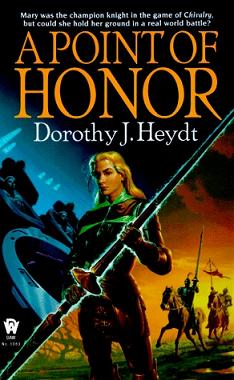
Cover of A Point of Honor


A Point of Honor
Dorothy J. Heydt
302 pages
published in 1998

A Point of Honor is the seventh book I’ve read in my Year of Reading Women challenge and the first I’ve read before. When I was setting up my reading list last year I wanted to include not just feminist sf classics or books to challenge myself, but also some old favourites that deserve a wider audience, of which this is one. I had read A Point of Honor when it was published back in 1998, after it had gotten some buzz on the old rec.arts.sf.written Usenet group, back in the day when that was still the number one science fiction hangout on the internet. The author herself was one of the group’s regulars, well respected and liked, one reason why I tried out her novel. This wasn’t the first nor the last time I did that: other writers I got to know through rec.arts.sf.written were Jo Walton, Brenda Clough and Matt Ruff, to name just three.

A Point of Honor is one of only two novels Dorothy Heydt wrote, the other being The Interior Life, a fantasy novel she wrote under the pseudonym of Katherine Blake. Apart from that she has only written short stories, some two dozen in total, the last ones a couple of years ago. None of her work is currently in print that I know off. A pity, but unfortunately an all too common fate for science fiction writers as their books for one reason or another fail to reach an audience. Which is another reason why I wanted to talk about this book, to bring some attention to an unfairly overlooked writer and do for A Point of Honor what Jo Walton did last year for The Interior Life.

Sir Mary de Courcy’s troubles all began the day she defeated the mysterious Grey Knight of the Sea in jousting and he paid off his ransom by deeding her his manor of St. Chad’s-on-Wye. First the plane from where the VR tournament had taken place is hit by a light aircraft and almost crashes as somebody had fiddled with air traffic control, then on the way home from the airport her little electric car is driven off the road by a truck and to top it all off when she finally is home her security system wakes her up to alert her to an intruder in the house… Once is happenstance, two times a coincidence, three times is enemy action, but is somebody really trying to kill Mary Craven for what her VR personality had done? And if so, why?

Sure, as Sir Mary de Courcy she is the reigning champion of the Winchester lists, one of the best players of Chivalry, good enough to make a living from it, but nobody special. She certainly hasn’t made anybody angry enough in the game to try and kill her outside surely, yet the very next day, while she’s teaching some newbies the ropes of VR and Chivalry, somebody not only puts a heart medication patch on her arm that could’ve killed her had she not noticed it immediately, but also stalks and mutilates her VR persona…

Luckily at this point she gets help, in the form of Brother Gregory, who in his mundane guise of Greg Hampton is one of the original hackers who build the world of Chivalry. Talking it through, Mary and Gregory decide that the best thing to do is for Mary to stay with Gregory in his secure flat, while the two of them go on a quest in Chivalry to her new manor of St. Chad’s-on-Wye to see if they can find something wrong. And they do of course, as it turns out the world of Chivalry is much bigger than it’s supposed to be and has some …interesting… links to other VR worlds. There is some sort of conspiracy going on in VR and Mary has stumbled right over it: the only thing for it to get her life back is to unravel it and bring it to light.

A Point of Honor was published in 1998, at a time when broadband internet was in its infancy, the web hadn’t become quite synonymous with the internet yet and porn was something you downloaded one fuzzy jpeg at a time. So it’s no wonder Heydt’s vision of what Virtual Reality would look like is a bit dated. People need surgical implants to engage with VR and data disks to keep their identities on. The way Chivalry is set up is quite different from how real life massive multiplayer games like World of Warcraft are run, much more elitair and explicitly structured on the Society for Creative Anachronism. For me at least this datedness brought on a bit of nostalgia for the nineties internet, a simpler time…

A Point of Honor is an enjoyable, light adventure science fiction story that sadly did not get the readership it deserved, despite the support of rec.arts.sf.written. There was the possibility of a sequel hinted at in the story, but this never happened. A good novel to look out for secondhand and somebody could do worse than to bring this out as an ebook.
The Hour of the Dragon – Robert E. Howard

The Hour of the Dragon


The Hour of the Dragon
Robert E. Howard
292 pages
published in 1936/1977

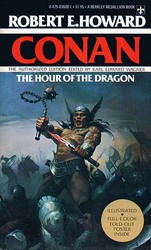
When I think of Conan I see John Buscema’s Conan: feet planted firmly on the ground, glaring at you from under his helmet, the weight of his muscular frame apparant in every picture. That’s the image I had in mind while reading The Hour of the Dragon, Robert E. Howard’s sole original Conan novel. Written in 1935 as an attempt to interest a British publisher, it was instead serialised in Weird Tales when the publisher went out of business. Recycling scenes and plot twists from earlier stories, it’s somewhat of a greatest hits story: Conan has to fight an overwhelming horde of enemies, is captured and has to escape a dungeon through his great strength, wrestle a supernatural creature and so. Buscema’s Conan naturally came to mind therefore: no other version has the sullen determination and toughness Buscema put in his Conan.

The Hour of the Dragon is set at the end of Conan’s career, after he has become king of Aquilonia. He doesn’t remain king long though as a conspiracy between neigbouring country Nemedia and Valerius, the last remaining heir of the old royalty of Aquilonia use magic to invade the country and depose him. They do this by raising an ancient evil, Xaltotun, an ancient sorcerer from the pre-Hyborian empire of Acheron. As the Nemedian army invades Aquilonia, Xaltotun nearly kills Conan and demoralises and destroys his army. Conan comes to as prisoner of Xaltotun who has … plans … for him. Valerius meanwhile has become nothing more but a pawn for the evil sorceror.

Conan escapes the dungeon with some unexpected female help and has to find the one thing that can stop Xaltotun, the gemstone that controls him. Of course this gemstone is halfway across the world, so the rest of the book has Conan getting into all sorts of dangers to get to it. Every few pages Conan escapes yet another dangerous situation only to be confronted by the next; it’s all very pulpy and the pacing is a bit odd, but it works.

The Hour of the Dragon was the first entry in Berkley’s late seventies’ reprinting of the original Conan stories, or at least those that were in the public domain, from their first magazine appearances. This was edited by Karl Edward Wagner, himself somewhat of a cult fantasy author and is presented as the first Conan series based purely on the original and untampered Howard stories. In his introduction to the series Wagner is critical of earlier series; as you probably know the old Lancer/Ace series edited by L. Sprague de Camp was heavily retouched and expanded by him to the point at which many stories are more de Camp than Howard. This series on the other hand is so faithful as to not even fix inconsistencies in spellings or what seems like obvious mistakes, like e.g. the jump from chapter 19 to 21 in this book. Of course in the end whether or not this editorial strategy is an improvement or not is a personal choice; what really matters is the story itself.

The Hour of the Dragon is not Robert E. Howard’s best Conan (my favourite would be either “The Tower of the Elephant” or “Red Nails”) but it is a good introduction of what Conan is about: pure pulp adventure, purple prose and more than a glimmer of something special.

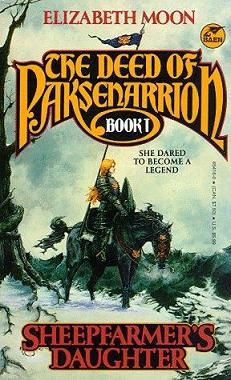
Sheepfarmer’s Daughter — Elizabeth Moon

Sheepfarmer's Daughter


Sheepfarmer’s Daughter
Elizabeth Moon
506 pages
published in 1988

Sheepfarmer’s Daughter was Elizabeth Moon’s first published novel and is now available from the Baen Free Library as a sample to get you to try her other work. I got it to have something to read in those stolen moments where it’s too much hassle to dig a paperback out of my bag, but I can get to my mobile. Sheepfarmer’s Daughter was the ideal book for this: not overtly complicated, easy to read in small chunks without missing much of the plot and engaging enough to keep reading.

I’ve only read one Elizabeth Moon novel before this one, A Sporting Chance, a science fiction adventure story that was decent enough but nothing special. From all I had read about her other novels, they seemed much the same so until now I’d never really sought out her books. But it’s hard to argue with free books and people I trust had been praising Sheepfarmer’s Daughter, so when I needed something new to read the choice was easy.

Sheepfarmer’s Daughter is the first in a trilogy called The Deed of Paksenarrion, which Elizabeth Moon allegedly wrote after she was introduced to Dungeons and Dragons by friends of her and got annoyed by the way it handled paladins, to show what real paladins were like. A paladin is “a holy knight and paragon of virtue and goodness”, as Wikipedia calls it and in D&D it’s one of the character classes you can play. What exactly Moon disagreed with I’m unclear about, but there certainly is some D&D influence visible in the fantasy world she created. The other influence on the series was Moon’s own background as an US Marine, giving her a somewhat more realistic idea of warfare than many other fantasy writers have.

Paksenarrion “Paks” Dorthansdotter is a, well, sheepfarmer’s daughter, who doesn’t want to be a sheepherd all her live and so runs away to become a mercenary soldier in duke Phelan’s Company when her father threatens to marry her to one of their neighbours. As in many other pseudomedieval fantasy worlds, soldiering is much more of an equal opportunities profession than it has been in real history and Paks is far from the only woman in her chosen outfit. Both the duke and most of the mercenaries in his Company are also far more nobler than was probably true historically, again not unusual in fantasy. The same also goes for the oh so convenient natural contraceptive herbs mentioned awkwardly in an early chapter. All these conventions are needed for Moon to tell the story she wants to tell.

Together with the other recruits Paks is taken to the company’s headquarters and turned into a soldier, which means a lot of drilling, arms instruction and exercise, much of which no doubt has been coloured by Moon’s own experiences as a marine. What I liked is that while it was clear from the prologue that Paks is destined for great things, she’s not preternatural good at soldiering, but has to be taught the basics just like anybody else. She has potential and her instructors know she’s one of the best of the new recruits, but still needs training.

But then she’s accused of assaulting an officer. Which she did, but only because she was resisting being raped. Beaten to a bloody pulp, she’s thrown unconscious in jail and it’s only when her sergeant visits her and realises that no way was it possible for her to be so battered when her supposed victim has just some bruises and scratches and something is wrong, that somebody believes her story. Things don’t get any simpler however when it turns out her assailant was himself drugged by some sort of magic potion. It’s the first overt sign that Paks is somebody special and makes clear, to the reader at least, that somebody is willing to go to a lot of trouble to get rid of her.

For Paks herself this is just an unpleasant incident and a reminder that the mercenary life has its downside as well. She emerges tougher from her ordeal, but doesn’t lose her trust in her fellow soldiers and willingness to help her comrades in arms. A new trial by fire is her first battle; this being a medievaloid world, this consists of battle phalanxes clashing with spears, followed by Roman style sword chopping, much holding of lines and such, as well as the occasional cavalry attack and rain of arrows. Again Paks does well but not spectacularly so, when she gets wounded in battle but doesn’t notice really until afterwards.

She and several other wounded are travelling back to their sponsoring city when they are attacked by mercenaries in service of the Honeycat, one of the less than nice mercenary leaders. This is again a disguised attack on Paks herself, but one that again only the readers recognise as such. This and other incidents however do convince duke Phelan to go after the Honeycat, with several other northern mercenary companies (all of the noble honourable persuasion) and southern city states joining in. This campaign dominates the second half of Sheepfarmer’s Daughter as Paks grows in her abilities and importance.

As a fantasy story sheepfarmer’s Daughter has few real surprises, which in this case didn’t matter to me. What I liked here was the execution of a familiar plot, which was much more low key and “realistic”, for lack of a better word, than many another post-Tolkien, Post-D&D fantasy novel. Moon spends a lot of time on the less glamorous aspects of soldiering: drills, ditches, latrine duty which a quick google tells me a lot of people disliked, but I actually enjoyed reading about. It makes it more realistic, as does the relative lack of spectacular magic and non-humans: there are dwarfs and elves in Paksenarrion ‘s world, but they’re only mentioned in passing here.

Moon is not as cynical as e.g. Glen Cook is in his view of the mercenary life, though not viewing it through rose tinted glasses either. While the attempted rape of Paks is shown as an aberration in duke Phelan’s company, it’s clear that other outfits are less bothered by that sort of thing. I’m not too wild about the use of (attempted) rape as a plot driver to be honest, due to its overuse as a “motivator” for both female heroes or as something for their boyfriends to avenge. It’s handled reasonably well here, but I’d rather not seen it all the same. Apart from that, this was a solid fantasy story, well told and entertaining. Nothing that you haven’t seen earlier perhaps, but there’s more to life than novelty.

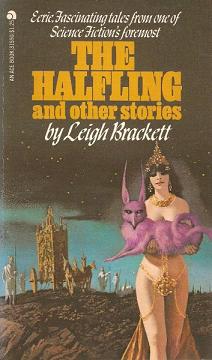
The Halfling and other Stories — Leigh Brackett

The Halfling and other Stories


The Halfling and other Stories
Leigh Brackett
351 pages
published in 1973

The Halfling and Other Stories is the sixth book I’ve read in the Year of Reading Women challenge I set myself after I’d noticed last year how few female written science fiction books I read. I had chosen this because it was something I hadn’t read before and I always liked Brackett. Unfortunately it turned out this was one of her lesser collections. The stories don’t fit well together, there’s no real theme to the collection and some are decidedly on the weak side.

It doesn’t help that the first two stories are basically the same. In both there’s the hardbitten protagonist falling for a mysterious beautiful alien girl who he knows is trouble yet can’t help himself but get involved with, who then turns out to be evil. Worse, in both stories this girl is shown to be representative of her race, their evil part of their biology. It’s a bit …uncomfortable… shall we say, but unfortunately these sort of assumptions are build into the kind of planetary romances Leigh Brackett wrote.

As a genre planetary romance has always been a bit dodgy, an evolutionary offshoot of the Africa adventure story, with a lot of the same racist and colonial assumptions build in. So you have cringing Gandymedian natives, mysterious jungles and alien drums, crazed halfbreeds and all those other tropes recycled from Tarzan. Just because the native races are now Martian or Venusian and coloured green or red instead of black or yellow doesn’t make the assumptions behind them any less racist. There’s still the idea that the various alien races encountered have existential qualities that each and every member of such a race shares. Leigh Brackett is usually better than this, with those tropes present in her stories but never this blatant as in these first two stories. Her writing style and sense of atmosphere are still present, but the execution is pedestrian, unlike the Eric John Stark story also present.

It isn’t all planetary romance in this collection. In fact most of the stories here are rather classic sf puzzle stories, something I don’t really associate with Brackett. These stories are okay, but nothing special. The same goes for the whole collection. There aren’t any bad stories in here, but apart from Enchantress of Venus, the lone Stark story, there’s nothing really outstanding here either. Something for the completists.

  • The Halfling (1943)
    A beautiful alien dancer joins John Greene’s circus. And then the murders start…
  • The Dancing Girl of Ganymede (1950)
    A Terran adventurer down on his luck rescues a strange dancing girl from her would be assassins; his native helper does not like this. Only when he meets her brothers does he realises what a mistake he made…
  • The Citadel of Lost Ages (1950)
    A twentieth century New Yorker is ressurrected in the far future, once the Earth has stopped revolving around its axis and the mutated people from the nightside reign over the Earth…
  • All the Colors of the Rainbow (1957)
    One of the better stories in the collection, this tale of two funny coloured alien visitors lost in an unreconstructed Southern town is not very subtle, but it is interesting to see a science fiction story of this vintage openly treating racism.
  • The Shadows (1952)
    A small expedition lands on a newly discovered planet and finds the ruins of the once dominant intelligent species that lived there, but who killed them? And what does their disappereance have to do with the strange shadows that start to hang around the expedition?
  • Enchantress of Venus (1949)
    An Eric John Stark story and the best in the anthology, as Stark comes to a half legendary city on the edge of the Venusian ocean in search of revenge. Leigh Brackett’ s pulpish stylings are always at their best when she’s doing a Stark story and this holds up with the best of them.
  • The Lake of the Gone Forever (1949)
    His father came back half mad from the planet Iskar, now Rand Conway is back to see the terrible secret his father left behind — and get rich exploiting it.
  • The Truants (1950)
    When Hugh Sherwin’s daugher and other children start skipping school to play with the “angels” and their “spaceship” in the forest on Sherwin’s land, he’s determined to get to the bottom of this. What he finds surprises him, though perhaps not the reader.

Bold as Love — Gwyneth Jones

Cover of Bold as Love


Bold as Love
Gwyneth Jones
403 pages
published in 2001

Bold as Love is the second book in my year of reading women sf challenge, chosen partially because Niall Harrison was also going to read it in February, for Torque Control‘s similar project. For a long time I wondered whether I had made a mistake selecting this book, picking it up and putting it down again, not getting to grips with it. Didn’t like the writing, didn’t believe the world building or plot, couldn’t care for the protagonists. Only the fact that I was reading this as part of a self imposed challenge kept me going. That, and the feeling that a novel which had won the Arthur C. Clarke Award and which was commercially succesful enough to span four sequels, must have something in it that I was missing.

Perhaps it was just that this was a novel I needed to immerse myself in fully, not read in bits and chunks here and there during the daily commute. Gwyneth Jones is not a writer who grabs you from the first sentence — at least she isn’t for me. She writes her characters from the outside in, rather coolly and hence it takes more time to get into her characters’ heads than it would with a more “warmer” writer. I had the same sort of problems with the future England Bold as Love predicted, which at first seemed dated and implausible, more sixties New Wave than early 21st century science fiction.

Bold as Love‘s future England is part of a Britain more or less peacefully dissolving itself, against a background of ecological catastrophe engulfing Europe, never really explained. There are some hints of global warming, some mentions of eco scandals — BSE, foot and mouth — that had recently happened or were happening when Jones wrote the novel, but nothing all that concrete. Despite all the chaos and dislocation this environmental stress supposedly visits on England, it barely impacts on the protagonists’ lives.

Probably it’s because our heroes are countercultural royalty, two rock princes and the princess they both love: Ax Preston, Sage Prender and Fiorinda, impossibly young, ethereal, a rockstar in her own right. All of them came together on one of the last big rock festivals to celebrate Dissolution Summer. The government meanwhile, or what remains of it while Britain dissolves, is running consultation sessions with all the heavies of the counterculturals, or at least those bothering to show up. The old system is dying and the young, ambitious men and women one or two rungs below the real power in England want to use the counterculturals to replace it, to get themselves into power. Ax certainly knows he’s being used, but he has his own plans, Sage knows but doesn’t care, while most of the other, lesser countercultural stars are just there for a laugh; Fiorinda is there but has bigger problems. But when of the lesser stars stages a coup and takes over the counter, all three are drafted to form part of his government to lead the green revolution.

Bold as Love revolves around the adventures of Ax, Sage and Fiorinda as they have to solve the problems of an England where the counterculture isn’t anymore, but in control of the country. These are huge, from more radical greens wanting to destroy everything modern to Muslim separatists in Yorkshire, but are all sorted out through the same solutions, by holding a rock festival. The power of rock and the genius of Ax, Sage and Fiorinda conquers all.

The plot’s not the heart of the book; that’s obviously the relationship between our three heroes, one that every review of Bold as Love insists is like that between Arthur, Lancelot and Guinevere, though I find that too pat. These three lovers don’t need to destroy themselves just because they’re two men loving the same woman. Gwyneth Jones instead makes this a much more mature love triangle, in the end based on mutual respect and love between the two men as well as between each of them with Fiorinda. It’s in the scenes that she concentrates on the deeping of these bonds that Jones is at her best and Bold as Love convinces the most.

At first glance Bold as Love looked like a late and out of date example of New Wave nihilism, but thinking about it when reading it I realised that instead it mirrors the anxieties of late nineties Britain, when the optimism of early New Labour had long since vanished, the country resigned to being rundown and slightly shit, but still with a bit of the glamour of Cool Britannia left, that idea that rock bands could influence politics by rubbing shoulders with the politicians. The counterculture as well aren’t sixties hippies, but the much harder nineties ecological movement, the people who’d sit out in the woods for months on end to stop the construction of another highway. Jones takes these elements and puts them in essentially a fantasy tale.

Bold as Love didn’t quite convince me as a novel, but I think that was as much me as the novel. Try it yourself.