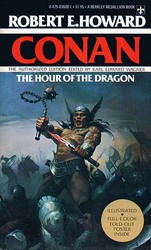
The Hour of the Dragon – Robert E. Howard

The Hour of the Dragon


The Hour of the Dragon
Robert E. Howard
292 pages
published in 1936/1977

When I think of Conan I see John Buscema’s Conan: feet planted firmly on the ground, glaring at you from under his helmet, the weight of his muscular frame apparant in every picture. That’s the image I had in mind while reading The Hour of the Dragon, Robert E. Howard’s sole original Conan novel. Written in 1935 as an attempt to interest a British publisher, it was instead serialised in Weird Tales when the publisher went out of business. Recycling scenes and plot twists from earlier stories, it’s somewhat of a greatest hits story: Conan has to fight an overwhelming horde of enemies, is captured and has to escape a dungeon through his great strength, wrestle a supernatural creature and so. Buscema’s Conan naturally came to mind therefore: no other version has the sullen determination and toughness Buscema put in his Conan.

The Hour of the Dragon is set at the end of Conan’s career, after he has become king of Aquilonia. He doesn’t remain king long though as a conspiracy between neigbouring country Nemedia and Valerius, the last remaining heir of the old royalty of Aquilonia use magic to invade the country and depose him. They do this by raising an ancient evil, Xaltotun, an ancient sorcerer from the pre-Hyborian empire of Acheron. As the Nemedian army invades Aquilonia, Xaltotun nearly kills Conan and demoralises and destroys his army. Conan comes to as prisoner of Xaltotun who has … plans … for him. Valerius meanwhile has become nothing more but a pawn for the evil sorceror.
Read more…

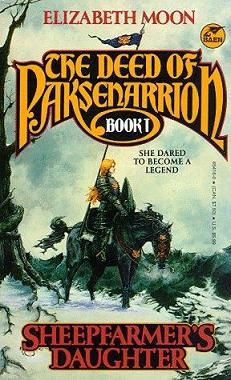
Sheepfarmer’s Daughter — Elizabeth Moon

Sheepfarmer's Daughter


Sheepfarmer’s Daughter
Elizabeth Moon
506 pages
published in 1988

Sheepfarmer’s Daughter was Elizabeth Moon’s first published novel and is now available from the Baen Free Library as a sample to get you to try her other work. I got it to have something to read in those stolen moments where it’s too much hassle to dig a paperback out of my bag, but I can get to my mobile. Sheepfarmer’s Daughter was the ideal book for this: not overtly complicated, easy to read in small chunks without missing much of the plot and engaging enough to keep reading.

I’ve only read one Elizabeth Moon novel before this one, A Sporting Chance, a science fiction adventure story that was decent enough but nothing special. From all I had read about her other novels, they seemed much the same so until now I’d never really sought out her books. But it’s hard to argue with free books and people I trust had been praising Sheepfarmer’s Daughter, so when I needed something new to read the choice was easy.

Sheepfarmer’s Daughter is the first in a trilogy called The Deed of Paksenarrion, which Elizabeth Moon allegedly wrote after she was introduced to Dungeons and Dragons by friends of her and got annoyed by the way it handled paladins, to show what real paladins were like. A paladin is “a holy knight and paragon of virtue and goodness”, as Wikipedia calls it and in D&D it’s one of the character classes you can play. What exactly Moon disagreed with I’m unclear about, but there certainly is some D&D influence visible in the fantasy world she created. The other influence on the series was Moon’s own background as an US Marine, giving her a somewhat more realistic idea of warfare than many other fantasy writers have.

Read more…

Books read July

I suppose the thing I find most tedious about Internet people is that a lot of them make a careful count of all the books they read in a year.

Nick can’t be talking about me, because I count how many books I read in a month. Ten this time. More than I thought I would manage this month, but there’s a lot of fluff on this list.

The Early Middle Ages — Rosamond McKitterick (editor)
This is intended as an introduction to and broad overview of (West) European history from 400 CE to 1000 CE, in which it succeeded reasonably well. Having some prior knowledge of this period helps though, especially if you got some grasp on the rough chronology.

The Sacred Art of Stealing — Christopher Brookmyre
Brookmyre’s slightly anarchistic thrillers are pure comfort reading.

An Imperial Possession — David Mattingly
A postcolonial history of Britain under Roman rule. What did the Romans ever do for us? Exploit our natural wealth, make our warriors into slaves and force us to grow cash crops for absentee landlords is the answer. This review at Blood & Treasure is why I bought this.

King of the Rainy Country — Nicolas Freeling
Another inspector van der Valk murder mystery, taking him far from his hometown of Amsterdam all across Europe.

Zoo City — Lauren Beukes
In Beukes’ near future/alternate South Africa (not quite clear which is the case) being a murderer can quite literally land you with a monkey on your back, or in Zinzi December’s case, a sloth. It makes her one of the new underclass, the Animalled, having to make a living exploiting the small magical talent to find anything she got along with her totem. Then she’s asked to find a lost person rather than a lost property.

Whoops! — John Lanchester
Readable if slightly out of date overview of why we were dropped in the shit when the financial crisis hit in 2007. Lanchester is the same guy who has written on this subject for the London Review of Books.

The Good, the Bad, and the Uncanny — Simon R. Green
Green is a cheerful hack writer (and probably the last to deny this) and this is a volume in his urban fantasy series. The whole experience is like reading a mediocre superhero title (Alpha Flight say) long after the talent left. Still enjoyable though.

A Point of Honor — Dorothy J. Heydt
Mary Craven is a world renowned player in the VR game of Chivalry, whose alter ego Sir Mary de Courcy is that game’s current champion of the Winchester Lists. And now she has stumbled on a real world secret hidden in the game, people are trying to kill her and she has to fight both offline and online for her very life. Dated in its technological assumptions, but something of a precursor to novels like Charlie Stross’ Halting State and Walter John Williams’ This Is Not a Game.

Trading in Danger — Elizabeth Moon
Entertaining and competently written adventure science fiction. First in a series, but enjoyable on its own.

Making a Killing — Iain McDowall
Treading some of the same ground as Ian Rankin, this is a slightly disjoint police procedural set in the fictional town of Crowby.

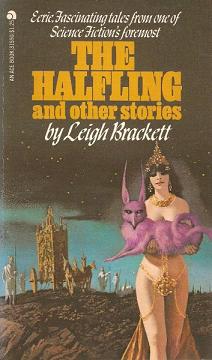
The Halfling and other Stories — Leigh Brackett

The Halfling and other Stories


The Halfling and other Stories
Leigh Brackett
351 pages
published in 1973

The Halfling and Other Stories is the sixth book I’ve read in the Year of Reading Women challenge I set myself after I’d noticed last year how few female written science fiction books I read. I had chosen this because it was something I hadn’t read before and I always liked Brackett. Unfortunately it turned out this was one of her lesser collections. The stories don’t fit well together, there’s no real theme to the collection and some are decidedly on the weak side.

It doesn’t help that the first two stories are basically the same. In both there’s the hardbitten protagonist falling for a mysterious beautiful alien girl who he knows is trouble yet can’t help himself but get involved with, who then turns out to be evil. Worse, in both stories this girl is shown to be representative of her race, their evil part of their biology. It’s a bit …uncomfortable… shall we say, but unfortunately these sort of assumptions are build into the kind of planetary romances Leigh Brackett wrote.

Read more…

Bringing back the midlist

Last week I wrote about the new Gollancz ebooks gateway which will launch “this autumn”. A week later and we’re slowly getting to see which authors will have books on this service, as they start to mention it on their blogs.

One of the authors I’m most excited about, who most unfairly has been out of prints for years, is Pat Cadigan:

It’s been busy around here but, yes, in case you haven’t heard me turning handsprings from wherever you are, Orion/Gollancz is bringing all of my work back into print. Synners is going to be in the SF Masterworks series and Mindplayers, Fools, and Tea From An Empty Cup will be published in a single omnibus volume. My collections Patterns and Dirty Work will be ebooks.

And all will be part of Orion’s SF Gateway program.

also back in print, Nicola Griffith’s first two science fiction novels:

Ammonite appeared in early 1993 (from Ballantine/Del Rey in the US and HarperCollins/Grafton in the UK). It won some awards. Slow River followed two years later (ditto). And ditto. But the books still went out of print in the UK. (That’s the UK publishing reality. It’s different in the US. Here both books here have been through a zillion printings and still sell steadily, if not spectacularly, in print and digital editions.)

So it’s wonderful to be able to announce that I’ll finally be a Gollancz author–back where I started all those years ago. Repeat Yodel of Triumph, add Nod of Satisfaction, and follow, as always, with beer.

I was already interested in seeing what Gollancz was up to ebookwise, but these two announcements make it much more likely that’ll will buy books through them. Much will still depend on price, easy of buying and the absence of intrusive DRM on the books. The price needs to be roughly in the range of what I would spend on secondhand paperbacks or it wouldn’t be worthwhile to me, though I am willing to pay a bit more for the convenience of buying online, certainly for authors like Nicola Griffith and Pat Cadigan.

As Pat Cadigan noted in her post, twenty-thirty years ago it was normal for most of science fiction’s back cataloque to be in print and easily available. In the last decades this backlist has been steadily eroded as it no longer made commercial sense to keep most authors in print. Epublishing changes this equation: once an ebook is created, selling more of them doesn’t cost more unlike with physical books, where new print runs are usually too expensive for moderately profitable books. The Gollancz intiative helps to re-establish the backlist, another good reason to support it.

(Edited to erase an incredibly stupid brainfart; see comments.)