Bold as Love — Gwyneth Jones

Cover of Bold as Love


Bold as Love
Gwyneth Jones
403 pages
published in 2001

Bold as Love is the second book in my year of reading women sf challenge, chosen partially because Niall Harrison was also going to read it in February, for Torque Control‘s similar project. For a long time I wondered whether I had made a mistake selecting this book, picking it up and putting it down again, not getting to grips with it. Didn’t like the writing, didn’t believe the world building or plot, couldn’t care for the protagonists. Only the fact that I was reading this as part of a self imposed challenge kept me going. That, and the feeling that a novel which had won the Arthur C. Clarke Award and which was commercially succesful enough to span four sequels, must have something in it that I was missing.

Perhaps it was just that this was a novel I needed to immerse myself in fully, not read in bits and chunks here and there during the daily commute. Gwyneth Jones is not a writer who grabs you from the first sentence — at least she isn’t for me. She writes her characters from the outside in, rather coolly and hence it takes more time to get into her characters’ heads than it would with a more “warmer” writer. I had the same sort of problems with the future England Bold as Love predicted, which at first seemed dated and implausible, more sixties New Wave than early 21st century science fiction.

Read more…

What should’ve been the Rule 34 cover blurb

From the humongous NotWMurdoch hacking scandal tread on Blood & Tresure comes this gem of a description of Charlie Stross’s Rule 34 courtesy of ajay:

A book of the same title has just been published – it’s by Charlie Stross and is basically ((“Ken MacLeod” – “explanations of Trotskyite splinter groups”) + (“Christopher Brookmyre” – “comedy violence”) * (“Ian Rankin” – (“jazz” + “whisky”)) + (“Cory Doctorow” – “inability to create convincing characters or dialogue)).

(Though I’d put “Rolling Stones albums” rather than jazz for Ian Rankin.)

ABC book sale loot

Pile of books I bought in the ABC sale

Above is the pile of books I bought in the ABC book sale: five euros per kilo of books, bring large bags. All of this cost me twentyfive euros, which is not bad for thirteen books. From top to bottom:

  • The Edge of Reason — Melinda Snodgrass. This looked okayish and it’s a writer I haven’t read anything from so I took a punt
  • Wyrdest Link — Pratchett and Langford: Discworld quiz book
  • Africa –John Reader. One volume history of the continent
  • The Extremes — Christopher Priest
  • The Cretan Runner — George Psychoundakis. A classic schlachtbummeler book, about the occupation of Crete in WWII
  • The Vengeance of Rome — Michael Moorcock. Last of the Colonel Pryat Quartet
  • Mythago Wood — Robert Holdstock. Read this in the library decades ago, this is the twentyfifth anniversay edition
  • A Distant Mirror — Barbara Tuchman. Replacement copy as mine had split in half
  • Beat Master’s Planet — Andre Norton. Collection of two classic novels, best known for inspiring the not that bad Marc Singer movie
  • Tiptree Award Anthology Vol. 2
  • Whoops — John Lanchester: I recognised his name from his articles about the economic crisis in the LBR; this is the book treatment of same
  • The Half-Made World — Felix Gilman. A much discussed book in sf&f circles
  • Penny Arcade vol. 2 More reprints of the webcomic

And I thought Richard Herring was the nerdy one

In a story I missed a year ago, Stewart Lee reveals he’s a packrat addicted to collecting comics, cds and books:

And all this stuff, in the digital age, is literally worthless financially, and losing any value it had daily. There’s nothing here a burglar would even bother with. I’m aware I’m a social relic from an age when you walked through the shopping centre with an unbagged album under your arm to show like-minded souls who you were, and when the book as an object was quietly fetishised. Now kids stake out their personal space with knives and guns and gadgets, and working stiffs flip falsified pages of virtual books on Kindles. I’m like a character in a dystopian science-fiction novel, holed up in a cave full of cultural artefacts, waiting for the young Jenny Agutter to arrive in a tinfoil miniskirt, fleeing a poisonous cloud on the surface, to check out my stash and ask me: “Who exactly was the Quicksilver Messenger Service? Who was this Virginia Woolf? What kind of man was Jonah Hex?”

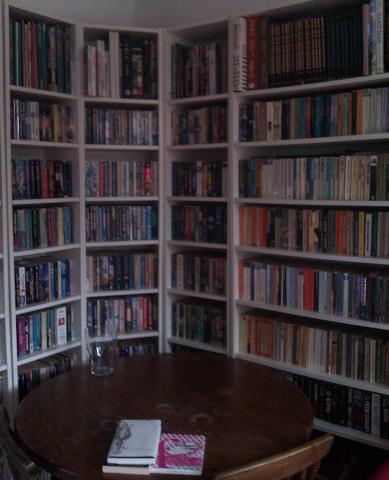
I feel his pain. Below is part of my own library; we’re sort of resigned to having to move on from our cozy two room flat in a couple of years solely because our (well, my…) collections will be too big for the limited space we have.

part of our book collection

Can *you* identify the two books on the table?

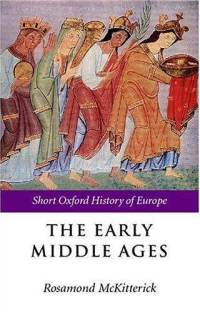
The Early Middle Ages — Rosamond McKitterick

cover of The Early Middle Ages


The Early Middle Ages
Rosamond McKitterick
308 pages including index
published in 2001

I spotted this book at the local library and got it out because it contained a contribution by Chris Wickham, whose Framing the Early Middle Ages and The Inheritance of Rome impressed me quite a lot when I read them earlier this year. The Early Middle Ages is one of the entries in The Short Oxford History of Europe and intended as an introduction to this particular period, what the editor Rosamond McKitterick called “the Boeing 767 view of early medieval Europe”, quite a different sort of book from the two Wickham books. I therefore didn’t expect to learn much news from this, but rather wanted to read it as an introduction to the other historians involved, none of whom I’d read before.

The Early Middle Ages attempts to give a broad overview of the evolution of Medieval Europe between 400 CE and 1000 CE and tries to evaluate this period on its own terms, rather than as a transition period between the Roman Empire and the “real” Middle Ages. Doing this in less than 250 pages, or some 80,000 words is a real challenge and of course means that a lot of history is elided. Ironically, if you are already familiar with the period, it helps a lot to understand some of the developments that are sketched out here, at least to put them into a chronological context. I’m not sure how much I would’ve understood of some the chapters had I come to this book as a complete novice. This feeling was the strongest in Chris Wickham’s chapter, which felt as an extract of his two books mentioned above…

Read more…