The dirty little secret of publishing

Nick Mamatas has it:

Finally, I saw some question about whether or not the original withdrawing author will be “blackballed” for being a troublemaker. The best answer to this is HAHAHAHAHAHA! The sad fact that nobody ever believes is this: there’s not a lot of competition out there. There really isn’t. It’s hard to find people who can write well, and that goes double for short stories or convincing young adult material. The field may seem competitive because of all the semi-literate baboons out there blogging about their rejections slips, but they don’t count. Remember the try-out weeks on American Idol—it’s like that. Tens of thousands try, maybe a couple hundred are good enough to make it to Hollywood Week, and in publishing there’s no need to find a single winner. Verday, whom Bookscan tells me sells fairly well, ain’t going nowhere. Certainly no book publisher cares about the placement of a story in someone else’s anthology, or any ensuing controversy. Verday almost certainly made back her lost $250 and more in terms of goodwill and linking and solidarity purchases of her books. So good for her, bad for the editor, and bad for the publisher for being snotty and defensive in its public statement.

Context available at his original post.
The Female Man — Joanna Russ

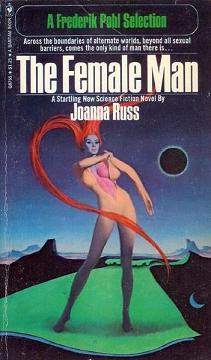
Cover of The Female Man


The Female Man
Joanna Russ
214 pages
published in 1975

The Female Man is the third book in my list of works by female sf authors I’ve set myself as a challenge to read this year. Of the books on the list it is the most explicitely feminist one, a cri de coeur of “second wave feminism”, a science fictional equivalent of The Feminine Mystique. Written in 1970 but only published five years later it was somewhat controversial, science fiction never having been the most enlightened genre in the first place. Reading it some thirtyfive years later it’s tempting to view it as just a historical artifact, its anger safely muted as “we know better now” and accept the equality of men and women matter of factly, its message spent as sexism is no longer an issue, with history having moved on from the bad old days in which The Female Man was written.

Bollocks of course, but seductive bollocks. The reality is that for all the progress made since The Female Man was published, its anger is not quite obsolete yet, or we wouldn’t have had the current debate about the lack of female science fiction writers in the first place. What’s more, The Female Man ill fits in this anodyne, whiggish view of history anyway. Russ is much more angry than that. She’s utterly scathing in her view of men in this novel, reducing them to one dimensional bit players: thick, macho assholes her much more intelligent heroines have to cope with. You might think this “hysterical”, “shrill”, “a not very appealing aggressiveness” but Russ is ahead of you and has included this criticism in her novel already, on page 141: “we would gladly have listened to her (they said) if only she had spoken like a lady. But they are liars and the truth is not in them.” Russ was too smart not to understand that no matter how non-threatening and “rational” The Female Man might have been written, (male) critics would still call it emotional and not worth engaging. But Russ uses her anger as a weapon and tempers it with humour and some of the angriest, bitterest scenes are also grimly witty.

Read more…

Books read March

Seven books read this month, one of which was a monster of a history book which took up most of the month to read.

Propaganda — Edward Bernays
There is nothing new under the sun, as this *ahem* propaganda pamphlet on the positive uses of properly directed propaganda in business and public life, first published in 1928, shows. Bernays was one of the founders of the “science” of public relations, active in helping the US government prepare the American public for the Great War and here he justifies his profession. The introduction by Mark Crispin Miller is helpful in setting out the context for Bernays’ book.

Empires of the Sea — Roger Crowley
For about sixty years the Ottoman Empire fought for mastery of the entire Mediterranean against a on again off again coalition of Christian states, from 1520 and the Siege of Rhodes to 1580 and the Battle of Lepanto where the Ottoman fleet was decisively defeated. Classic narrative history here, a good introduction to an important and interesting part of European history.

Ashes of Victory & War of Honor — David Weber
I got myself a new Android phone in late January and got the Kindle ebook app for it early in March, so I decided to download some David Weber for it as a test of whether or not reading books on a mobile actually worked for me — two novels later, I say it did.

Winterfair Gifts — Lois McMaster Bujold
Another Kindle book, a Miles Vorkosigan story I had not read yet. Set after A Civil Campaign, it’s told from the point of view of one off Miles’ armsmen as he witnesses the preparations for Miles wedding. A bit of emoporn for Vorkosigan fans.

Framing the Early Middle Ages — Chris Wickham
An excellently written and researched, very thorough socio-economic history on the transformation of the world of the Roman Empire into the world of the Middle Ages. It’s not the definitive answer to why the Roman Empire fell or why the transformation from Roman to post-Roman Europe and the Medtiterranean happened the way it did, but he does try to frame those question in such a way that you understand that this process was not predetermined, trying to avoid the teleological trap of wanting to write history in terms of its outcomes.

The Female Man — Joanna Russ
A classic feminist science fiction novel, which I read for my Year of Reading Women project. This is one of those novels every science fiction fan should at least try to read to be knowledgable about the genre. It’s also quite good.

Reading David Weber on my mobile phone

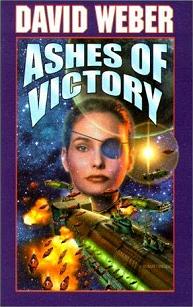
Cover of Ashes of Victory


Ashes of Victory & War of Honor
David Weber
Kindle editions
published in 2000 and 2002

Bear with me because this is relevant. This January, about a year or so after everybody else, I finally broke down and got myself a smart phone on a not too onerous subscription plan. The phone I got was a HTC Wildfire, a dear little thing with some annoyances, but nothing major and because it was an Android phone, it had a version of Amazon’s Kindle available for it. Earlier this month I got this, then was looking around for some free books to put on it. Got the usual set of the Classics from Project Gutenberg of course, but I also wanted something more modern, something light and preferably science fiction, something I could read on the tram without having to pay too much attention to it.

Enter David Weber and his Honor Harrington series. Back in the nineties I devoured those books, but even then I knew they were not by any measure good books: wish fulfillment war porn with a severe case of hero worship and occasional dodgy politics and more than occasional dodgy science. Even on a sentence and paragraph level Weber is often just not very good: awkward dialogue, oodles of infodumps just as the spacewars heat up and in general too much verbiage with stock phrases repeated over and over again. Yet for all that I kept reading. I was going to just read a bit of Ashes of Victory just to test Kindle on my phone, yet here I am having read both that and War of Honor. Weber must be doing something right.

Read more…

Absorption — John Meaney

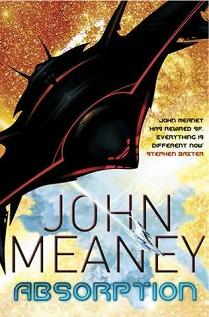
Cover of Absorption


Absorption
John Meaney
407 pages
published in 2010

Absorption is the first volume in John Meaney’s new Ragnarok trilogy. It seems to be set in the same future as most of his novels, from his first book To Hold Infinity onwards, have been set. You don’t need to have read those to understand this book, but if you have you’ll know roughly what to expect and will get certain references quicker than a new reader would. In general however it is enough to know that John Meaney is of the same generation of British writers like Richard Morgan, Alastair Reynolds and Neal Asher and writes the same sort of widescreen “hard space opera”, though a bit more cyberpunky.

But Absorption is more than just another space opera novel. You could in fact say that this is not science fiction at all, but fantasy dressed up as space opera. Because while one of the three main storylines is set in Meaney’s standard future of Mu-space pilots with jet black eyes and the computer upgraded Luculenti upperclasses of Fulgor around 2603 AD, the two other storylines are set in 777 AD and 1926 AD and both feature things that look a lot like magic… And with flashes of an even father future in which the main characters of all three storylines meet, as well as hints of magic in the main future storyline as well, who knows what’s really going on?

Read more…