(07) Phosphophyllite is a dark side Akko

A protagonist who doesn’t let their innate weakness and lack of talent stand in the way of their greatest wish, who doesn’t give up when everybody tells them their dream is foolish: Hoseki no Kuni‘s Phosphophyllite really is a lot like Little Witch Academia‘s Akko, even if they are a genderless gem person. But Phos is Akko seen through a dark mirror, with the latter’s strengths becoming liabilities in Phos’ world.
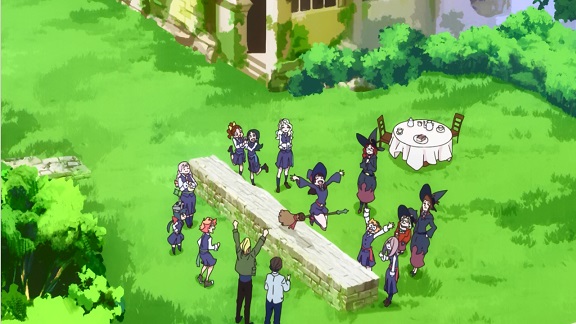
LWA: Akko flies with a little help from her friends

With Akko, the greatest criticism of her character was always that her headstrong and impulsive nature, remaining mostly unchanged throughout Little Witch Academia, should’ve gotten her in bigger problems than it did. LWA‘s world was forgiving enough that she could usually get herself out of the trouble she got herself into — if with a little help from her friends — and usually without lasting consequences. Akko’s best strength is that same headstrongness and boundless enthusiasm, keeping going through failure after failure until she reaches her goal.
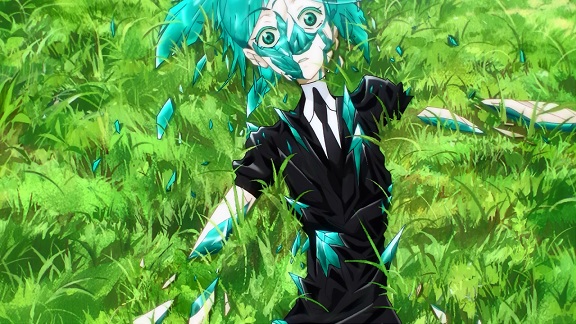
Hoseki no Kuni: the fragility of Phos

Phos shares that same impulsiveness with Akko and that same longing to become something they really aren’t suited for, but where Phos differs from Akko is that they have already mostly given up on it. Phos wants to be a warrior like her fellow gems, fighting off the Lunerians who want to kidnap the gem people to make them into jewelry or something. But as events in the very first episode make clear, they are wholly unsuitable for it, shattering just from hearing Kongo sensei’s battle cry. Phos is idle and drifting through life, with little desire to do anything if they can’t fight.
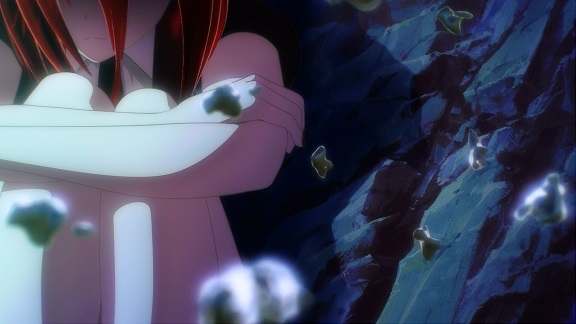
Hoseki no Kuni: the loneliness of Cinnabar

That changes when Phos meets Cinnabar, who is in a self imposed exile because their very presence can poison the other gems: any part of a gem that comes into contact with it loses its ability to transmit light and has to be chipped off. And because a gem’s memories are stored in their bodies, they loses any memories stored in those parts as well. That’s why Cinnabar patrols alone at night, but when they save Phos, the latter decides to rescue them from this exile, finding a job for them to do safely with the other gems.
Hoseki no Kuni: phos is self repairing

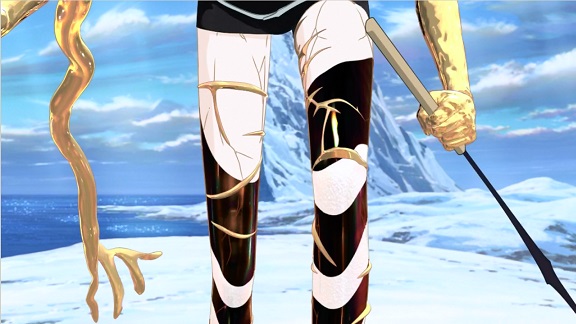
This sets Phos up on the same sort of self improvement journey that Akko goes on in Little Witch Academia, but for Phos there are much greater costs to pay. Phos gets stronger, faster legs, but at the cost of their original ones and the memories they held. Then, as they stays awake during winter with their new friend Antarcticite, Phoa loses their arms, which were too weak to hold a sword. Getting new arms takes an infusion of platinum and gold alloy, but getting them leads to Antarcticite being kidnapped by the Lunerians. As the other gems awake from their winter sleep, what they encounter is a new Phos, one with Antarcticite’s haircut and powers resembling that of Cinnabar, but without much of their memories or personality.

Incidently, the way that gold/platinum alloy fills the cracks in Phos’ original body is reminiscint of how broken pottery is repaired in Japanese Buddhist tradition. TBuddhist influences are everywhere in Hoseki no Kuni, as explained here: in this context you could argue that Phos’ attempt to grow stronger at all cost is foolhardy or even wrong as it leads to more suffering. It would’ve been better had they remained the same person they were at the start of the series, rather than live up to an unattainable ideal.

Comparing Phos to Akko, the latter never had to deal with this sort of side effects to her quest to grow stronger until very late, and even then it was active interference by the Big Bad of the series that caused it. Being Phos on the other hand is suffering, both for Phos themselves and their fellow gems. Each attempt by Phos to grow stronger leads to some loss on their part and that loss is not limited to just Phos themselves, as Antarcticite found out. Perhaps that’s the difference between a western oriented series like LWA and one with such a Buddhist influence where perhaps the desire to grow strong in itself is wrongheaded.

This is the Sixth post in this year’s twelve days of anime challenge. Tomorrow Today: how the ugliest, lowest budget series of the year turned out to be one of the best and how corporate interests fucked it over.

(08) Young Love

There’s perhaps nothing as cliched and predictable as an anime high school romance series. Whether played straight or as a comedy, it’s hard to think of any romance series as genuinely innovating. And yet, both Tsuki ga Kirei and Just Because managed to breathe new life in the genre. How?

Versimilitude.

Just look at the opening minute of Just Because, introducing its characters through a montage of small scenes of everyday life. There’s an amount of detail and care in there you rarely see even in the best slice of life anime series. Tsuki ga Kirei did something similar in its opening episode, following its protagonists through their first school day and accidental encounter at a family restaurant. Both series use their first episode to slowly build up their protagonists, through their everyday life, while laying the foundations for the romance(s) that will drive the rest of the story. It’s a slow accumulation of small details rather than the broad strokes of most romance anime, with no faithful encounters or sudden ephipanies, just a getting to notice a particular person in that way you didn’t before, or a slow re-awaking of an old love.

Both series are set in a time of transition: in Tsuki Ga Kirei the protagonists are starting their third school year in middle school, while in Just Because it’s the last semester of high school. The everyday routine of school life well established, but with the knowledge that it will soon be over and your friends and classmates will each go their own way, lending a bit of uncertainty and perhaps desperation to any new relationship. It’s a time of last chances, when perhaps you can finally gather the courage to turn a long standing crush into a relationship.

In both series there are complications, romantic rivals, but in neither does it take the familiar form of a love triangle. In Tsuki ga Kirei the best friend of the female protagonist falls for the male protagonist as well, but never has a chance and the scene in which she realises it is heart breaking. Again, it’s a realistic take on a standard romcom situation, which is also present in Jjust Because, where there’s a whole tangle of crushes and one sided loves buried under the surface.

Some people will find these series to be too slow, with too little progress in the romance, but for me this is an advantage, not a handicap. Because the series take their time to develop the romance naturally, there’s no need for the usual contrived misunderstandings or subplots. Instead you get an almost voyeuristic look into a budding relationship, where each small step forwards is reason to cheer. And even when there isn’t much progress, just spending time with these people is interesting.

This is the fifth post in this year’s twelve days of anime challenge. Tomorrow: how Phosphophyllite from Hoseki no Kuni is a lot like Akko from Little Witch Academia, only much worse.

(09) Little Witch Academia fanfic kept me sane this year

Let’s face it, 2017 wasn’t the best of years for most of us. Even if you personally did well, the state of the world, post-Trump, post-Brexit, did nobody any favours. No wonder we all need some form of escapism. For me, that wasn’t just anime, but fanfiction. Little Witch Academia fanfiction to be precise.

LWA: Diakko by Ticcy

Little Witch Academia is the perfect sort of series for fanfiction: an inventive, fully realised world where there’s still plenty of room for new stories, populated by likeable characters. What’s more, it’s an upbeat, positive series where ultimately friendship and love triumph over cynicism.

Also: Diakko.

Akko, the likeable, klutzy, emotional novice witch who doesn’t let her inexperience and lack of talent stand in the way of her quest to become the greatest witch in the world and Diana, heir to one of the oldest witches families in the world, immensely talented, graceful and composed: a natural couple if there ever was one. The series itself may have only shown Akko’s one sided rivalry with Diana morphing into a real friendship, but there are enough hints of something more between them that it’s not hard to turn it in a full fledged romance.

Both being dense when it comes to romance, there’s a lot of potential for cute little romance stories, as a cursory glance at the AO3 LWA archive shows. I especially like SilverSupa’s stories, as they get the characters and have a good sense of humour to them. Fanart wise, Ticcy is my favourite, again combining a sense of humour with a sense of romance.

Especially the last couple of weeks, as I’ve sat at home having had an glandular infection surgically removed from my right shoulder, reading LWA fanfiction has been a life saver.

This is the fourth post in this year’s twelve days of anime challenge. Tomorrow: a look at young love in Tsuki ga Kirei and Just Because.

(10) PriPara Season 2 as metaphor for that Patreon mess

I’ve been at home sick since Monday last week, just as the changes Patreon was going to make to its charges became public and while I was watching PriPara season 2 it struck me that the overall story arc that season looked remarkably similar.

PriPara: everybody is an idol, everbody is a friend

PriPara, for those who don’t know it, is an idol show aimed at younger girls that ran from 2014 until earlier this year, for three seasons and 140 total episodes. The first season was a relatively straightforward story of how Manaka Laala became an idol, formed her own group with two of her school friends and overcame the hostility of the head of school against PriPara and idols. What made it interesting is the concept of the series: “when the time is right, all girls receive a PriTicket, granting them access to the world of PriPara”, which is a sort of virtual reality but not quite, created by the Goddess Jewlie to make every girl (and the occasional boy) an idol. Later in the series you learn that PriPara has existed since at least the time of the Egyptian pharaohs.

In season 2 the old groups are broken up and new idols appear, as everybody competes for a change to take part in the PriPara Parade through a series of live concerts, with the winners of each getting the right to appear in the final to win that place in the Parade. A fairly typical idol tournament arc, which has new combinations of characters “fighting” together. Throughout Laala behaves according to her and PriPara’s motto: “everbody’s an idol, everybody’s a friend”.

PriPara: Hibiki

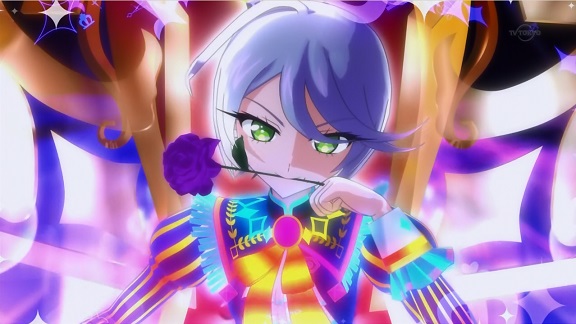
Enter Hibiki. Hibiki is diametrically opposed to Laala’s view of PriPara and is the closest the series comes to an out and out villain. A superstar in her own right, she’s introduced in episode 13 as a prince type character, a boy even; it’s only in episode 35 that she casually reveals the truth. Hibiki is a fascinating character and for more on her I refer to Andrea Ritsu’s excllent post on PriPara and Hibiki. What’s important here is that Hibiki doesn’t believe that everybody can be an idol, that everybody can be friends, but that idols should be only those with the talents for it and everybody else should be content to just watch.

Which brings me to Patreon. As you know, Bob, Patreon is a website that makes it easy to support your favourite artist or creator through monthly donations. By letting Patreon handle the billing, onerous credit card or Paypal charges are avoided, making it affordable to e.g. support a dozen creators with one or two dollar monthly contributions. This is of course also a boon for the creators themselves, as it’s of course easier to get a hundred fans to pitch in a dollar each each month than to get that one fan who’s willing to pay a hundred bucks. For smaller and part time creators Patreon has become indispensible, as it provides a steady income, lessening the pressure to find a “real” job or hunt for commercial assignments.

But then Patreon attempted to change this, by attempting to charge the patrons their transaction fees directly, rather than having them paid by the creator. So instead of a $1 donation, it would now cost you $1.38 to pledge a dollar. At first this change was justified as being necessary to cover costs, that it was too expensive for Patreon to continue doing business the old way (though this was its whole raison d’etre), but soon it turned out there was an ulterior motive. It wasn’t just costs, or Patreon wanting to gouge more money out of each transaction, but a fundamental change in its approach. Patreon had become big as a place where small and medium creators could make a living out of the donations from dozens to thousands of their fans each contributing a few bucks each month. What Patreon wanted instead was to be a place where Big Name Creators could get Superfans to drop hundreds or thousands of bucks each month. The changes therefore were a deliberate attempt to freeze out the smaller creators, though fortunately this failed and Patreon rolled them back.

PriPara: only celebs are idols

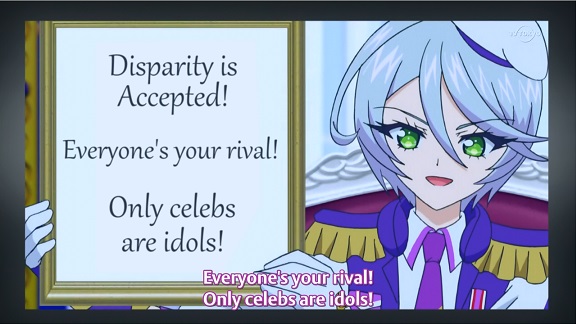
Which brings me back to Hibiki’s vision for PriPara. In episode 39 she gets control over it and changes it to CelebPara. In CelebPara only already famous idols get to perform, everybody else is supposed to be content just watching the best of the best perform. And with lesser idols no longer allowed to perform, they can no longer rank up either, but then Hibiki doesn’t believe it’s possible for small time idols to become top idols anyway. Hibiki’s vision is a sterile affair, with little of the liveliness of PriPara before it, but it is superficially attractive, being able to watch top concerts by top idols all the time and no longer having to struggle yourself as an amateur. There’s a certain glitz, a certain glamour to it. Watching it while seeing the Patreon mess unfold in real time I couldn’t help but see the similarities.

Hibiki’s vision of PriPara is one of idols and consumers, where the twain shall never meet, like how Patreon was determined to have a roster of top creators and a mass of fans donating to them, rather than the messy reality of fans and creators intermixing with little distinction. More generally, it reminded me of the ways in which fandom is often co-opted and commercialised, divided in stars and punters. Too often in anime we see fans only as consumers, the image of the otaku just mindlessly buying merchandise and character goods, with only the occassional nod to the creative side of fandom. PriPara as a series is all about fans as creators: everybody is an idol. In the end, Hibiki’s vision of CelebPara is rejected and she herself comes to see how wrong she was to want it. It’s a good vision to strive for in real life fandom, not get too excited by the possibilities of commercialising your hobbies.

This is the third post in this year’s twelve days of anime challenge. Tomorrow: how Little Witch Academia fanfiction kept me sane in 2017.

(11) Little Witch Academia is the most important anime of the year

My five year old niece watches Little Witch Academia on Netflix, which makes it the most important anime series of the year.

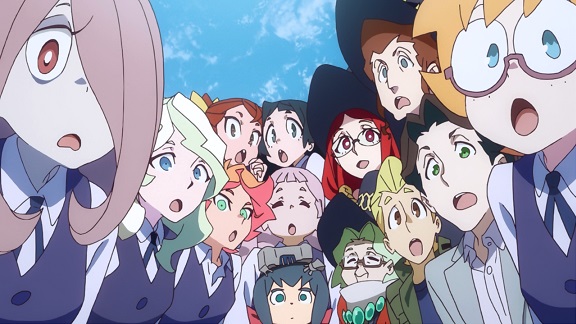
LWA: surprise

No, seriously. Not because it’s my niece of course, but rather because having a series like Little Witch Academia available for and accessible to young children like her will build a new anime audience five-ten years down the road. Netflix made that possible, by sponsoring the series in the first place but especially by making it available alongside all their other (children’s) programming and by making it all available at the same time. Because that’s how kids watch television: through Netflix or Youtube or whatever, watching whatever is available of their favourite show all at once if they get the chance, be it Thomas the Tank Engine or LWA. So while it was frustrating not to be able to watch Little Witch Academia week by week like a “normal” anime series, I don’t mind too much knowing that having it on Netflix rather than a dedicated anime streamer like Crunchyroll meant it was available to all those little kids whose parents already had Netflix anyway.

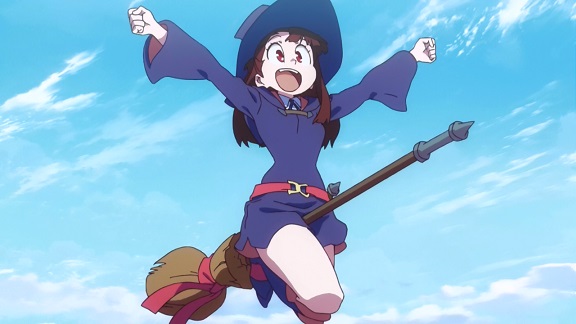
LWA: Akko flies

But that wouldn’t matter if Little Witch Academia had been just another anime series like e.g. Seven Deadly Sins, also on Netflix. Instead Trigger took pains to make it as universal as possible, free from the usual anime cliches & tropes. There’s the setting, not just that of a witches school straight out of Harry Potter, but Akko herself: the impulsive, brash, hard working underdog from a mundane family who has to watch all the other witches being so far ahead of her just for having been born in a witches’ family, without it getting her down.

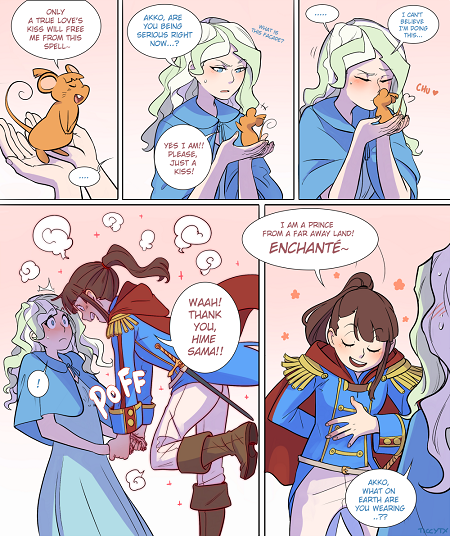
Diana kissess Akko to free her from her enchantment

There’s a bit of the Disnesy princess in Akko too, of humble non-magical origin but with a believing heart that ultimately makes her stronger than those who never had to struggle with magic. Diana too of course is a total Disney princess: aristocratic, talented, a sense of duty that sometimes crosses over into arrogance, but with her heart in the right place. As Ticcy’s wonderful cartoon shows, she’s such a Disney princess that she can free Akko from a spell with a kiss. Both Akko and Diana than are very familiar archetypes for regular viewers of Disney and its imitators.

Akko’s story is equally universal, of struggling to become the wonderful witch you always knew you were, of having a rival who seems to effortlessly accomplish what you cannot do, but who in the end has had to go through the same hard struggle as you, as you find out you have more in common than what separates you. Combine that with how it’s told, in that most episodes are standalone stories that have her getting involved in some magical problem through her impulsiveness or recklessness, but where she usually can get herself out of as well, with a little (well, a Lotte) help from her friends. That makes it so much more easy to follow the series than if it had a more tight plot, as some fans complained it should have.

Of course, ultimately it’s the sheer quality, of animation, of character and character design, of storytelling that makes Little Witch Academia so accessible and so fun. Even if they don’t realise that Little Witch Academia is anime, kids like my niece who are growing up watching it and similar series like the latest Pokemon series will remember it when they grow up and hopefully seek out other anime series then. And that’s what makes LWA so important, as it could make anime fans out of thousands of children watching it.

This is the second post in this year’s twelve days of anime challenge. Tomorrow: PriPara season 2 as a metaphor for the commercialisation of fandom.