Anime Resolutions (The New Year’s kind)

I was good yesterday. Instead of watching the first two episodes of yet another boring isekai premiering this season, or the equally boring first episode of a mobile game adaptation, I rewatched the first three episodes of 1999’s To Heart.


You don’t really get this sort of aspect to aspect mood setting scene anymore in anime, do you? Based on a Aquaplus romance simulator, To Heart is a nice little romcom centered on Hiroyuki, the guy at the end of the clip. Hiroyuki has a little bit more to him than the usual potato-Kun, even if his personality consists mostly of being helpful to any girl he meets (except for middle school friend Shiho) and wanting to sleep. But there isn’t that much romance in these first three episodes and they’re mostly told through other characters than him, mainly his childhood friend Akari, who very much has a crush on him, unlike Shiho, who sees him as her rival and a nuisance.

I first watched this years ago, in 2016 and thought it was good, but not that special. The only reason I started rewatching it was because various people I follow on Bluesky were talking about how good it was, independently from each other (for Bless it was his anime of the year, frex). Yes, I am easily influenced.

But I also did it because I wanted to get out of the habit of trying every bucket of slop that’s released in season and then continue to watch it out of habit. There is so much good good anime I still need to watch I’d really should start being more ruthless in culling the crap from my diet. Especially because there are a number of series on my backlog I really want to finish this year as I’m starting to feel guilty about them. In order:

  1. Mazinger Z (1972), 54 out of 92 episodes to go:
    The super robot show that saved anime from being crushed by the Tokusatsu craze of the early seventies. A kids’ show, but one in which in the last couple of episodes I watched we see a bus full of innocent people being murdered by the bad guys, a plane blown up and crashed and similar violence. Started out episodic in a monster of the week format but starting to deviate slightly from the format in the last few episodes. Not really made to be binge watched which is the problem.
  2. Kingyo Chuuihou! (1991), 28 out of 54 to go:
    A comedy series set in a school full of weirdos, done by the same staff who would go on to work on Sailor Moon directly afterwards. I started watching this a couple of years ago as part of a group watch but fell behind and stopped. The problem I have with it is that I like it when I’m watching an episode, but rarely find myself wanting to watch it. It is very funny but also something that I can only watch in small doses.
  3. Mobile Suit Gundam ZZ (1986), 42 out of 47 to go:
    The third series in the OG Gundam chronology, the problem I have is that it’s a) an incredible mood swing from the previous series and b) its protagonist is an even greater jackass than Kamille or Amuro ever were. I first started watching this in 2020 (!) and never got more than five episodes in, even restarting it last year didn’t work. Just never build up the momentum to get over my dislike of Judau.

There are many other series I started and need to finish, but those three are the most important ones. If I managed to finish any of them I’ll be happy.

Area 88 12 — #aComicaDay (66)

One of the very first manga series to be regularly published in the US, from the time when they were still published like any other comic.

A floppy haired pilot is climbing out of his lovingly rendered jet fighter, some sort of Mirage or Kfir.

Manga had been published in the US before, most noticeably an abridged version of Barefoot Gen, but these had been one-offs. It was only after Viz Comics was founded in 1986 that the first regular series got published. At that time Viz was little more than a middleman, getting startup capital from and licensing titles through Japanese publishing giant Shogakukan. Therefore Eclipse was taken on board as the actual publisher, who at the time had a decade worth of experience with the direct market. Area 88 was one of the four launch titles, together with Legend of Kamui, Mai the Psychic Girl and Xenon. All of these were published as regular US comic books, artwork flipped so it reads left to right.

The strategy here was the same as other companies were doing with licensing anime at roughly the same time. Two of the four titles were science fiction (Mai the Psychic Girl and Xenon), while Legend of Kamui offered samurai action of a kind American audiences were already familiar with through B-movies. Area 88 however was a bit of an outlier, an adventure story about a Japanese airline pilot who, betrayed by his friends, is forced to become a mercenary pilot in the air force of a small, fictional Middle Eastern country in the grip of a civil war.

Here in Europe the jet fighter pilot strip is a well established genre. Typically starring a handsome airforce pilot, with optional comedic sidekicks, the emphasis is on ‘realistic’ adventures against a backdrop of lovingly rendered military hardware. The venerable Buck Danny is the best known example, starring an US Airforce/Navy pilot, but there’s also Tanguy et Laverdure serving in the French airforce and Dan Cooper whose unfortunate hero serves Canada. Area 88 fits in well with these comics, Shintani Kaoru too drawing his aircraft with loving care even as his characters are more cartoony. Not that you can tell from this issue as all action takes place in the sky, with everbody wearing helmets and oxygen masks.

In American comics I don’t think there was ever a similar series published; there were stories about fighter pilots in DC’s war comics, yes, but no series about a jef fighter pilot I can remember. So it’s a bit odd that Viz would choose Area 88 as one of its launch titles. Nevertheless it was successful enough, the first two issues getting a second printing and lasting for 36 issues in total. It was only because Viz was dissatisfied with Eclipse’s handling of their titles that these were cancelled. From what I can tell all of them did well enough and Mai the Psychic Girl especially became famous enough that for years there were plans to make a Hollywood movie out of it.

Of all these early manga, this issue is the only one I ever saw and bought myself. Either I wasn’t really looking for them at the time or they never made their way down to the Netherlands. The story here is simple, just one big aerial battle between the good guy mercenaries flying Mirages or Kfirs (as their planes have the little canard) and the bad guys flying Mig-23s. There’s nothing in here that makes you root for one set of mercs over the other, but the battle is well drawn and the planes look like their real life counterparts. What I liked is that this had a three page article on shoujo manga (or ‘women’s comics’ as it’s called here) by Heidi MacDonald which namechecks Urusai Yatsura and Rose of Versailles, among others.

Love and Language Barriers — Okitsura — first Impressions

I feel sorry for the unfortunate subtitler on this series:

Half the screen is covered in subtitles but there's a blonde haired girl standing next to a black haired boy with a smaller, brown skinned girl next to him

Teruaki moved from Tokyo to Okinawa and has become besotted with his class mate Kyan, but there’s one problem. She speaks Uchinaaguchi, the indigenous language of Okinawa which almost entirely but not quite unlike standard Japanese. Luckily there’s his other classmate Hina who does understand her and translates for him. Which she doesn’t do out of the kindness of her heart but because she fancies him. Teruaki loves Kyan, Hina loves Teruaki and Kyan is just an adorable gremlin who seems to be rooting for her friend. An incomplete love triangle romcom that’s also about selling Okinawan culture to its audience.

But how do you represent one character speaking in basically another language on screen? Clearly thinking it was not enough to just have Kyan speak Uchinaaguchi, the Japanese production added subtitles for her as well. And at times these subtitles show both the original Uchinaaguchi as the Japanese translation, both of which the English translator also shows, the Uchinaaguchi done in romanji. Which means there are four different subtitles covering the screen. Not sure why the original subs couldn’t have been removed beforehand, but maybe they were hardsubbed into the master file? It makes watching this a lot more difficult than it could’ve been.

Apart from the subtitle issues this is a fairly unremarkable mix of romcom and tourist information; charming enough to continue watching though the gimmick started wearing thin already by the end of this first episode. The various explorations of Okinawan culture and behaviour also felt slightly patronising? Very much as made by outsiders to the island, enthusiastic and well intentioned perhaps, but not maybe that familiar with the culture to show more than the surface details of it. Having Teruaki, an outsider himself, as the main viewpoint character reinforces this. A series like this does probably need a character like this, as clueless as the audience presumably is about Okinawa, to have its culture explained to. Nevertheless currently the series treats Okinawan culture like a Slice of Moe show would treat a hobby like fly fishing and that grates.

You probably cannot expect a light and fluffy romcom like Okitsura to go into the colonial relationship between Japan and Okinawa, and the reasons why a young girl speaking Uchinaaguchi is extremely unlikely, but it does colour my perception of the show. Japan, not unlike the Netherlands, has a very rose tinted view of its own colonial past, to the point where it’s hard to recognise Okinawa (or Hokkaido for that matter) was once its own country. Even a ‘harmless’ comedy like this will be coloured by this. Personally, I can ignore this in favour of just enjoying the show, but I fully understand why somebody like Cy Catwell cannot:

It’s a shame that this is where I’m landing because I don’t think this is necessarily bad, but I think it’s uncomfortable. I think my lived experience in Japan and my lived experience as a second class citizen in my own home country have left me at odds with being able to igonre the potential for issues when it comes to colonizer student and colonized classmates. Maybe things will stay the course and the crush Teruaki has will fade into the background in lieu of more linguistics and exploration of his time in Okinawa. I have a sinking feeling it won’t, which is why I’ll be saying guburii sabira to my time with this show.

Leather & Lace 01 — #aComicaDay (65)

When you are that proud of the plot of your porn comic, everybody should read it, so you bring out a general audience version.

A blonde girl in torn negligee, her nipples prominently displayed is clining to a Japanese looking girl in a tight bodysuit, with equally protruding nipples, holding a sword (the girl, not the nipples)

Staying within the proud tradition of Malibu and its zillions confusing imprints and related comics companies, this is Aircel’s first issue of the “general audiences” version of Leather & Lace. The man responsible for it is Barry Blair, who wrote and drew roughly a zillion different series for Aircel and related companies, most on the same level as this one/ Leather & Lace would run for a whopping 25 issues, the first eight of which got a “general audiences” release with the porn excised. Presumably they stopped doing them because everybody who’d want to buy the series would rather get the porn version. Even this “clean” version is dodgy enough with its nippleage that you probably don’t want your kids to read it.

To start with the obvious: the porn scenes are not worth the additional $0.55 it would’ve cost to buy the adults only version. The blonde on the cover is assaulted and double teamed by twin twinks in lizard bodysuits for a bit of oral, the other girl is also attacked by a bloke who is very grateful when she’s starts beating him up and finally, the villain of the piece gets a blowjob in his office from one of his floozies. That’s it. The “clean” version mostly just skips these scenes, although that second one is replaced by a page of the ninja looking girl crawling through ventilation vents instead. Very heterosexual even if the cover does hint at a bit of sexual attraction between the two leads.

The plot is simple. Pamela, the blonde, is visiting a certain night club to find her sister, who disappeared from there some time ago. Chris meanwhile, together with her twink partner Billy, is just aiming to rob the place. The two meet just in time for Chris to save Pamela from being drugged and disappeared like her sister was and escape the club together. The story ends with the club’s owner and villain swearing that he will get “these two bimbos” while Pamela and Chris relax, both in their undies, at Chris’ hideout, thinking about how to bring him down. Very eighties B-movie territory.

I got this in the random back issue boxes of my local comic shop because it looked interesting, mostly for the reasons you think it would. Blair’s storytelling and artwork is decent enough that reading this isn’t a chore. Barry Blair was an interesting fellow, who sadly died in 2010. Aircel actually started out as his own company before Malibu acquired it. It had actually started as an insulation company (!) owned by a friend of his. Blair had already been self publishing Elflord and other comics before he started Aircel, for which he was so prolific at one point every title they published was written & drawn by him. Most of these had similar levels of sex and violence as Leather & Lace had. Very much pulp entertainment, with his best remembered work probably being Gun Fury, a Punisher parody that got some critical attention at the time. This issue however is the only work of his I ever saw myself.

Protectors 05 — #aComicaDay (64)

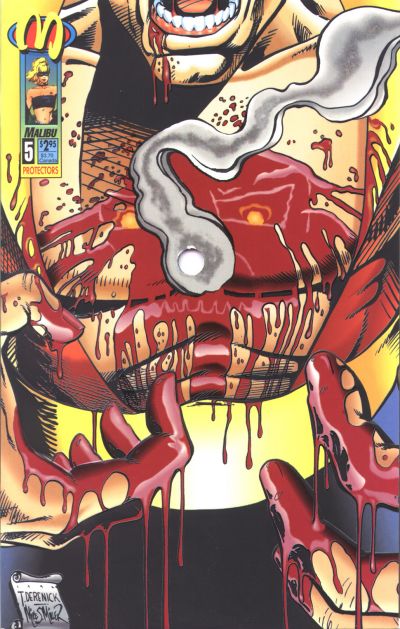
This book has a hole in it I-it’s not mint! Dear god in heaven it’s not mint! People, I give you the dumbest ever cover gimmick, courtesy of the good folk at Malibu.

A bloody bare chest takes up most of the cover, with two bloody hands held in front of it and the character's mouth wide open, only his bottom teeth visible. Int he center of the cover is a literal round hole

This stupid stunt only makes sense in the context of when it came out. By the early nineties, comics had been overrun by speculators, idiots who bought them as investments. These had already crashed the market once before in the 1987 black and white bust, when everybody looking to be the next Teenage Mutant Ninja Turtle launched their own much crappier version, speculators bought them until even they realised they were worthless and dozens of comic shops went bankrupt, left with thousands of unsellable comics. By 1992 though this was long forgotten as more and more people started treating comics this way, thanks in no small part to price guide magazines like Wizard judging comics only by how ‘hot’ they were.

And what makes a comic hot? Not so much a good story or great artwork, but whether it had the flavour of the month artist on it, or guest starred a particular character, or was important in some way other than in being an enjoyable read. Books like the Turtles had become hot through years of hard slog and word of mouth sales, but that’s difficult. Far easier to just slap a gimmicky cover on your comic instead. People loved that shit in the nineties. Gatefold covers, chromium covers, gold or silver foil covers, covers you can rub the blood on, anything that made a cover special in any way was like catnip to collectors. Most of those were harmless fun, but one or two, like DC’s Eclipso: the Darkness Within #01 had gimmicks that could do actual damage; in this particular case because it had a fake plastic gem glued to the cover which is not good for whichever comic is put in front of it. Protectors #05 went a step further: it actually damaged the book it was covering. The hole after all went through the entire issue.

If this sounds like a parody of what somebody wanting to spoof the special cover craze, that’s because it is. Malibu stole the gimmick from a small press title, Jab, whose third issue had its entire run shot through with various calibres of guns, to create several variant covers! That comic had been actually designed for it, but here Malibu had just punched a hole without any thought on how to incorporate it in the actual story and page composition. It’s very clearly something that was done afterwards, inspired by or stolen from that Jab issue.

I remember seeing the ad for the original Jab issue in Advance Comics, a few months before Protectors 05 came out. Even in there it was very much presented as a joke, so I was flabbergasted when Malibu did it for real. Just unbelievably crass and stupid all round.

The actual comic? Ehhhh. Protectors was a superhero series created out of old Golden Age characters from the long defunct Centaur Comics, written and created by R. A. Jones, with Thomas Derenick, who also did the cover as inked by Mike S. Miller. This issue featured the death of Nightmask, whose chest the hole was punched through on the cover. On the whole, one of those series that looked better in the Comics Scene interview I read about it then in the actual series. Even so, it really didn’t deserve this cover.