So last month Julie Burchill got to write a hate filled column about trans people in The Guardian; this morning she got to have a nice old chinwag with Kirsty Young on Desert Island Discs. Seems wrong somewhat, doesn’t it? The BBC wouldn’t let a Nick Griffin on the programme, so why give somebody who is clearly bigoted against trans people a pass?
To be fair, Burchill isn’t that similar to Nick Griffin, a better comparison would be Christopher Hitchens: a self identified leftist who always was a bit of a bully and who made a sharp rightwing turn once being leftist fell out of fashion. Like him, she’s has always moved in media circles –“queen of the Groucho Club” and such nonsense– and I have the suspicion that this cuts her a lot of slack outsiders, like Griffin, don’t get. It’s annoying as fuck to see those smallminded fools get media attention because of who they know and took coke with twenty years ago when so many much more interesting people are ignored.
So we start the sixth year of doing these monthly Wot I Done Read Last Month reports. Back in 2008 I started doing them to at least record something about the books I’d read, as I felt guilty about falling behind with my booklog; something which hasn’t been solved yet. Oh well.
In the meantime, I’ve read five books this month, somewhat below par.
Soul Music, Interesting Times — Terry Pratchett
Two Pratchett novels, of which the latter shows the return of Rincewind and the former stars Susan the first time. Decent but not the best of the Discworld series.
Exit Music — Ian Rankin
The last Rebus novel, as he’s finally retiring. Some loose ends are cleaned up, some aren’t. Even more melancholy and sombre than usual.
The Dark Reign of Gothic Rock — Dave Thompson
A decent chronological history of a sometimes deservedly, much maligned genre, that is smart enough to limit itself to a specific period and grouping of bands, the original English gothic bands like Bauhaus, the Cure and the Cult.
Maskerade — Terry Pratchett
Another Discworld novel, starring the Lancre witches. Doing opera this time.
So this weekend was spent in the beautiful old town of Gent, with a couple of friends, as we went to pick up a supply of what’s supposedly the best beer in the world: Westvleteren 12. The results you can see above.
For those who are not beer geeks, Westvleteren is a socalled Trappist beer: beer brewed by Trappist monks within the monastry itself to pay for the upkeep of the monastry, with any remaining profit going to charitable works. What makes Westvleteren unique amongst the eight existing Trappist breweries is that it’s only sold at the abbey itself and brewed in limited quantities. To get it, you first need to make an appointment a couple of weeks in advance, then show up by car to pick up your two crates of 24 bottles. You can’t choose the beer they’re selling and you have to wait at least two months before you can buy them again.
All of which has imparted a certain mystique to the beer, as most beer geeks, especially those outside Europe, will have had little to no chance to drink it. Personally I quite like both the 12 and the 8 as I sampled them this weekend, sitting in the restaurant across the monastry, but I’m not sure how much its reputation reflects its own intrinsic qualities and how much it has to do with its rarity.
But getting it was a good excuse for a trip to a beautiful city and spent a couple of days boozing in its bars with friends who appreciate good beer. Not to mention that it also gave me the opportunity to visit an old friend for the first time and admire his beautiful, well kept house and perfect family…
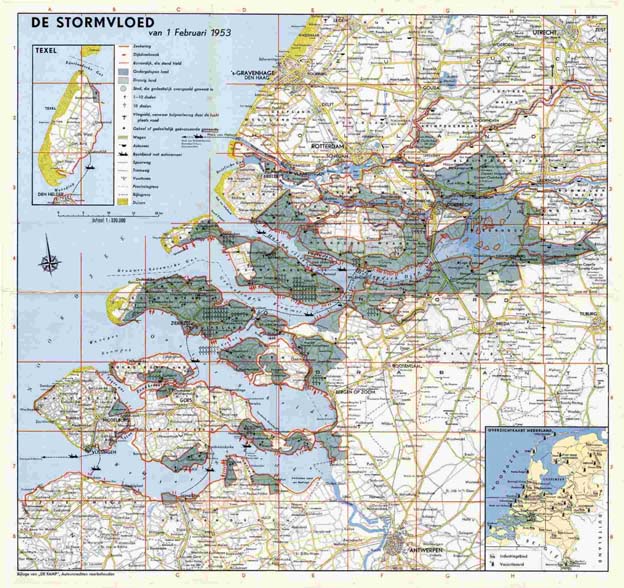
This is a comparison I wouldn’t have reached on my own, but it is true. For those who went through the Watersnoodramp it was the biggest shock of their lives, perhaps an even bigger shock than living through World War II had been. That disaster after all was manmade, with convenient villains and which could be easily remade into a self flattering narrative of a plucky little country standing up to the might of the efficient, ruthless nazi hordes. But to be overwhelmed by nature, by the old enemy, the sea, the enemy we were supposed to have tamed and bound our will, suddenly showing just how fragile our defences really were: that shocked us to the core, that hit us in the national psyche.
And like 9/11, while the disaster seemed to come out of the blue, the reality was that it had been predicted long before it happened. The southwest of the netherlands is a delta, where two huge rivers, the Rhine and the Schelde, come together and flow into the sea. Much of the land within the delta, in the provinces of Zuid-Holland, Noord-Brabant and Zeeland is artificial, won from the sea through centuries of patient dyke building and inpoldering; land reclamation. It lies therefore mostly below the normal water level already, only kept from flooding through the dykes. And because of the long coast line and the high costs of dyke strengthening, many of those dykes were strong enough to withstand normal flooding conditions, but not strong enough to withstand the extra strong surge of water that resulted from a combination of springtide and an unusually heavy storm on the North Sea.
To continue the comparison with 9/11, the response to the disaster was similar as well. Suddnely there was money and political will to implement the safety measures experts had been advocating for decades. But where after 9/11 this led to the TSA and the need to take your shoes off before boarding a plane, in Holland we go the Delta Works. Instead of merely repairing and strengthening the existing water defence works, instead the decision was made to radically alter and shorten the Dutch coastline, by closing up all those estuary mouths and inlets, except those that led to the ports of Rotterdam and Antwerp, of course.
But while we started off energetically to dam all the things, greater environmental awareness led to huge campaigns from the seventies onwards to stop the damming of the last remaining estuary, the Oosterschelde. Instead we got the stormfloodkering: a dam that’s normally open, but can close during springtides or at other dangerous times. This keeps the Oosterschelde at roughly the same salt level as it was at before the dam, keeps the normal tides coming in and out, hence keeping the ecosystem that was there before the dam alive. It was vastly more expensive than a simple dam would’ve been, but it’s the perfect compromise between safety and nature and has created the eight wonder of the world.