Come on down to the Mothership

The Atlantic discovers Black musicians can be geeky too:

But what such cutesy nicknames obscure is that R&B music—and black American culture more widely—has embraced fantasy, sci-fi, or other “nerdy” subcultural tropes more often than many people realize. From the space-travel fantasias of Sun Ra and George Clinton in the ’70s to the Wu-Tang Clan’s Shaolin kung-fu obsession in the ’90s to the present day—when 2012’s most widely acclaimed album, R&B singer Frank Ocean’s Channel Orange, includes a nine-minute odyssey imagining the ancient Egyptian empire reincarnated on the Las Vegas Strip— black musicians have drawn from the same wellsprings of imagination and popular culture as everyone else.

Well, yeah. Moreover, Black musicians have not just drawn on those wellsprings, they’ve replenished them as well. People like George Clinton or Sun Ra were not just influenced by fantasy or science fiction, they also composed their own epics. Clinton especially with his parliamentfunkadelicgroovethang was just as creative in developing their own cosmology as Jack Kirby was in developing his Fourth World. It’s just that these contributions often go unrecognised. Black geekdom, Black interest in science fiction and fantasy is still strange, still dangerous.

Growing up in a human made landscape

It takes somebody who’s strange to your part of the world to truly see what makes it special. Here’s Abi Sutherland on what makes Noord Holland’s polder landscape so different from everything else she’s used to:

The more I go out into the polder, the more I see how that narrow, dark line is the focus of the whole landscape. It gives everything else scale and context. The sky is vaster and emptier against its peaks and curves; the clouds are fluffier for its sharpness. It frames and defines the fields around me. And it surrounds my journeys as well, lying at the beginning and the end of every path. Everywhere I go, I’m heading toward it—though, like a mirage, it dissolves into individual trees, houses and villages as I draw near. But then the ever-varied unified silhouette reappears, reformed, when I leave the settlement and reach the next set of fields.

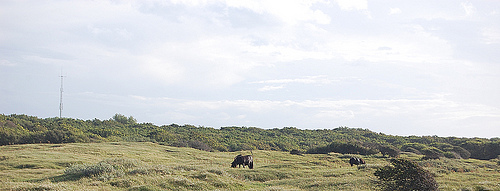
I grew up on the not quite an island anymore of Walcheren, living in Middelburg, on the mid-east side of it. Growing up we did everything — going to school, the beach, visiting family elsewhere on the island — by bike, which nine out of ten times meant heading out from town into the polder landscapes in the heart of it. Largely flat, with Middelburg one of the oldest and therefore highest settlements, with the rest of Walcheren built polder by polder around it, whichever direction you looked, you’d see a human build line on the horizon. To the east, we’d see the same narrow, dark line of towns and villages Abi talks about; every other direction there would be the dunes. Which look natural, but are of course as artificial as the towns themselves.


picture of dunes near Oostkappele, by Henk Kosters

As a kid, you don’t really question the landscape you grow up in, or think it anything other than natural, in both senses of the world. Sometimes it’s seeing the old and familiar to new eyes to make you realise how unnatural the land you grew up on is.

Pien


I didn’t think it would’ve been possible to cover Nine Inch Nails’ Hurt in Dutch, but the Heideroosjes manage to pull it off; it’s almost as good as the Johnny Cash version below. The only difference is that Cash brought a history of a life lived with regrets and pain in a way that somebody in his mid-thirties, no matter how good a musician just cannot do. In both cases this is a very masculine song, a very male emotional mix of regret and crippling doubt, self pity and genuine pain, defiantly shouted at the world.


#Transdocfail

Julie Burchill being nasty again about trans people in The Guardian (in an article since replaced by an apology of the editor) is bad enough, as it might provide cover for bullying but much more worrying is the general disrespect and disdain many trans people receive from their own doctors, as documented in stories shared through Twitter and elsewhere.

Two weeks ago, one of the few doctors providing gender re-assignment outside the NHS, doctor Richard Curtis came under investigation by the General Medical Council, for alleged errors made during gender reassignment, including one alleged wrongful referral for surgery.

For many trans people this investigation looked like yet another attack on the already scarce resources for gender reassignment in the UK, once again focusing on the alleged harm that might have been done to people erroneously under going gender realignment therapies, rather than the everyday difficulties many trans people have with getting the right medical support.

This anger led to the establishment of the TransDocFail hashtag on twitter, started by trans activists Zoe O’Connell and Lib Dem councillor Sarah Brown, asking UK trans patients to relate their experiences with gender reassignment and health care in general. It led to a flood of tweets by trans people, often anonymously describing the problems and bigotry they encounter at their GP or hospital.

The heart of the problem still seems to be the idea that trans people need to be protected from making a potential mistake more than they need to be helped become what they really are, as well as a continuing transphobia amongst some health care workers, not often addressed in the news media. As Sarah Brown is quoted:

“The media are typically invested in presenting a rigid narrative about how trans people interact with medicine. The stories trans people would like to tell, stories of outrageous levels of systemic abuse and transphobia, don’t fit this narrative and so go ignored and unreported. Social media is changing this. The stories trans people have to tell are reaching people who seldom hear them, and people are often appalled by what they hear. We can’t even begin to tackle widespread medical abuse of trans people until there is wider awareness of just how bad it is.”

A related problem is the fact that so often, the only trans stories covered in the media are negative ones, which is something the We Happy Trans project attempts to do something about.

(Originally posted on MetaFilter.)

Cat Claw

Cat Claw

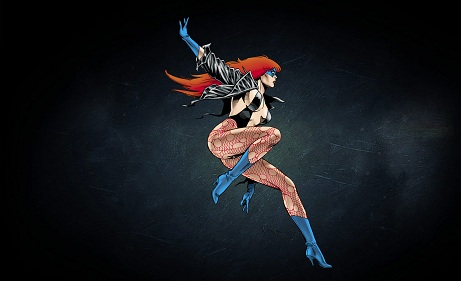
So this might sound familiar. A meek, shy student is bitten by an escaped lab animal and is given strange powers as a result; radiation is involved. Once these strange new powers have revealed themselves to her, she decides to become a superhero. Wait, “she“? Yes, because this is Bane Kerac’s Cat Claw, not Lee/Ditko’s Spider-Man. Not that the similarities in their origins are coincidence; Kerac was inspired by Spider-Man when he created Cat Claw for a Yugoslavian comics zine in the mid-eighties. Where they differ is that Carol Connor was much more likely than Peter Parker to lose her already skimpy costume.

Popular enough in her home country to get a television special dedicated to her and her creator in 1991, Cat Claw was also exported to various other European countries including Holland, as well as reprinted in a nine issue series by Aircel/Malibu comics in the US. To be honest, her adventures, or at least the ones I’ve read, are all pulpy nonsense, but Kerac has a sense of humour and that makes up for a lot. The mini movie from that tv special, excerpted below, meanwhile is very eighties, but does get across the spirit of the comics well.