Perhaps.
Translate this: Boerke – de Zoon Van
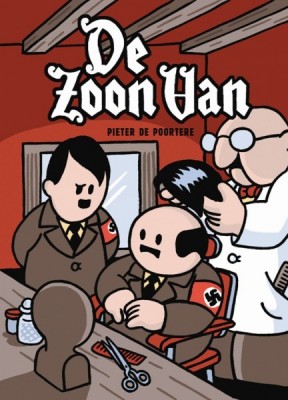
Translate this is an occasional series about European comics that need to be translated into English, inspired by Grant Goggins’ old Reprint This blog. Last time around it was Bernard Prince, this time it’s Boerke: De Zoon Van.
Boerke has actually been translated before; two volumes of Dickie have been published by Bries. However the Dutch language series runs to seven albums in total, of which De Zoon Van is the sixth. Translating the series shouldn’t be the hardest of jobs; the strips are mostly textless. Silent comics are perhaps the purest form of comics and Pieter de Poortere is very good at them. He manages to put a lot of character and emotion in his Playmobil like characters.
Whereas the first five or so albums are largely one page gag strips, this one is a complete story, the first longer story Pieter de Poortere has attempted for Boerke. As you might deduce from the cover, left, the story revolves around a certain German Chaplin moustache wearing dictator. Or rather, his son. Because it turns out that at the end of the First World War Hitler got slightly too friendly with a Flemish peasant woman and got himself a bastard son he never knew about: Boerke.
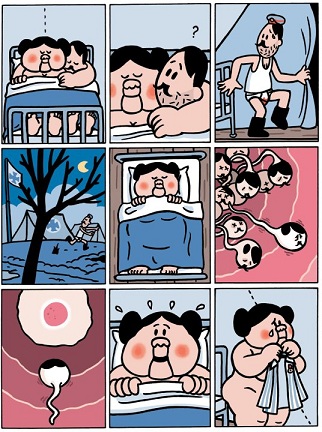
Boerke has to deal with all the little problems living in occupied Belgium in the Second world War brings with it: being mistaken for a collaborator, hiding a Jewish refugee and later an American airman, handing them over to the nazis when they fall in love and he gets jealous, try to commit suicide only to be almost hanged by the resistance, escaping, being mistaken for a jew and shipped to Auschwitz, that sort of thing.
Meanwhile in Berlin things are not going well either as Eva wants a child but Adolf, well, can’t get it up. She then tells him of the existence of his son, he goes to get him, some more adventures later they are united for the first time and the reich has a new slogan: Ein Reich, Ein Volk, Zwei Fuhrers…
There’s a strange sort of innocence about Boerke, helped by the simple, almost childlike artwork of de Poortere. The humour is black, but not cynical, if that makes any sense. The artwork is simplified but great, especially in the two page Where’s Wally spreads that intersperse the story.
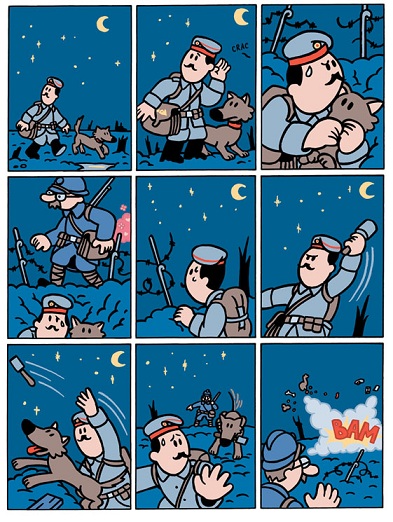
Winter is coming
A picture I took riding back from work a couple of days ago, showing the bare trees swarming with birds preparing for migration. There’s this little patch of wilderness near the sluices I have to bike over to get to the ferry to the station, which always has a lot of birds living in it, usually parrots, though I’m not sure what these are.
Terry Pratchett: Choosing to Die
Last year Terry Pratchett made a documentary about his Alzheimer’s Disease and his wish to die when he wanted to, meeting other people in the same situation, actually following some of them to their moment of dying. It was a powerful, emotional and honest documentary about a difficult subject.
Sandra had had much longer than Pratchett to make up her mind on this, having had to live with her disabilities for decades, living on a precarious edge where a small push could sent her towards complete helplessness. She had come to the same conviction as Pratchett had, that it was better to chose the time of her death even if this would out of necessity earlier than it medically needed to be, than keep on living without hope for progress.
When the side effects of our kidney transplant started to become chronic, especially after the first or second time she had slipped into coma this became her worst fear, that she would wait too long to die and it would slip out of her control, that she might end up phsyically alive but mentally destroyed.
She had always been a fighter though and she saw no reason just then to give up, though it was hard on her. There were also her sons to consider, the eldest of which was in trouble we need get into right now what she needed — and did — sort out from her hospital bed and of course there was me. She didn’t want to leave us, but she knew there would be a time she had to.
Watching that Pratchett documentary in June of last year crystalised a lot of these things for her, as it did for me and we had some long, serious talks about what and how we would handle it if she did come to a point of no return. At the time actually she had started doing better, she would be out of hospital not too long after, come home and for a while it looked we finally had all the support we needed, that she was finally stabilising and moving back to a “normal” life, before it all came crashing down again in September.
And this time she had made up her mind. She stopped treatment, said her goodbyes and died, a year and a week ago. She died as she lived, in as full a control of her own destiny as she could get.
She would’ve done the same without Pratchett’s documentary, but it did make it easier for her, for us, to go through with it. It’s one more thing I have to thank him for: thanks to him we met and fell in love and thanks to him she could die with dignity.
Oh no Terry Pratchett, No!
News to make the blood of any Discworld fan curdle:
What happened next is that Pratchett collapsed. “I had to kneel on the back seat of the taxi and give him CPR,” Rob says. “It was fingers down throat stuff. He nearly died.”
According to the interview extracts in the New Statesman, if the unthinkable does happen, which looks more and more likely, his daughter will take over the series:
The author tells me that he will be happy for her to continue writing the Discworld books when he is no longer able to do so. “The Discworld is safe in my daughter’s hands,” Pratchett assures me.
For any science fiction or fantasy reader this may not be a comfort, knowing what somebody like Brian Herbert made of his father’s legacy, but I do trust Terry Pratchett enough to give Rhianna Pratchett a chance. I just hope it will be some time yet before she gets it…