The Strategic Steam Reserve — myth or legend?


It’s November 10, 1983. The Soviet leadership has completely misinterpreted the NATO exercise Able Archer as preparations for a sneak nuclear attack and preemptively launched a first strike the day before, hitting targets in Western Europe and Britain, but not yet in continental America. Completely nuclear armageddon is narrowly avoided, but if you’re living in Europe, you’re out of luck. Britain has been hit less but the attacks still have left millions dead and the national infrastructure devastated, not in the least because the electromagnetic pulses of all these nuclear weapons going off have fried everything electronic in the country: planes can’t fly anymore, cars and trucks don’t have petrol to run on anymore, while diesel and electric powered trains have also been fried or no longer have power to run. There’s only one transport system that has escaped the war unscathed: the steam locomotive.

Steam locomotives are after all 19th century technology, completely mechanical, without electronics to fry. So it’d make sense that in a rail dense country like the UK, they could be used after a nuclear war to help rebuild the country. Moreover, Britain has huge coal reserves, so no problems with powering them. Finally, Britain was late in switching from steam to diesel and electric powered trains, the switchover only completed in the sixties and seventies. There were quite a lot of modern, new steam locomotives that could be mothballed and kept in reserve.

On the face of it therefore, especially knowing that the UK had made extensive preparations for rebuilding a post-nuclear war Britain, the idea that, like Sweden or the USSR, that somewhere in Britain there were stockpiles of steam locomotives waiting patiently for the day after.

But did Britain really have a strategic steam reserve, or was it just an urban myth? On an Ukranian expat forum, they think it did. At a more conspiracy minded website they’re undecided, but one Robert Moore pours cold water on the whole idea:

However, there are also some notable drawbacks in relying on the rail network as a means of transportation following a nuclear war. To begin with, we can suppose that most of Britain’s population-centers would have been hit during an nuclear exchange. Also gone – of course – would be the tracks leading to them; tracks that were specifically built to connect these settlements to other parts of Britain. Additionally, much of the “surviving” track could be very seriously heat-damaged, either warped by heat directly radiated from (probably) multiple nuclear explosions, or by the firestorms, which follow afterwards. The latter are likely to ravage large tracts of the U.K following a nuclear strike, and would inflict almost as much damage as the warhead detonations themselves! In regards to this, it should be remembered that most trackways have interconnected wooden components, which would both fuel and channel the direction of a fire along them (especially if they were exposed to a nuclear-generated “heat-blast”). Furthermore, shock-blasts generated by nuclear detonations are likely to radiate for miles from the explosion’s “ground zero” point. A force capable of smashing houses to rubble and matchwood is surely more than capable of dislodging exposed railway tracks!

Therefore, it is probable that the British railway network would require extensive repairs before it could even be seriously used again…

There are other reasons why, if such a steam reserve existed it would be not as useful than you might think and it can best be summed up by the below map, which shows the absorption of black carbon in the atmosphere (PDF) (and subsequent dropping of global temperatures) after a limited nuclear exchange between India and Pakistan.

absorbtion of black carbon after a nuclear war

Perhaps

Perhaps some day the sun will shine again,
And I shall see that still the skies are blue,
And feel once more I do not live in vain,
Although bereft of You.

Perhaps the golden meadows at my feet
Will Make the sunny hours of Spring seem gay,
And I shall find the white May blossoms sweet,
Though You have passed away.

Perhaps the summer woods will shimmer bright,
And crimson roses once again be fair,
And Autumn harvest fields a rich delight,
Although You are not there.

Perhaps some day I shall not shrink in pain,
To see the passing of the dying year,
And listen to the Christmas songs again,
Although You cannot hear.

But, though kind Time may many joys renew,
There is one greatest joy I shall not know
Again, because my heart for loss of You
Was broken, long ago.

Perhaps (“To R. A. L. Died of Wounds in France, December 23rd 1915”) is a poem by Vera Brittain, composed after the death of her fiancé during the First World War. I came across it while reading Singled Out by Virginia Nicholson, a book about the “generation of spinsters” that war left in its wake in Britain. It seemed a fitting poem to mark the occasion of Sandra’s death a year ago today.

How capitalism makes shitty beer worse

How capitalism can make even already shitty beer much, much worse:

One Friday night in January, Rinfret, who is now 52, stopped on the way home from work at his local liquor store in Monroe, N.J., and purchased a 12-pack of Beck’s. When he got home, he opened a bottle. “I was like, what the hell?” he recalls. “It tasted light. It tasted weak. Just, you know, night and day. Bubbly, real fizzy. To me, it wasn’t German beer. It tasted like a Budweiser with flavoring.”

He examined the label. It said the beer was no longer brewed in Bremen. He looked more closely at the fine print: “Product of the USA.” This was profoundly unsettling for a guy who had been a Beck’s drinker for more than half his life. He was also miffed to have paid the full import price for the 12-pack.

[…]

There was another reason for Brito to be reticent. He’s been running AB InBev’s business in the U.S. like a private equity investor. He has increased revenue and profit, but he has done so almost entirely by raising prices and cutting the cost of making the product. This has done wonders for AB InBev’s balance sheet. “If you look at what AB InBev has done since it took over Anheuser-Busch, it has made it enormously more profitable,” says Trevor Stirling, a beer industry analyst at Bernstein Research (AB), who detects more than a little xenophobia in the criticism of the company. “Is that un-American? Is it unconstitutional to increase the profitability of a business?”

[…]

What will Brito buy after this? There’s not much left. There is Pepsi, of course. Analysts speculate that it will acquire SABMiller (SAB), the world’s second-largest brewer. (AB InBev isn’t saying.) That would be something, adding beers like Coors Light and Foster’s to AB InBev’s lineup. It might be bittersweet for him. After one last carnival of cost-cutting, he’d have no more easy ways to juice his company’s stock. There would be nothing left for Brito to do but sell beer.

This is what real late stage, financier and stock market driven capitalism looks like. A company like AB InBev doesn’t exist to sell beer, not even to sell shitty beer, it exists as a tool for financial speculation. The real money lies in buying other companies, orchestrating mergers, conquering new markets through joint ventures and wholesale takeovers of local companies, splitting off unwanted parts and selling them to other companies doing the same, squeezing costs and increasing margins all to provide the seed sum for the next round of speculation.

It doesn’t really matter whether or not sales in the long term, or even the medium to short term sales of beer collapse for AB InBev as long as the margins are higher now, because the real money isn’t made there anyway. All the real money is on the financial speculative side, rather than the physical beer selling side. Get your money, let some other sucker worry about the future.

That’s also why the “let them drink craft beer” response to this sort of article (some examples seen here) misses the point entirely. This isn’t about shitty beer getting worse, it’s how high capitalism destroys everything in its quest for high profits now.

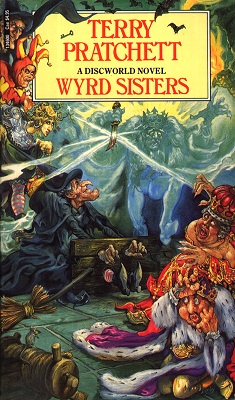
Wyrd Sisters — Terry Pratchett

Cover of Wyrd Sisters


Wyrd Sisters
Terry Pratchett
331 pages
published in 1988

The wind howled. Lightning stabbed at the earth erratically, like an inefficient assassin. Thunder rolled back and forth across the dark, rain-lashed hills.

The night was as black as the inside of a cat. It was the kind of night, you could believe, on which gods moved men as though they were pawns on the chessboard of fate. In the middle of this elemental storm a fire gleamed among the dripping furze bushes like the madness in a weasel’s eye. It illuminated three hunched figures. As the cauldron bubbled an eldritch voice shrieked: ‘When shall we three meet again?
There was a pause.
Finally another voice said, in for more ordinary tones: ‘Well, I can do next Tuesday’.

The opening paragraphs of Wyrd Sisters are a good indication of the rest of the book. This is MacBeth: Discworld style and the witches do not intend to stick to the script. That’s because Granny Weatherwax and Nanny Ogg are sensible witches and while the third member of the coven is a bit wet — as in, she actually believes in such things like covens — Magrat Garlick still has a steel core of good Lancrian common sense. They know better than to meddle in affairs (well, mostly) or dance with demons, never mind doing it skyclad. Yet when the king is murdered, his baby heir disappears and the usurper duke turns out not be just a bit evil, but actually uncaring about the land, they’re dragged into meddling against their own will.

Read more…