Books read October

Eleven books read all together this month, largely made possible by rereading some eight Pratchett novels.

Natural History — Justina Robson
Humanity has split itself into a multitude of forms, better to colonise the Solar System with. Then one of the first interstellar human ships finds the remnants of an alien vessel and the secrets of FTL travel and nothing will be the same…

The Hydrogen Sonata — Iain M. Banks
This is the latest Culture novel and somewhat of a disappointment. Good, but not as good as the last one, with a bit of a copout ending.

The Case of the Gilded Fly — Edmund Crispin
The first of Crispin’s Gervase Fen’s mysteries, in which an excentric Oxford don (aren’t they all) solves murders. This one is marred by the lack of sympathy shown to the victim as well ae the mindgames Fen plays with the suspects and readers both.

The Colour of Magic, The Light Fantastic, Equal Rites, Mort, Sourcery, Wyrd Sisters, Pyramids, Guards! Guards! — Terry Pratchett
The first eight Discworld novels, read both because I wanted something comfortable to read as well as because I wanted to re-examine the early Discworld novels. Arguably, it’s in these eight novels that Pratchett matures as a writer and the Discworld is shaped; by the time of Guards! Guards! most of the major subseries have been established.

Time Out

I just wanted a Youtube video of the Dave Brubeck Quartet’s Time Out to listen to at work, the cats were a bonus:


Ever since Youtube eased the length restrictions on uploaded videos a while ago people have been using it to share full length albums or concerts, but it’s usually done lazily, just a straight audio rip of an album with some cover art. This guy however (and somehow I do think it’s a bloke, as they tend to be more anorakish about these things) has gone out of his way to make the video almost as appealing as the music. He’s included the titles of the songs, the back cover text of the original album, not to mention some great shots of the record player doing its thing and his cats responding to the music.

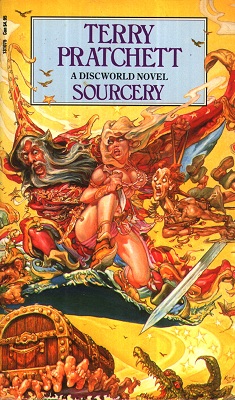
Sourcery — Terry Pratchett

Cover of Sourcery


Sourcery
Terry Pratchett
285 pages
published in 1988

Sourcery is the fifth Discworld novel and the first one after the initial two novels to star Rincewind again. Over time fan opinion has switched to thinking the Rincewind novels are the weakest in the series, but I’ve always liked them myself and I think Sourcery holds up as well as any of the other early novels. It’s the first novel in which there’s a real villain, the first tiem we get to see what makes a real villain in Pratchett’s eyes.

On a surface level there are some similarities to Equal Rites: again there’s a powerful, untrained magic user coming to Ankh Morpork to shake up the Unseen University, but this time he’s not so benign. Coin is not the eight son of an eight son, but the eight son of a wizard. And when a wizard has an eight son, that son doesn’t become a wizard himself, but a sourcerer, a source of magic. The magic he yields is not the tame, nice magic which is the only kind of magic the Discworld has known for ians, but wild magic, the magic from the dawn of times. Not perhaps the kind of magic you’d want a ten year old boy to have, even if his dead father has possessed his wizard staff to give him counsel.

Read more…

Grief

The thing about grief is, that for me at last, it’s nothing like the grandstanding you see in movies or on tv. It’s not a great outpouring of emotion, no crying jags, no dramatic shakings of fists at uncaring heavens, just that dull, gnawing pain in the pit of your stomach, occasionally forgotten or unnoticed, but always there. It’s just there, whatever you do, churning.


It’s almost a year now since she died and it seems like forever. You slide deceptively easily back into your daily routines after that initial period of shock, just existing day to day, getting on with life. Yet that feeling remains at the edge of your consciousness that she’s just stepped out of the room, you could pick up the phone and call her, she’s still lying there in hospital if you’d care to visit. So many times during a day that you hear something or see something or read something you’d want to share and so many times you stop short, wait, you can’t do that anymore.


The worst comes at night. The worst always comes at night. All the suppressed anxieties of the day are expressed in dreams, part of the half familiar, half distored landscape of your subconsciousness. There she is, waiting and sometimes you know it’s a dream and she’s dead and sometimes you don’t, but the worst are those that you know but it had all been a mistake. That glimmer of hope you know is wrong and which evaporates when you wake up, setting you up nicely for yet another day.

Wittering about comics again

In which I disagree (somewhat) with two of the Mighty Godking bloggers that aren’t Christopher Bird, blogged because for some reason I can’t leave comments there. First up, Jim Smith on the hype around Clark Kent leaving the Daily Planet and what the Superman titles have been missing:

What Superman needs, I think, is consistency. Not necessarily tighter continuity, but just a general sense that this is the same character as he was 70, 20, or even three years ago. 3 Any idiot can decide to have Clark Kent, the most famous newspaper reporter in fiction, quit the newspaper business because “print is dying” and Superman has better things to do. What would be far more interesting is to explain why Clark would remain a newspaper reporter in spite of reaching those conclusions, which have presumably crossed his mind long before this week.

Thing is, the last time the Superman titles had consistency instead of a series of stunt stories was in the early nineties, when the Comics Buyers Guide praised it for being so well crafted. That was just before Image and nobody actually bought them. It was only when they killed him off that people got interested in poor old Kal-EL again. No wonder then that DC learned stunts equal success, especially if you get the mainstream media on board. With Superman you can do that, because everything said and done he’s still Superman.
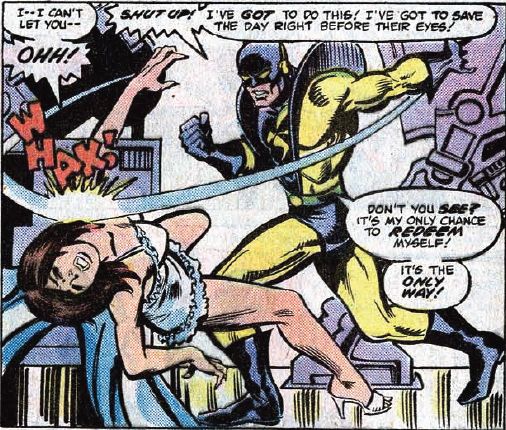
Hank bitchslapping Janet

John Seavey meanwhile talks about Hank Pym the wife beater:

This isn’t to say that people should get over Hank’s actions and start liking the character or anything. The comment on io9 was totally valid. I’m certainly the last person to talk, seeing as how I haven’t been able to read a Batman comic ever since he used Brother Eye to murder a few thousand people and I still can’t stand Tony Stark, Iron Douchebag in the wake of ‘Civil War’, despite being explicitly told by Marvel’s editorial staff that his brain has been rebooted and I should just forgot he did all that imprisoning and murdering. So yeah, I can totally get how some fans can’t really get past Hank Pym slapping his wife around for trying to stop him from creating a killer robot to defeat all the Avengers to make him look good. (Because that couldn’t possibly go wrong.)

As I said last year, I liked the original Shooter story but hate how that has since defined the character, ever since Bendis and co decided this was how they could show their psychologicial insight and Serious Writer credentials. So this incident was upgraded to domestic abuse, when it really was the standard “superhero loses his mind, attacks teammates, has to win back their trusts” plotline and had long since been resolved. To make this bit of superhero soap opera into some serious statement about domestic abuse I can’t think but be a bit insulting to real life victims of it. It’s cheap, nasty and boring to keep coming back to this.

(Yes, technically Hank is a wifebeater as he hit the Wasp, but there was also the time he beat up Thor and Iron Man and the other Avengers because he’d gotten crazy again and nobody has been writing angsty stories about the time he battered his friends. You can write serious stories about domestic abuse, even with superheroes, but this isn’t how you go about it. It’s all part of that faux realism Marvel has been gorging itself on for the past decade where realism is brown and superheroes are no more than glorified bureaucrats.)