Mort — Terry Pratchett

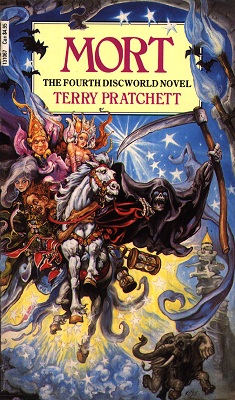
Cover of Mort


Mort
Terry Pratchett
272 pages
published in 1987

If anybody can lay claim to being the first breakout star of the Discworld series, it has to be Death. Started off as a bog standard personification of an abstract concept, managed to work his way up through several cameos in the first three books to this, his first start turn in a novel. Four more would follow, though none in the past decade. He’s not quite his cuddly self here yet, still a bit on the evil side, not as human as in e.g. Hogfather.

Nevertheless Death is being humanised, or why else would he end up looking for an apprentice? Anthropomorphical personages don’t need successors, now do they? Yet still Death ends up on a dusty market square in a small village at the stroke of midnignt taking on a most unlikely apprentice: Mort. Mort is one of those boys who are all knees and legs, who think too much for what they’re doing. An apprentice with Death is literally his last opportunity, but as his father said, there may be opportunities for a good apprentice to eventually take over his master’s business, though Mort is not sure he wants to.
Read more…

Flat land

Sometimes you have to look at a familiar landscape through foreign eyes to appreciate it:

But there’s no bridge from anyplace I’ve lived to the Dutch polder. This is nothing like anything I have ever known. If my love of California came through the front door and my love of Scotland through the side, this sudden, inarticulate love of the Netherlands is the unexpected guest who appears one day in the living room, ringing no bell and answering no invitation. And yet, here it is, and it draws me out of the house and away from the cities every bright day. I go out for half-hour rides and come back three hours later, windblown and bright-eyed.

And the Noord-Hollands polder through which I’ve been riding is the real deal, the unfiltered, unadulterated Dutch landscape, served neat. It’s undiluted by tulips and uncut by the tourist trail. It stretches out northward from the urbanized shore of the IJ to the Afsluitdijk, making up the land between the North Sea and the IJsselmeer. The fields are punctuated by towns and villages: Purmerend, Volendam, Alkmaar, Heerhugowaard, Den Helder, Edam, Enkhuizen, Hoorn, Schagen, Heiloo. Straight, elevated canals and swift roads cross them, taking the people and the freight to and fro. But the land between is filled only with a kind of vastness: long, straight lines of pasture under the endless, endless sky.

Abi Sutherland declares her love for the flat, Dutch landscape. I’ve always found Noord-Holland, that stretched out farmland north of Amsterdam, to be dull and depressing, the worst part of the Netherlands but Abi shows it can be beautiful too.

So did Jacques Brel decades ago, talking about Vlaanderen, but it could be Holland as well:


Equal Rites — Terry Pratchett

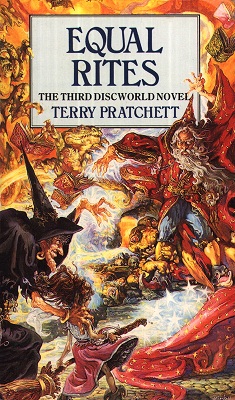
Cover of Equal Rites


Equal Rites
Terry Pratchett
283 pages
published in 1987

With the third novel in the series, Equal Rites, it became clear that the Discworld was more than just the sum of its characters. Gone were Rincewind, Twoflower and the Luggage, as an entire new setting and cast turned up. This wasn’t something that had been done much — or ever — in fantasy before, not often done after either. It must’ve seemed a bit of a gamble at the time, but this freedom to change protagonists and settings is what made the Discworld series, what has been keeping it from going stale for so long. If you don’t like one particular subseries, there are several others that you can read. Of course it also helps that Pratchett has been such a good writer for so long…

Equal Rites is the first Witches story, though the Granny Weatherwax that shows up here isn’t quite the one we get to know better in the later novels, differing somewhat even from how she’s portrayed in Wyrd Sisters three books onwards. The plot of the story is all about how if you’re a wizard on the verge of dying and looking for an eight son of an eight son to hand your staff over to, it helps to not be too hasty and check that eight son of an eight son isn’t actually a daughter…

Read more…

The Light Fantastic — Terry Pratchett

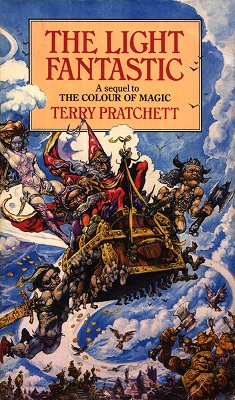
Cover of The Light Fantastic


The Light Fantastic
Terry Pratchett
285 pages
published in 1986

The Light Fantastic is of course the second Discworld novel and a direct sequel to The Colour of Magic starting in media res with Rincewind having fallen off the Disc. To his own amazement he does not actually fall to his death, but is saved by the Great Octavo Spell that had taken up residence in his head. It turns out that this hadn’t actually been an accident all those years ago that had gotten it in his head and all other magic spells afraid to stay near it, but had been in preparation for just this moment. The Discworld is heading towards a huge red star and unless the spell and its seven counterparts are said at exactly the right time, the world will be destroyed…

There’s three years between the publication of The Colour of Magic and The Light Fantastic and it’s noticable in Pratchett’s writing, which has improved a lot between the two novels. It’s also much less parody orientated, but still nowhere near the Discworld we’ve gotten to know and love. We do get a first glimmer of some of the subjects that Pratchett would engage more fully in later novels, including his humanitarianism. For the moment however, the Discworld is still much closer to a standard fantasy world than to what it would later become.

Read more…

Drawing comics in Noord

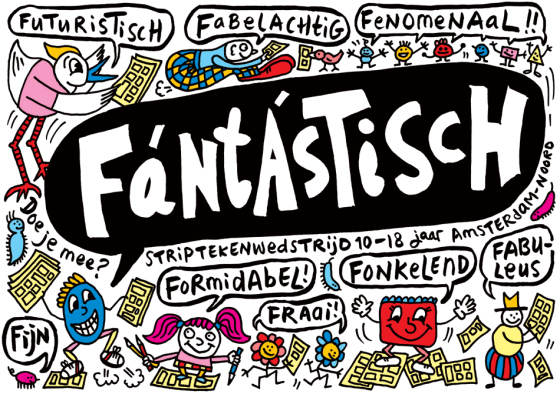
flyer Noord comics competition

Edith-Made-it (aka Edith Kuyvenhoven) is a Dutch cartoonist working and living in Amsterdam Noord, the huge neighbourhood north of the IJ that isn’t quite part of Amsterdam proper still. (It’s also where I live). She graduated as a graphic designer from the Rietveld Academy and has been doing the usual cartoonist things: freelance for various magazines, getting her first album of autobiographical comics out, selling the usual shirts and merchandise, organising a comics drawing competition for school children in Noord, for the second year in a row even…

The setup is simple: all school children in the last two classes of primary school or high school in Noord can participate, the best three in each category (primary school / high school) get a small prize (from 40 to 80 euros worth of comics) and there will be an exhibition of all the nominees. At the same time Edith also provides workshops at schools or libraries during the competition. It’s the sort of cheap, grassroots art activity that comics are ideally suited for because, well, you don’t really need expensive equipment to make comics, all children love drawing and comics and it’s cheap enough to do that you can do it out of your own pocket; no subsidies required.

It’s a great initiative and I hope Edith is as succesfull with it this year as she seemed to have been last year. I only wish I’d known about it then.