Dutch people counting to one hundred, in order of age, as filmed by Jeroen Wolf.
Eric Hobsbawm 1917 – 2012
Unlike some others, Hobsbawm achieved this wider recognition without in any major way revolting against either Marxism or Marx. In his 94th year he published How to Change the World, a vigorous defence of Marx’s continuing relevance in the aftermath of the banking collapse of 2008-10. What is more, he achieved his culminating reputation at a time when the socialist ideas and projects that animated so much of his writing for well over half a century were in historic disarray, and worse – as he himself was always unflinchingly aware.
In a profession notorious for microscopic preoccupations, few historians have ever commanded such a wide field in such detail or with such authority. To the last, Hobsbawm considered himself to be essentially a 19th-century historian, but his sense of that and other centuries was both unprecedentedly broad and unusually cosmopolitan.
The sheer scope of his interest in the past, and his exceptional command of what he knew, continued to humble many, most of all in the four-volume Age of… series, in which he distilled the history of the capitalist world from 1789 to 1991. “Hobsbawm’s capacity to store and retrieve detail has now reached a scale normally approached only by large archives with big staffs,” wrote Neal Ascherson. Both in his knowledge of historic detail and in his extraordinary powers of synthesis, so well displayed in that four-volume project, he was unrivalled.
Of all 20th century Marxist and Marxist influenced historians, Hobsbawm has been perhaps the most influential, especially in the English speaking world. For me he was one of the historians I started to discover and read when I had become a socialist, back in 2001/2002, somebody who was capable of showing the grand sweep of history without losing sight of its foundations.
James at Blood & Treasure always found Hobsbawm slightly off putting for his continued support of the Communist Party long after most people had abandoned it, as well as being a bit cavalier about the suffering actually existing communism perpetuated. For me, that was largely irrelevant, coming to him long after the USSR had ceased to exist, but also because Hobsbawm really didn’t have all that influence outside of his historical work and that was always solid.
The essence of Ware
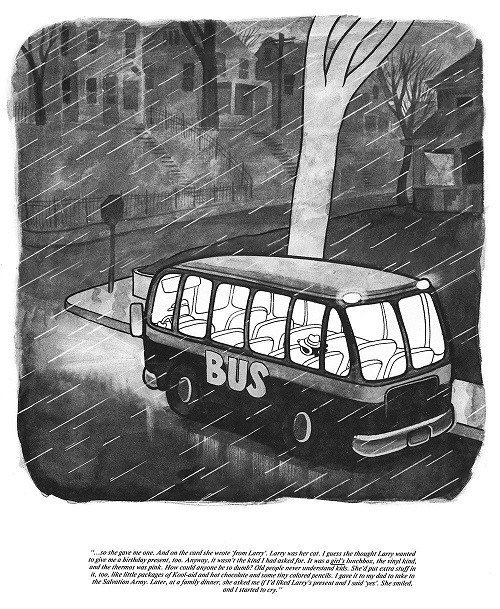
They’re holding their annual festival of hate over at the Hooded Utilitarian and Bert Stabler took aim at Chris Ware:
In twee there is neither humor nor horror, neither conviction nor swagger, just feelings. Feelings and nostalgia for feelings. Chris Ware was sucked into this vortex, streamlining himself into a reliable product for easy digestibility by self-styled “nerds” everywhere, and so we ended up with emo comics garbage overflowing the microcosm of craft-fair entrepreneurship and spilling into Michel Gondry, Death Cab for Cutie, and overdetermined bangs (all much to Chris Ware’s chagrin, if he has any left). True, this infantile regression might have happened anyway. Maybe it was September 11th that whetted the American appetite for saccharine melancholia, but I blame Chris Ware. What twee had to offer that was positive– androgyny, sloppiness, magic– was latent but present in his flamboyant early work. He could have made different choices, But it is lost now, lost irrevocably in the sterile, commercially lubricated navel into which his vision has apparently gone to die.
I’m not sure at all that I agree with this criticism, even if there is a kernel of truth in it, but there is an argument to be made that Ware has a limited palette as a cartoonist and keeps returning to the same themes. All of which are present in the cartoon above: the selfish and socially inept protagonist, alone in an uncaring (rather than a hostile) world, reliving childhood trauma in an atmosphere of melancholy, nostalgia and sadness. Everything else in his work is just commentary, an embellishment of the same themes.
Books read September
Seven books read this month, three histories and four novels, two fantasy, two science fiction.
Bombers & Mash — Raynes Minns
A social history of the British homefront during World War II as experienced by British women in all walks of life.
the Mad God’s Amulet — Michael Moorcock
The sequel to The Jewel in the Skull, another slab of sword & sorcery.
Bitter Gold Hearts — Glen Cook
The second of Cook’s Garrett, P. I. mix of hardboiled detective and fantasy novels.
Once a Hero & Rules of Engagement — Elizabeth Moon
Two of Moon’s largely enjoyable if lightweight military science fiction novels, somewhat marred by me by Moon’s insistence to use rape as a plot device.
The Kaiser’s Battle — Martin Middlebrook
An exhaustive description of the first day of the last German offensive in World War I, 21 March 1918. What made this book were the numerous eyewitness accounts, both culled from the vast WWI literature already existing and taken from interviews of surviving veterans. Originally published in 1978, this was about the latest that a historian could still do this.
Roger II of Sicily — Hubert Houben
A history of the life and reign of Roger II, the founder of the kingdom of Sicily, translated from the German for the Cambridge Medieval Textbooks series.
What my day has been like
Can best be described by my Twitter feed, from noon to eight o’clock in eighteen beers (and one unofficial one not tweeted) all drunk at the Bodegraven Beer Festival:
- Haandbryggeriet Fyr & Flamme IPA 6.5 abv
- Narke Rainbow Warrior
- Undressed bordeaux Flemish red sour ale 6.9 abv
- Gänstaller-BräNaturtrub Zoiglbier 5.8
- Burton Smokey and the bandaid 7.5 abv
- Evil Twin Danbic Gooseberry lambic alike
- The Evil Twin Danbic cranberry version 5.0
- Jester King Funk Metal 8.2 abv sour stout
- Emelisse Earl Grey IPA 6.8
- Imperial Brown Stout London 1856 from Kernel
- Christmas Eve in a New York hotel room 2011
- Whisky Barrel Rodeo, a co-op between Jester King and Mikkeller, 12 abv
- SpontanDoubleCherry 1 year from Mikkelle 8.5 abv
- Rasputin Laphroaig BA 11.4 abv
- Narken Macpeat 7.something very very peaty
- Cuvee de Montagne 14 abv
- Narken Black Golding starkporter
- SpontanDoubleBlueberry 8.5 abv from Mikkelle
*Hiccup*