Rape should not be inevitable

It’s not always good for readers to get to know what their favourite writers really think, but the other way around can be painful as well. Seanan McGuire found this out the hard way when one of her readers asked why none of her female characters had been raped yet:

My response: “None of my protagonists are getting raped. I do not want to write that.”

Their response: “I thought you had respect for your work. That’s just unrealistic.”

Verity is the bastard daughter of Dazzler and Batman. Toby is what happens when Tinker Bell embraces her inner bitch and starts wearing pants. Velveteen brings toys to life and uses them to fight the powers of darkness. Sarah is a hot mathematician who looks like Zooey Deschanel but is actually a hyper-evolved parasitic wasp. The unrealistic part about all these characters? Is that they haven’t been raped.

It’s the ultimate thriump of grimdark fiction: rape is no longer optional, but mandatory for a certain type of fan. It’s the inevitable consequence of the increasing use of rape as a cheap plot motivator, either to threaten or traumatise your heroine, or to get your male hero something to avenge, to make your mediocre urban fantasy extra gritty without having to think about it too much. Rape has become the modern equivalent of giving your private dick a knock on the head at a convenient point in the plot.

But of course rape is different from a knock on the head, because it so gender unbalanced, both in real life and (much more so in) fiction happening mainly to women, can be much more traumatic or triggering for readers, while there always is that prurient element that creeps in, that makes rape look glamourous or sexy.

Rape can be used as a plot element, but not if it’s done lazily, if it is now just a checkmark for your urban fantasy construction kit.
Girlschool

Have some N.W.O.B.H.M. courtesy of Girlschool:


That was thirtytwo years ago but they’re still going strong, though sadly without lead guitarist and singer Kelly Johnson, who died of spinal cancer in 2007. Here they’re performing live at Wacken:


Finally, here’s their crossover with Motorhead:


Some random comics links

It shows the essential childishness of much of the American comics industry that a major “newssite” feel the need to censor Guido Crepax’s art, putting those silly little black bars over every side boob visible (but not the heroine’s arse, I see. Hmmm.)

Alan David Doane, one of the web’s earliest comics reviewers/bloggers is quitting comics cold turkey:

The best advice I can give you is, if you find yourself in a similar place as me, unable to enjoy comics and outraged, disgusted or made crazy by the industry and the community, take a breath. Step away. Do something else. Do anything else. You might find it feels better than you could ever have guessed. For me, I am starting to feel free from something that was really becoming bad for me. I feel like I can breathe a little better. It’s a start.

It’s sad to see what should be a hobby, a passion, so poison somebody that they feel the need to purge themselves so drastically, but I’ve been there myself. In 2000 I just stopped buying and even reading comics, completely gotten sick of them. One month I was spending most of my disposable income (and more) on them, the next one I didn’t. I just stopped caring. That’s the risk of having so much of your own identity wrapped up with what is basically still a disposable commodity. Mind, I never entirely gave up on comics, kept my collection, occasionally even bought a new one if I came across something interesting, then got sucked back in thanks to various blogs, but no longer to the extend I was before. There’s no such thing as Club Comix and you shouldn’t try to become a member because it’ll break your heart.

Finally, Darryl Ayo is unhappy with Benjamin Marra’s appropriation of Black history for his revenge fantasy comics:

It is very self-serving and I’ll go as far to say callous about playing in the sandbox of people whose degradation and oppression you do not share. Not writing about black characters or exploring the pain of black people but rather exoticizing the struggle, the pain, the humiliations, the inhumanity of the road to freedom.

I feel the need to who-viate


Of course Doctor Who is no more than it wants to be, light Saturday evening sci-fi entertainment for the whole family, glitzy and fun, good enough for the hour it takes to watch it. Worrying about whether it should be anything more than this, at this point in time, is useless; it’s pretty clear its creative staff isn’t really interested. Therefore this post is really only for my own amusement, a short examination of what’s wrong with New Who without any expectation that it will ever change.

Last night’s episode was emblematic of New Who’s failings. It had an intriguing premise (little black cubes show up in their billions all over the world simultaneously, then do nothing. The doctor is intrigued, then bored, buggers off to go gallivanting across the universe, leaving the Ponds to deal with Real Life as opposed to Doctor Life, then almost a year later Things Start to Happen and the alien invasion really starts, only it turns out to be more of a weeding than an invasion, with some new alien baddy wanting to get rid of the human plague. In other words, starts off interesting, ends up being yet another overtly complicated alien plan easily spoiled by the doctor waving his sonic screwdriver around for a few seconds.

It’s also fairly incoherent, as the promise made in the trailer above, of the doctor coming to stay for a year just isn’t true, while the plot depends on some fairly big coincidence (the human transmitter needed to boast the signal from the alien ship to the cubes just happens to hang around the very same hospital as Rory works) to resolve itself and some of the bad guys’ actions (kidnapping people into their ship) just don’t make sense if their aim was extermination in the first place. All the fx, banter, witty asides and clever touches do only so much to cover this up even when watching.

In that regard it’s almost the opposite of the old Who, which for the most part was stodgy rather than glitzy, with low budget wobbly sets and cardboard monsters being made up for by good writing and acting, as well as more room to tell a story, not having to depend on just a one hour show to tell it, but being able to take four to six half hour episodes instead. that way the suspense of the little black boxes could’ve been build up and resolved more gradually, more in the background while the doctor went on other adventures, dealing with life on Earth while waiting for them to do their stuff…

The perfect place to start Cerebus

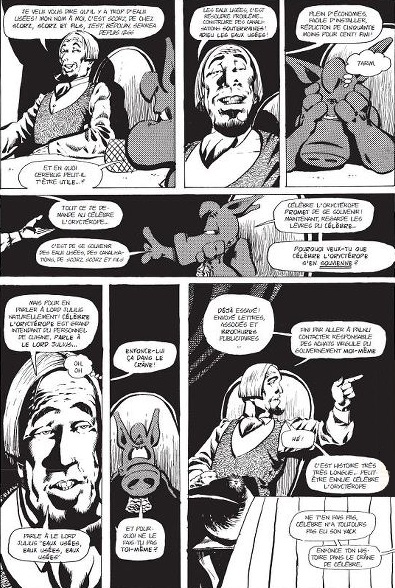
a page from High Society

It’s a strange situation. First you had Dave Sim running a very successful Kickstarter campaign to republish the entire Cerebus series as high quality digital comics, including all the ephemeral content left out of earlier reprints. Then a fire destroyed many of the Cerebus negatives, which, combined with the end through low sales of his Glamourpuss project left Dave Sim pondering the end of his career as a cartoonist. Finally, this triggered a response from Fantagraphics, with head honcho Kim Thompson offering to reprint Cerebus in a more market friendly format:

I’d be perfectly happy to repackage the CEREBUS material in a more bookstore-friendly format than those fucking phone books and give the material the new lease on life it (or at least the first two thirds of it) so richly deserves.

Dave Sim responded and now you have what’s basically a contract negotiation happening in public, which Tom Spurgeon is right to think is absurd. Great fun though and it inevitably leads to thinking about how to start the series. As Kim Thompson put it:

Actually, I feel it absolutely must start at the beginning. CEREBUS is a very complex story and everything builds on what’s come before. The liability is of course that the first several issues are crude and jokey, so you’re not leading with the best work, but if you don’t make these available the stuff that follows is a lot harder to make sense of. That’s a curse of serial comics created by a developing cartoonist.

but there’s a solution to this dillemma and it’s not a difficult one: start with High Society. As Kim Thompson says, the problem with starting reprinting Cerebus from the beginning is that it started out int he late seventies as not that good a parody of Conan the Barbarian as well as other contemporary comics, one of the first wave of creator owned alternative comics, together with series like the Pinis’ Elfquest and Jack Katz The First Kingdom. These first few issues just aren’t that interesting, though Sim develops fast and gets more and more ambitious over time, but they are of a particular time and place and perhaps less interesting if you’re not a hardcore comics fan.

High Society is different. It’s one single story, originally told over twentyfive issues, which if I’m not mistaken was even the longest story told in American comics up to that time. It’s also the story in which Dave Sim came into his potential, complex, cynical, incredibly funny. Best of all, it’s also a story that really needs little to no introduction, no knowledge of what had gone before. All you need is half a page introducing Cerebus, then the story can start with him coing into Iest looking for a room to sleep and expecting to be thrown out of the city, only for everybody treating him with respect and fear and eager to make him happy, which drives him up the wall until he sees a way to profit from it. You don’t really need to know that Dirty Fleagle McGrew and his baby brother Dirty Drew were modelled after Canadian cartoonists Gene and Dan Day to enjoy the story. All you need to know is that it starts off a little bit like Nikolai Gogol’s The Government Inspector and take it from there.