Oh heck, have another video post, courtesy of Batman: the Brave and the Bold. Flash your peepers on Catwoman, the Huntress and Black Canary displaying some unexpected talents:
David Attenborough sings what a wonderful world. The original broadcast was after the last episode of The Frozen World, which talked about how both the North and South Pole are disappearing fast due to Climate Change, the end result being not unlike hearing Vera Lynn singing “We’ll Meet Again” at the end of Dr. Strangelove…
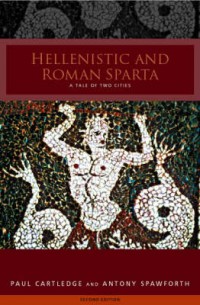
Hellenistic and Roman Sparta
Paul Cartledge & Antony Spawforth
312 pages including index
published in 2002
When most people think of Sparta their first thought will probably be about that godawful movie based on that godawful Frank Miller comic 300: This! IS! Sparta! and all that. For all its faults, it does mirror the common view of Sparta as a warrior state, one of the superpowers of classical Greece, indomitable in its resistance to tyrannical Persia, if not quite a democracy itself. But there is more to Sparta’s history. There’s a tendency in pop history to look only at the classic Sparta, to lose interest once it has been overtaken by Thebe and lost its supremacy, just before the rise of Macedon under Philip and Alexander. What happened to the city once it became just another polis doesn’t interest us all that much, it seems.
We should therefore be grateful for books like this: Hellenistic and Roman Sparta: a Tale of Two Cities which does look at Sparta’s history after its fall from grace, first under Macedon rule, then under Rome. It was originally published in the early nineties, but updated for a second edition in 2002. More of a textbook than a pop history book, but I’ve struggled through much drier texts. At the very least it was an effective treatment of a part of Greek history I’m not that familiar with.
And then it was exactly a month ago I was facing my first night without Sandra. Here in the Netherlands fortunately the Christmas insanity starts late, as we have to deal with Sinterklaas first, but it has started now. At work the Christmas trees are being put up, the shops have traded in the Sinterklaas tat for Santa tat; worse the X-Mas adverts are back on telly. Awful as they are though, with the incredibly annoying yet very very earwurmable Sky Radio jingle being the worst, none of them can match the horrors of this particular example from the UK, as Charlie Brooks shows:
The rest of the lyrics are worse still. It’s a terribly sad song. So sad Leonard Cohen should be singing it. “Mum” appears to have purchased an entire nervous breakdown’s worth of cold branded goods in a pathetic bid to win the affections of her own family. Her desperate offerings include a top-of-the-range MacBook for Grandad, “an HTC for Uncle Ken”, a “Fuji camera for Jen”, and a “D&G” for Dad. In case you’re wondering what a “D&G” is, the advert makes clear it’s a truly disgusting designer watch even Jordan might balk at. In the mad Littlewoods universe “Dad” seems inexplicably delighted by the sudden appearance of this ghastly bling tumour on his wrist, instead of screaming and trying to kill it with a shoe, like any sensible human would.
Everybody involved with this ad should’ve topped themselves rather than kill their souls this way. Christmas has always been a festival of commercial greed of course, but I’ve not seen it as blatant as this yet. It’s as if the naked lust for more stuff has burst out from behind the veneer of asperation it was made slightly more respectable by.
For Sandra Christmas never was about presents, though she did like the ritual of buying each other slightly more expensive gifts than we could afford, the one time of year we could legitimately spoil ourselves. She loved the rituals of Christmas, the food: mince pies, turkey or another sort of roast, even brussel sprouts, but especially Christmas cake. She made them each year, even in 2009 while we were preparing to go to hospital for the kidney transplant operation she made two, one of which is still on the top shelf of one of the kitchen cupboards. Last year she was in hospital, so I brought Christmas to her, getting all sorts of nice little treats that could be eaten cold or heated up in the ward’s microwave. It wasn’t perfect, but it was Christmas.
This year I’m going back to my family, the first without her and also the first I will be spending entirely with my family since I first met her; it’s like going back to my childhood, not entirely pleasant even had the circumstances been different. It’s hard to explain without sounding ungrateful, but it’s going back from having your family, no matter how small, to being part again of the family; the dynamics of Christmas are altered. It’s only a small complaint in the scheme of things, but I’m still dreading going home a bit, especially with the sentimentality surrounding these holidays.
Never mind, at least I’ll get to enjoy my father’s oliebollen again, which nobody does better…
Politicians and socalled objective media both have been pushing hard the idea that the Euro crisis can only be solved by spending cuts and spending discipline, but luckily there’s the Washington Post to spell out the real reasons behind this:
“If adopted by other nations in the union, the deal would mean drastic cuts in European budgets. It would also spell the end of three decades of overspending that helped finance a cozy social protection system envied by much of the world.”
It has nothing to do with solving the crisis, it’s needed to destroy what remains of social democracy in the EU, by attempting to take away the power to set budgets from elected national politicians through hard spending limits and fines if these are breached. There already are some such agreements in place amongst the countries who have the Euro as their currency, but in practise these turned out to be not as hard as they were supposed to be in theory, especially not when you’re called France or Germany. The proposed plan would make it difficult to “blow the budget” even for those countries, but it will of course still be the weaker countries that will suffer more under these plans. Introduction therefore would inevitably lead to more spending cuts and more structural budget cuts even in the richer countries.
It would have been much easier to sanction the decade’s violators of the Stability & Growth Pact – Germany and France. Of course they got sanctioned anyway, but perhaps they would have had to pay a fine. Let’s be charitable for a moment and assume that this would indeed have caused them to run a lower public sector deficit. This would have changed what, precisely? Had it depressed internal demand in Germany, all other things being equal, it would have caused Germany to increase its trade surplus. A bigger trade surplus implies a bigger deficit elsewhere, and it also implies that German and French banks would have lent the private sector “elsewhere” the money they needed to buy the additional exports. An additional problem might have been that, had German bonds been in shorter supply, investors would have sought other AAA-rated assets and piled up even more bubbly mortgage-backed securities, which the banks would have been delighted to sell them.
[…]
But one thing this proposal would categorically not have done is to stop Italy or Spain or Ireland running up more public debt. Public debt fell in these countries from 1995 to 2007. Even Portugal and Greece didn’t exactly explode. Ireland would still have a budget surplus if it hadn’t massacred itself to save the banks (in part because the ECB wouldn’t help). Greece, well, perhaps, but it seems to be clear that just yelling at the Greeks is insufficient to fix Greece’s problems.
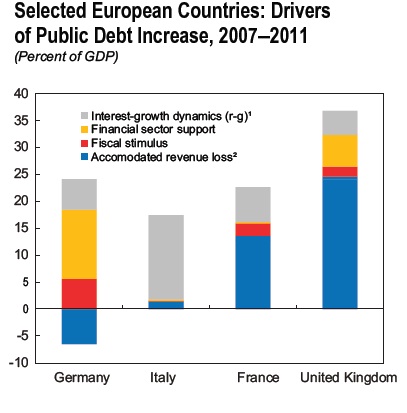
Meanwhile the chart above (From ToUCstone) shows what really drove up government debt in the four largest EU economies and it ain’t “a cozy social protection system”.