Four weeks ago now…


What do you do after you met, lived with and lost the love of your life? Other than write maudlin posts on your blog that is?

No idea, but it has been four weeks since Sandra died, almost a month since she was cremated and that means I can shortly pick up her ashes — another milestone I’d rather not have reached so soon.

Last Saturday I spent part of the afternoon listening to another of Sandra’s favourite bands, Steely Dan, whose brand of mellow, technically perfect, coked up yacht rock is not quite the sort of music you’d think she’d enjoyed when you know she spent most of the seventies trawling record stores for import funk and dancing to northern soul at the Wigam casino, but she did. What she liked was how mellifluous they sounded, the calm perfection of their sound. She hated any sudden loud noises, discords, anything that jared and whatever you think of Steely Dan, their music always flowed and flowed smoothly.

Perfect late night reading music, with a glass of whisk(e)y or cognac and a good book, a cat somewhere and a roaring fire.

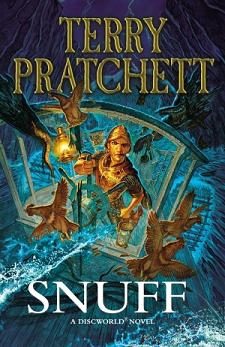
Snuff — Terry Pratchett

Cover of Snuff


Snuff
Terry Pratchett
416 pages
published in 2011

Wouldn’t you know it; you try to start writing a review and suddenly you can’t find the bloody book anywhere. Which is not just annoying because I want to get started but also because I’m now worrying I lost it somewhere. If I have I will have lost a piece of history, it being the last Discworld novel she and I read together before her death, as we did with all the new Discworld novels when we were together; usually she read them first as I could be slightly more patient. We not only were both fans of Pratchett, but we actually met thanks to him, through the dedicated IRC channel at lspace.org which had been set up for the alt.fan.pratchett newsgroup. What’s more, his documentary this year on assisted suicide and the dignity of choosing your own death helped Sandra make up her mind once she was convinced she couldn’t go on anymore.She had thought about it before, but seeing that really firmed up her conviction not to suffer if there was no point to it. Reading Snuff therefore was a bittersweet experience.

Snuff itself is a typical late Pratchett novel, good but not outstanding with few surprises for the longtime fan. Once again, as in Jingo, The Fifth Elephant or Thud to name but three, Samuel Vines is taken out of his element and has to maintain the peace outside of his jurisdiction and once again there are powerful forces who profit from the lack of it he has to conquer. This time Vimes is sent on holiday to his wife, Lady Sybil Ramsbottom’s country estate to play the laird, something he’s not good at nor likes much. Fun is had with city boy Vimes’ discomfort with country ways, again as in previous novels. Finally, there’s yet another fantasy race rescued from its stereotypes: after trolls, dwarfs, golems, zombies and vampires it’s goblins this time.

Read more…

You wouldn’t steal the music for your anti-piracy ad


Dutch copyright advocacy group BREIN asks composer Melchior Rietveldt to create the music for an anti-piracy ad to be shown at a local film festival. That’s in 2006. A year later Rietveldt notices that his music is used in another piracy ad, one put on dozens of dvd titles in the Netherlands:

The composer now claims that his work has been used on tens of millions of Dutch DVDs, without him receiving any compensation for it. According to Rietveldt’s financial advisor, the total sum in missed revenue amounts to at least a million euros ($1,300,000).

The existence of excellent copyright laws and royalty collecting agencies in the Netherlands should mean that the composer received help and support with this problems, but this couldn’t be further from what actually happened.

Soon after he discovered the unauthorized distribution of his music Rietveldt alerted the local music royalty collecting agency Buma/Stemra. The composer demanded compensation, but to his frustration he heard very little from Buma/Stemra and he certainly didn’t receive any royalties.

It gets better:

Earlier this year, however, a breakthrough seemed to loom on the horizon when Buma/Stemra board member Jochem Gerrits contacted the composer with an interesting proposal. Gerrits offered to help out the composer in his efforts to get paid for his hard work, but the music boss had a few demands of his own.

In order for the deal to work out the composer had to assign the track in question to the music publishing catalogue of the Gerrits, who owns High Fashion Music. In addition to this, the music boss demanded 33% of all the money set to be recouped as a result of his efforts.

So an anti-piracy group doesn’t ask permission or pay a composer to use his music and the group that should be protecting his rights actually has its boardmembers attempt to extort him…

The future of the internet according to CmdrTaco

MetaFilter founder Matt Haughey interviews Slashdot founder Rob “CmdrTaco” Malda, who is not optimistic about the future of the internet:

Rob: The internet is simply not as free as it was when Slashdot began. Government is increasingly legislating away our rights and criminalizing actions that are impossible to regulate. I know it’s inevitable, but it’s still disappointing to witness. The joy of logging in to an IRC chat room in the early 90s, to talk to people who were innovating powerful technologies simply for the sake of it was absolutely intoxicating. To be able to talk to the guy who was responsible for some component of your system. We were all pseudo-anonymous strangers brought together by the technology that we loved, and the belief that an open future was spread out before us. The future will be exciting for my children, but I’m afraid that their technology will come in boxes welded shut at the factory. Their software locked down. Linux, and the Internet broke everything wide open. It’s taken 20 years to get a lot of it boxed back up again. I hope there are still air cracks by the time my kids are old enough to jam screwdrivers in there.

On the other hand, there’s the experience of MetaFilter commenter dreamyshade of working on the Ipad/Iphone hacking scene:

One of my favorite parts of working on Cydia is when I meet young kids who know exactly what jailbreaking is and how to do it. (Like at Thanksgiving, telling acquaintances what I work on — the 12-year-old boy grinning in surprised recognition while the grown-ups carefully listened to an explanation of the concept.) There are lots of kids splashing around on their hand-me-down iPod touches jailbroken in one way or anoher: installing goofy homebrew software, crafting custom icon themes with terrifically ugly icons, installing OpenSSH and forgetting to change the default password but learning to SSH in and paste intriguing commands from the internet, editing plists to enable hidden features, figuring out how to restore the device when things inevitably go wrong, and generally making a lively mess of the device they get to totally play with. They cause some support burden for Cydia and App Store developers alike, but this is one way to learn to feel comfortable with poking around at the internals of things, to gain the confidence to break stuff because you know you can figure out how to fix it, to self-identify as a person good with technical stuff, to take an interest in AP Computer Science class later. This makes me happy. Each new generation of devices gets harder to jailbreak, but for now there’s still some good stuff happening.

I hope dreamyshade is right but I fear CmdrTaco is closer to the truth. Internet has long ago ceased to be the domain of hardcore geeks — nothing wrong with that — but with it has come the Facebooking of the internet, where you sacrifise your freedom and privacy for ease of use and comfort.

Books read November

Not much this month, thanks to Sandra’s death. I just couldn’t concentrate. What I’ve read is below:

Deathworld — Harry Harrison
A nice classic sf adventure story that through the magic of Gutenberg.org I could read on my mobile phone.

Spirit — Gwyneth Jones
A standalone space opera novel of revenge, which at one points threatens to become The Count of Monte Cristo but then doesn’t. I enjoyed this much more than Bold as Love.

Europe After Rome — Julia M. H. Smith
An excellent overview of the cultural changes in Europe after the “fall” of the Roman Empire.

Indo Roman Trade — Roberta Tomber
A slim volume examining the archaeological evidence for trade between India and the Roman World, with some attempt to provide context as well. Recommended.

Austin-Healey — Graham Robson
Other than watching Top Gear I’m not that interested in cars, but I took a punt on this because it was short and cheap. This history of a classic British sports car marque is a volume in the Shire Library of social history books about Britain and the British way of life, I’ve bought quite a few of them for Sandra in the past two years. The format is a little bit like the much better known Osprey series of war books.

Crime at Guildford — Freeman Wills Crofts
One of the B or C-list writers of the Golden Age of detective novels. Entertaining, but you can see the author pulling the strings to get the mystery solved in a way you can’t with Agatha Christie for example.

No Present Like Time — Steph Swainston
The second part in the Castle series, I read this as this month’s entry in my Year of Reading Women project. Excellent novel.

The Victorian Soldier — David Nalson
Slim even for a Shire Library book, this is barely an overview of British soldering life in the 19th century. Didn’t tell me anything new, but lots of good pictures make it worthwhile.

The British Soldier of the Second World War — Peter Doyle
Another Shire volume, slightly more in depth than the previous one, but again just a quick sketch rather than the full story. Lots of pictures though. Each individual volume in the Shire library is obviously limited by its format, but there plenty more volumes on life during the Second World War and together they add up to a pretty complete picture.