The mask slips: the real reason for insisting on budget discipline

Politicians and socalled objective media both have been pushing hard the idea that the Euro crisis can only be solved by spending cuts and spending discipline, but luckily there’s the Washington Post to spell out the real reasons behind this:

“If adopted by other nations in the union, the deal would mean drastic cuts in European budgets. It would also spell the end of three decades of overspending that helped finance a cozy social protection system envied by much of the world.”

It has nothing to do with solving the crisis, it’s needed to destroy what remains of social democracy in the EU, by attempting to take away the power to set budgets from elected national politicians through hard spending limits and fines if these are breached. There already are some such agreements in place amongst the countries who have the Euro as their currency, but in practise these turned out to be not as hard as they were supposed to be in theory, especially not when you’re called France or Germany. The proposed plan would make it difficult to “blow the budget” even for those countries, but it will of course still be the weaker countries that will suffer more under these plans. Introduction therefore would inevitably lead to more spending cuts and more structural budget cuts even in the richer countries.

But what it doesn’t do is solving the current crisis, as Alex at A Fistful of Euros explains through examining what would’ve happened had it been in place already:

It would have been much easier to sanction the decade’s violators of the Stability & Growth Pact – Germany and France. Of course they got sanctioned anyway, but perhaps they would have had to pay a fine. Let’s be charitable for a moment and assume that this would indeed have caused them to run a lower public sector deficit. This would have changed what, precisely? Had it depressed internal demand in Germany, all other things being equal, it would have caused Germany to increase its trade surplus. A bigger trade surplus implies a bigger deficit elsewhere, and it also implies that German and French banks would have lent the private sector “elsewhere” the money they needed to buy the additional exports. An additional problem might have been that, had German bonds been in shorter supply, investors would have sought other AAA-rated assets and piled up even more bubbly mortgage-backed securities, which the banks would have been delighted to sell them.

[…]

But one thing this proposal would categorically not have done is to stop Italy or Spain or Ireland running up more public debt. Public debt fell in these countries from 1995 to 2007. Even Portugal and Greece didn’t exactly explode. Ireland would still have a budget surplus if it hadn’t massacred itself to save the banks (in part because the ECB wouldn’t help). Greece, well, perhaps, but it seems to be clear that just yelling at the Greeks is insufficient to fix Greece’s problems.

What causes government debt in the four largest EU countries

Meanwhile the chart above (From ToUCstone) shows what really drove up government debt in the four largest EU economies and it ain’t “a cozy social protection system”.
Four weeks ago now…


What do you do after you met, lived with and lost the love of your life? Other than write maudlin posts on your blog that is?

No idea, but it has been four weeks since Sandra died, almost a month since she was cremated and that means I can shortly pick up her ashes — another milestone I’d rather not have reached so soon.

Last Saturday I spent part of the afternoon listening to another of Sandra’s favourite bands, Steely Dan, whose brand of mellow, technically perfect, coked up yacht rock is not quite the sort of music you’d think she’d enjoyed when you know she spent most of the seventies trawling record stores for import funk and dancing to northern soul at the Wigam casino, but she did. What she liked was how mellifluous they sounded, the calm perfection of their sound. She hated any sudden loud noises, discords, anything that jared and whatever you think of Steely Dan, their music always flowed and flowed smoothly.

Perfect late night reading music, with a glass of whisk(e)y or cognac and a good book, a cat somewhere and a roaring fire.

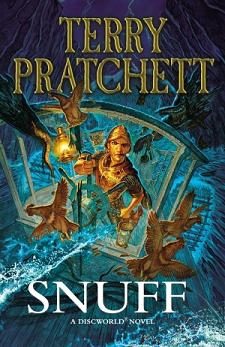
Snuff — Terry Pratchett

Cover of Snuff


Snuff
Terry Pratchett
416 pages
published in 2011

Wouldn’t you know it; you try to start writing a review and suddenly you can’t find the bloody book anywhere. Which is not just annoying because I want to get started but also because I’m now worrying I lost it somewhere. If I have I will have lost a piece of history, it being the last Discworld novel she and I read together before her death, as we did with all the new Discworld novels when we were together; usually she read them first as I could be slightly more patient. We not only were both fans of Pratchett, but we actually met thanks to him, through the dedicated IRC channel at lspace.org which had been set up for the alt.fan.pratchett newsgroup. What’s more, his documentary this year on assisted suicide and the dignity of choosing your own death helped Sandra make up her mind once she was convinced she couldn’t go on anymore.She had thought about it before, but seeing that really firmed up her conviction not to suffer if there was no point to it. Reading Snuff therefore was a bittersweet experience.

Snuff itself is a typical late Pratchett novel, good but not outstanding with few surprises for the longtime fan. Once again, as in Jingo, The Fifth Elephant or Thud to name but three, Samuel Vines is taken out of his element and has to maintain the peace outside of his jurisdiction and once again there are powerful forces who profit from the lack of it he has to conquer. This time Vimes is sent on holiday to his wife, Lady Sybil Ramsbottom’s country estate to play the laird, something he’s not good at nor likes much. Fun is had with city boy Vimes’ discomfort with country ways, again as in previous novels. Finally, there’s yet another fantasy race rescued from its stereotypes: after trolls, dwarfs, golems, zombies and vampires it’s goblins this time.

Read more…

You wouldn’t steal the music for your anti-piracy ad


Dutch copyright advocacy group BREIN asks composer Melchior Rietveldt to create the music for an anti-piracy ad to be shown at a local film festival. That’s in 2006. A year later Rietveldt notices that his music is used in another piracy ad, one put on dozens of dvd titles in the Netherlands:

The composer now claims that his work has been used on tens of millions of Dutch DVDs, without him receiving any compensation for it. According to Rietveldt’s financial advisor, the total sum in missed revenue amounts to at least a million euros ($1,300,000).

The existence of excellent copyright laws and royalty collecting agencies in the Netherlands should mean that the composer received help and support with this problems, but this couldn’t be further from what actually happened.

Soon after he discovered the unauthorized distribution of his music Rietveldt alerted the local music royalty collecting agency Buma/Stemra. The composer demanded compensation, but to his frustration he heard very little from Buma/Stemra and he certainly didn’t receive any royalties.

It gets better:

Earlier this year, however, a breakthrough seemed to loom on the horizon when Buma/Stemra board member Jochem Gerrits contacted the composer with an interesting proposal. Gerrits offered to help out the composer in his efforts to get paid for his hard work, but the music boss had a few demands of his own.

In order for the deal to work out the composer had to assign the track in question to the music publishing catalogue of the Gerrits, who owns High Fashion Music. In addition to this, the music boss demanded 33% of all the money set to be recouped as a result of his efforts.

So an anti-piracy group doesn’t ask permission or pay a composer to use his music and the group that should be protecting his rights actually has its boardmembers attempt to extort him…

The future of the internet according to CmdrTaco

MetaFilter founder Matt Haughey interviews Slashdot founder Rob “CmdrTaco” Malda, who is not optimistic about the future of the internet:

Rob: The internet is simply not as free as it was when Slashdot began. Government is increasingly legislating away our rights and criminalizing actions that are impossible to regulate. I know it’s inevitable, but it’s still disappointing to witness. The joy of logging in to an IRC chat room in the early 90s, to talk to people who were innovating powerful technologies simply for the sake of it was absolutely intoxicating. To be able to talk to the guy who was responsible for some component of your system. We were all pseudo-anonymous strangers brought together by the technology that we loved, and the belief that an open future was spread out before us. The future will be exciting for my children, but I’m afraid that their technology will come in boxes welded shut at the factory. Their software locked down. Linux, and the Internet broke everything wide open. It’s taken 20 years to get a lot of it boxed back up again. I hope there are still air cracks by the time my kids are old enough to jam screwdrivers in there.

On the other hand, there’s the experience of MetaFilter commenter dreamyshade of working on the Ipad/Iphone hacking scene:

One of my favorite parts of working on Cydia is when I meet young kids who know exactly what jailbreaking is and how to do it. (Like at Thanksgiving, telling acquaintances what I work on — the 12-year-old boy grinning in surprised recognition while the grown-ups carefully listened to an explanation of the concept.) There are lots of kids splashing around on their hand-me-down iPod touches jailbroken in one way or anoher: installing goofy homebrew software, crafting custom icon themes with terrifically ugly icons, installing OpenSSH and forgetting to change the default password but learning to SSH in and paste intriguing commands from the internet, editing plists to enable hidden features, figuring out how to restore the device when things inevitably go wrong, and generally making a lively mess of the device they get to totally play with. They cause some support burden for Cydia and App Store developers alike, but this is one way to learn to feel comfortable with poking around at the internals of things, to gain the confidence to break stuff because you know you can figure out how to fix it, to self-identify as a person good with technical stuff, to take an interest in AP Computer Science class later. This makes me happy. Each new generation of devices gets harder to jailbreak, but for now there’s still some good stuff happening.

I hope dreamyshade is right but I fear CmdrTaco is closer to the truth. Internet has long ago ceased to be the domain of hardcore geeks — nothing wrong with that — but with it has come the Facebooking of the internet, where you sacrifise your freedom and privacy for ease of use and comfort.