Holland is getting more and more shitty to live in

The last ten years have been a very disappointing decade for the Netherlands, politics wise. We started the decade with a clapped out coalition of neoliberal technocrats completely failing to respond to the rise of the first charismastic, populist, Islamophobic demagogue the country was blessed with. He promptly got shot, the backlash catapulted his party into government but their incompetence doomed them almost immediately. Their legacy lasted much longer however, collapsing the vote of the traditional big parties, with a large part of the electorate becoming swinging voters, going for the party that most satisfied their gut instincts this election, opening up space for more populist parties. In itself this was not a bad thing, was it not fueled as much by a healthy dose of xenophobia as a visceral hatred of politics as usual, with various politicians trying to make lightning strike twice. This is not without dangers, as a national firebrand is stabbed to death for his views on Muslims

Fast forward a few years and governments and we’re back into a much worse economic crisis and an even worsely fractured political landscape. We’re now ruled by a rightwing minority coalition of neoliberal technocrats who use this crisis as an excuse to sell of everything the state owns not yet sold by previous governments, as well as ram through all the ideologically driven spending cuts it had been wanting to see through for years. To do so, it has to depend on a racist party, throwing them a bone every now and again, which doesn’t help make the country any nicer to live in. Both developments on their own are bad enough, but acting in concert as they do makes them incredibly dangerous.

Several stories coming out this week underscore how bad things are getting. First, there’s the ongoing saga of the ban on ritual slaughter of non-stunned animals, which has now been passed by parliament, which uses the guise of animal welfare to taunt religious Jews and Muslims. Then there was the minister of interior affairs who stated that the multicultural society was finished and would no longer be subsidised, followed by a colleague of his own party saying yesterday that “the fear of many Dutch people for foreigners is justified”, followed by the xenophobes overtaking him on the right by stating that third generation immigrants, the grandchildren of the people who actually immigrate to Holland, are still dirty foreigners and not to be trusted. Meanwhile the first wave of spending cuts have moved effortlessly through parliament, as arts funding is slashed and the public broadcasters see massive budget cuts as well.

It all doesn’t make for a nicer country to live in.
Climate change denial hits Dutch government

Government party VVD wants to stop funding the KNMI, the Royal Meteorological Institute because it actually takes climate change seriously. According to member of parliament René Leegte the KNMI is a partisan organisation that listens too much to the IPCC (Dutch). What’s more, according to him twenty percent of the KNMI’s researchers work for the IPCC and are therefore certainly not to be trusted.

A shocking display of truthiness, roundly mocked in the Dutch media, but these accusations are done in the context of a debate about the possible privatisation of the KNMI. By throwing doubts about its independence and realibility Leegte attempts to make it easier to sell the idea of getting rid of it to parliament and the voter. It’s done very clumsily, but that it’s done at all is worrisome. More and more our rightwing parties are using Republican tactics to force through their ideologically driven policies.

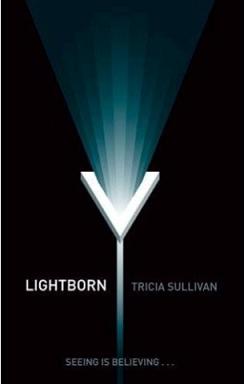
Lightborn — Tricia Sullivan

Lightborn


Lightborn
Tricia Sullivan
438 pages
published in 2010

Late last year Tricia Sullivan decried the fact that of the ten Clarke Award winners in the last decade, only one had been a woman, which in turned triggered a long discussion about women in sf in general much of it indexed at Torque Control. For me personally this discussion triggered a resolve to read more sf and fantasy written by women, as they had been woefully underrepresented until then. It was through the same discussions I learned about Tricia Sullivan herself, who as a writer had been completely unknown to me until then. Not only did she trigger the debate, her novel Maul ended second in the top ten Future Classics poll that Torque Control ran. So I kept an eye out for it at the local library, but they didn’t have it.

What they had instead was Lightborn, her latest novel. It’s a classic coming of age story, set in the city of Los Sombres in a somewhat alternate America, where instead of computers they have Feynmans and people use a special sort of light, Shine to program their own brains, as well as communicate with their version of the ‘net, the field, which is also inhabitated by the lightborn of the title, artificial intelligences, both benign and rogue. There are safeguards build/created in the field to keep the lightborn tame and Shine under control, but of course these fail at the start of the novel –otherwise there’d be no story after all. It leaves almost all the adults in Los Sombres permanently Shined and useless and kids like Roksana and Xavier, our heroes, scrabbling to survive in the aftermath.

Read more…

Jennifer Pournelle’s The Mote in God’s Eye sequel actually looks interesting

Sequels written to well loved science fiction classics by the children of the original writer never turn out right therefore you can safely ignore them. It’s a rule that saved me a lot of frustration, but I think I might break it for Jennifer Pournelle’s Outies, a sequel to her father’s and Larry Niven’s The Mote in God’s Eye. If the novel is as interesting and intelligent as this article makes it out to be, this could be a very good book:

What do you want the reader to get out of your novel?

JP: That monolithic viewpoints tend to drown out available options. That “first contact” is not a singular event. That urban sustainability depends upon ecological sustainability. That local people are not necessarily incompetent. That religion is as much about organizing principles as about belief systems. That the “hard science” in science fiction isn’t (or should not be) limited to physics and rocketry – to genuinely do “hard science,” you need to get your biology, geology, archaeology, anthropology, etc. right too.

Pournelle herself is an archaeologist and here she’s hitting a lot of my buttons — science fiction with a genuine grasp of the complexity of human history is rare and even in modern sf a lot of planets still feel no bigger than a small island…

A novel to look out for. Thanks James.

Crowpoek

jackdaws snacking on kroepoek

A somewhat blurry picture of us feeding the jackdaws at the hospital. They’re snacking on kroepoek, an Indonesian shrimp based crisp like snack, de riguer when you’re getting a Indo-Chinese takeaway, popular with crows as well as people so it seems.

And yes, that means S. is still in hospital, after three unsuccesful attempts to get back home earlier in the year. It’s still unknown when she can try again, but she’s waiting to undergo yet another operation, to cure yet another problem caused by interactions between the various medications she’s on. I’ll spare y’all the details, but it’s a long story full of medical mistakes and accidents that are more the product of the whole medical process as a whole than the fault of any one individual. It’s all getting her down, as you can imagine, so if you want to cheer her up a bit…