Her facts are all wrong, but does she get the spirit of the thing!

While Sarah Newton gets everything, but everything wrong about hard science fiction to rage against a problem with it that does not exist, she inadvertedly gets the spirit of it spot on in her introduction:

ow, a hundred or so years ago, it was widely regarded that all the known laws of physics had been discovered, and that theoretical physics was a “completed” science, with nothing more to do other than cross a few t’s and dot a few i’s. It was also believed that if you travelled more than 15 miles per hour in an automobile you’d probably suffocate…

Can you see what’s wrong with that? That’s right, “a hundred or so years ago” gets you to 1911, after the Wright Brothers, when the automobile was well on its way to become more than just a rich man’s toy and when steam locomotives had been travelling at speeds greater than fifteen miles an hour with no reports of suffocation for donkeys ages. Worse, 1911 was smack dab in the middle of the Einsteinian revolution, six years after Einstein’s Annus Mirabilis in which he introduced the special theory of relativity, his observations about the photoelectric effect that helped get quantum mechanics started, not to mention that whole E=MC squared thingie.

In this small paragraph Sarah gets her facts wrong, doesn’t think through when “a hundred years ago” was and ignores actual history and science for comforting myths about Progress — sounds remarkable like most hard science fiction to me.

(It doesn’t get much better in the rest of the post. Thanks James.)
Bruce Sterling reports on the Dutch War on Culture

Bruce Sterling comments on the philistinism of the current Dutch government’s arts policies:

“There are absolutely no policy reasons for the €200 million of cutbacks. This deal was struck with the PVV in exchange for its support in parliament of the minority cabinet. The intention is to inflict irreparable damage on an entire profession. Zijlstra is striving to decimate and eliminate this professional group’s creative, innovative and critical potential. Not a single member of his own party (VVD), or anyone from its coalition partner, the CDA (Christian Democratic Party) has opposed him. As far as they are concerned, traditional art is merely the superfluous ornamentation of a society. Contemporary art is labelled as alienating, and even, although no one actually says it out loud, as ‘degenerate art’.

The notion of “entarte kunst” does fit in well with the rightwing “populism” of the PVV and Wilders, as I also noted yesterday, but as Bruce Sterling indicates, the betrayal of the art by the supposedly respectable CDA and VVD is just as nihilistic. This is something that would not have been possible twenty or even ten years ago, but a decade of relentless rightwing philistinism in which everything had to be reappraised solely for its commercial potential has eroded the sense of social responsibility these parties used to hold. Obviously, there have alwas been disagreements over the arts and funding thereof; what’s new is the idea that they shouldn’t be funded at all, apart from very respectable high culture institutes like the Rijksmuseum or Concertgebouw. This is an ideologically driven attack, one that wants to make art safe for the rich and only aimed at their tastes.

Rightwing hobbies

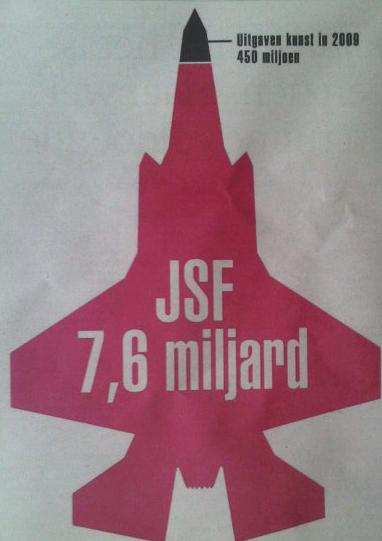
Total cost of Dutch culture budget v total cost of JSF

So we got ourselves a rightwing minority goverment in the Netherlands a while back, who now rule with support of the racists aka Geert Willders and his “Freedom Party”. Wilders thanks his success by pandering to the worst prejudices of the socalled common man, while the government thanks its succes to pandering to Wilders. Which explains why while the government tries to sell us on how Maturely they are trying to handle the Very Serious Task of getting Holland’s finances back in order in the wake of the bankers’ crisis, the sort of measures they come up with is to slash the culture budget. As the picture on top shows, the total amount of money the government spents each year on culture is roughly 450 million euros: a lot of money, but nothing compared to the 7,6 billion euros it would cost to buy the F-35. So why is that sacrosant when cutting the cultural budget is only penny ante stuff?

Because stopping money being “wasted” on opera, theatre and other “leftwing hobbies” as Wilders put it, is a goal in itself for this government. It keeps Wilders and its voters happy, can be spun as showing how serious the government takes the budget deficits and pisses off the leftwing opposition. Who cares that it doesn’t help achieve its nominal goal as long as white elephants like the F-35 are kept fully funded but does destroy a lot of cultural capital?

Pure pandering. And to add insult to injury, not only are the budgets slashed, the value added tax paided on art and other cultural products will be upped as well, from six to nineteen percent. Except on porn. Because wanking is a rightwing hobby…

The Second Anglo-Dutch War — Gijs Rommelse

The Second Anglo-Dutch War


The Second Anglo-Dutch War
Gijs Rommelse
230 pages including index
published in 2006

I’m not sure if in these enlightened times they still do it, but if you ever come across a Dutch naval ship with a broom in the top of her mast and you want to know what’s that all about, read up about the Second Anglo-Dutch War and especially the Dutch raid on Medway, when the English fleet was “swept” from the sea. Yes, though these days the Dutch have been reduced to the butt of cheap racist jokes about dope smoking and homosexuality in the English consciousness, there once was a time when Holland was Britain’s greatest enemy and competitor, despite the common ground between the two countries. In fact, it was exactly this common ground that was the problem. England and Holland both were dependent on trade for their prosperity, both tried to monopolise the lucrative trade in e.g. spices and it was inevitable that they would fight for supremacy — it took four wars in total for England to get the upper hand. Of the four wars, the Second Anglo-Dutch War (1665–1667) was the one with the clearest Dutch victory.

Apart from that very general outline however, I knew little about this war, so I’m glad Gijs Rommelse decided to turn his thesis into a proper book. The Second Anglo-Dutch War‘s main interest lies in determining the causes of the war, how commercial, as well as both foreign and domestic political considerations on both sides drove the countries to war. In process Rommelse also delivers an overview of the war itself, giving short and to the point accounts of all aspects of the war, including the struggle in the Americans and the privatering both the English and the Dutch engaged in. This was after all as much as anything a war about trade.

Read more…

They came from the seventies

From James Nicoll: which of these female sf/f authors who debuted in the 1970ties do you know? Italicize the authors you’ve heard of before reading this list of authors, bold the ones you’ve read at least one work by, underline the ones of whose work you own at least one example of.

  • Lynn Abbey
  • Eleanor Arnason
  • Octavia Butler
  • Moyra Caldecott
  • Jaygee Carr
  • Joy Chant
  • Suzy McKee Charnas
  • C. J. Cherryh
  • Jo Clayton
  • Candas Jane Dorsey
  • Diane Duane
  • Phyllis Eisenstein
  • Cynthia Felice
  • Sheila Finch
  • Sally Gearhart
  • Mary Gentle
  • Dian Girard
  • Eileen Gunn
  • Monica Hughes
  • Diana Wynne Jones
  • Gwyneth Jones
  • Leigh Kennedy
  • Lee Killough
  • Nancy Kress
  • Katherine Kurtz
  • Tanith Lee
  • Megan Lindholm (AKA Robin Hobb)
  • Elizabeth A. Lynn
  • Phillipa Maddern
  • Ardath Mayhar
  • Vonda McIntyre
  • Patricia A. McKillip
  • Janet Morris
  • Pat Murphy
  • Sam Nicholson (AKA Shirley Nikolaisen)
  • Rachel Pollack
  • Marta Randall
  • Anne Rice
  • Jessica Amanda Salmonson
  • Pamela Sargent
  • Sydney J. Van Scyoc
  • Susan Shwartz
  • Nancy Springer
  • Lisa Tuttle
  • Joan Vinge
  • Élisabeth Vonarburg
  • Cherry Wilder
  • Connie Willis

Lots of names I recognise but either never read or only read a few stories off in various anthologies.