Underwater — #aComicaDay (6)

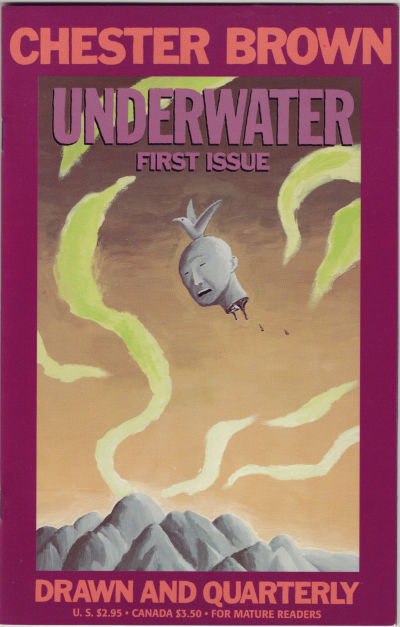
A granite head is floating above a grey mountain range

What if you created a biographical comic following one woman from her birth to her death? And because she obviously doesn’t understand language as a baby, all the dialogue will be gibberish at first?

Chester Brown does love to set a challenge for himself, but Underwater turned out a bridge too far. Autobiographical stories about learning to wank? Fine. Having a protagonist with Ronald Reagan for a penis? Great! Issues upon issues of indecipherable text? Not so much. The art may not have helped either, with all the characters bald and barely looking like human in that first issue. Underwater lasted eleven issues before he abandoned it for the easier challenge of creating a series about Canadian folk hero Louis Riel.

I only got this first issue, probably a year or two after it had been published (in 1994). In the mid-nineties I moved to Amsterdam to go to college there. Not unsurprisingly, that was also my taste in comics broadened out from just reading superheroes. Partially this was due to me subscribing to the Comix-L mailing list, but that’s a story for another time.

The nineties were also the “golden age” of Canadian autobiographical cartoonists: Julie Doucet, Seth, Joe Matt and Chester Brown and I started reading all of them. Yet, as it was for most people, Underwater was still a bit too avant garde for me…

The Maze Agency 9 — #aComicaDay (5)

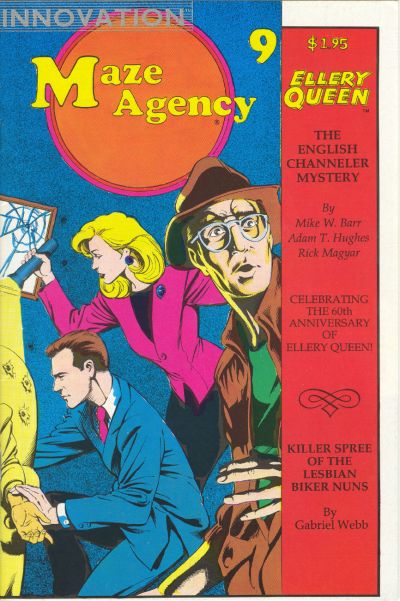
Mike W. Barr’s detective team gets a little competition from none other than Ellery Queen in solving the murder attempt on a mystic channeling the spirit of an Atlantean sorcery 10,000 years dead — who claims he is the one trying to kill her!

Ellery Queen is investigating a corpse in a comfy chair while Jennifer Mays is shining a flashlight at it. Gabriel Webb is looking at something behind them. The cover is done up like the Ellery Queen Mystery Magazine

Mike W. Barr was a big Ellery Queen fan as the editorial page explains and with 1989 being the 60th anniversary year of the first Queen story published, he asked for and got permission to use him in this story, apparantely the first new Ellery Queen mystery in fourteen years.

This is the sole issue of The Maze Agency I own. I’ve never seen another issue pop up, either new or in the back issue bins, though it had a relatively healthy twentythree issue run first at Comico and then at Innovation from 1988 to 1991. There have also been several reboot attempts. It’s a bit of an oddity, a proper, classical detective series which actually tries to create fair mysteries for the reader to solve, when most American detective series are of the hardboiled variety. Mike W. Barr is probably still best know for his Batman work in the eighties (alongside Camelot 3000), especially Batman and the Outsiders, so he wasn’t quite new to writing murder mysteries. The artwork here is by Adam Hughes, present on the first nine issues.

I only knew about this because Comics Scene had done an interview with Barr about his current projects at the time. Comics Scene was a glossy comics and animation magazine in the vein of Fangoria or Starlog, with half of each issue devoted to animation as well as comics based movies and tv, the other half to interviews with comics creators and other comics news. My local comic shop started carrying it at roughly the same time as it started selling US comics and it was one of the few ways I learned about new and upcoming projects. I’ve always had a soft spot for it ever since but in the nineties it lost out to the wave of comics as investment huckster zines like Wizard. Unlike those though it was smart enough to see that the mid-nineties superhero boom would inevitably crash and honest enough to warn its readers about it.

Innovation, The Maze Agency‘s publisher for most of its run, was an interesting company. Founded in 1988 by David Campiti it became a fairly major player in the few years between the decline of the old school indepedents like Comico and the rise of Valiant and Image. Ironically, given its name, it had its biggest success doing comics of various nostalgic media franchises like Lost in Space as well as long, (twelve issue) adaptations of several Anne Rice novels. The Maze Agency wasn’t the only series it had taken over from a defunct company. They also continued various superhero titles from publishers that went bankrupt during the black & white comics bust. Sadly, they in turn went bankrupt in 1994.

Uncanny X-Men 248 — #aComicaDay (4)

Jim Lee joins the team and makes them sexy again.

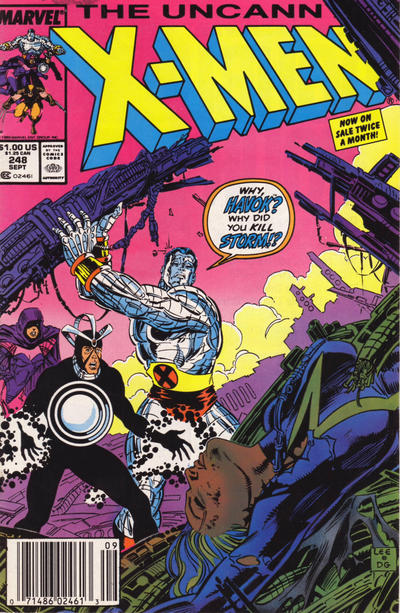
Storm is lying motionless in the foreground while havok is looking desperate at her. Collossus lifts up a piece of debris and asks Havok why he killed her.

The very first American Uncanny X-Men issue I ever bought and also the debut of Jim Lee as the penciler. If only I had been more careful with this issue I could’ve sold it and retired on the profits… I had started reading superhero comics in 1987 and had been buying the Juniorpress version of the X-Men, roughly a year behind the original, since 1988. And then in the summer of ’89 my local comics shop started experimenting with selling new American comics so I started buying those. Frustratingly, they did stop doing so for a few months which meant I missed a few key issues from that time…

This issue came at the tail end of the whole “X-Men Down Under” arc, when the team was already falling apart again. In a few issues they would all be gone and the next year or so would be spent in yet another “rebuilding the X-Men” project. ironic, considering sending them to Australia had been intended as a fresh start as well. I’ve said it before that Claremont at this late stage was stuck in a rut, never letting his characters catch a break. The ‘mistake’ I made there of course was reading a year’s worth of stories in one go: then this is a tedious slog. Read as intended though, issue by issue as it came out it kept me on the edge of the seat. With Claremont you never knew what would come next, just that it would rarely be something good to our heroes…

But still, Claremont was running out of gas. Australia hadn’t quite worked out, something new was needed. In the past Claremont was always at his best when he had a good artist to bounce off of: John Byrne, David Cockrum, Paul Smith each in turn had revitalised the series. Jim Lee could do that too.

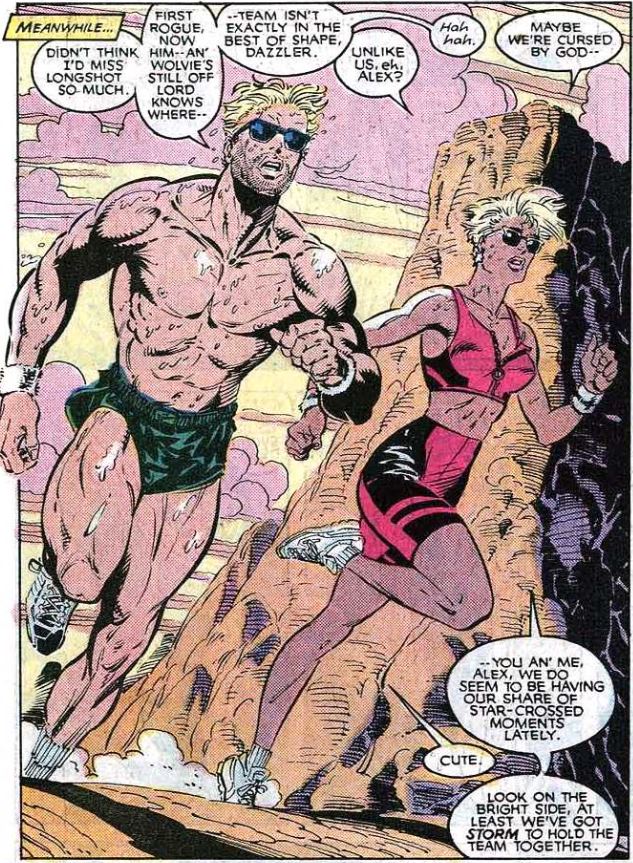
Havok and Dazzler going for a run. Havok is topless and sweaty, Dazzler is tanned and wearing a crop top.

But it took some time. Issue 248 was only a fill-in; Silvestri was back the next issue and would remain until #256, when Lee would return for a three issue stint. He would only take over as the regular artist with #268, twenty issues after his debut. Starting from that point on, the series did have a new energy to it, though ironically it would ultimately lead to Claremont’s departure. But that was still in the future at this point.

Even as ‘just’ a fill-in that debut had a real imapct, at least on fifteen year old me. I liked Marc Silvestri well enough and his slightly cartoony, scratchy drawing style, but Lee brought something he lacked: the horny. Just look at Havok’s chiseled abs and Dazzler’s casual sexiness there. That was a lot for a nerdy teenager like yours truly. It’s no wonder Lee got so popular, so quickly. It’s also no wonder he even got Marc Silvestri to change his style; just look at his work on Cyberforce later…

As a story, uncanny X-Men #248 is just another day of misery for the X-Men, but artwise then it was a revelation. A turning point in the series history, even if it wasn’t obvious at the time.

Dutch Treat — #aComicaDay (3)

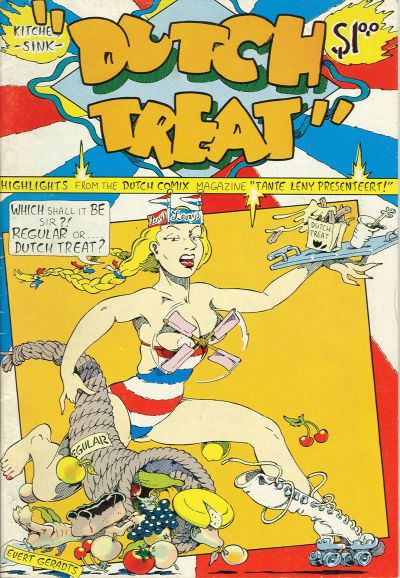
Joost Swarte! Mark Smeets! Bill Bodéwes! Harry Buckinx! Ever Meulen! Peter Pontiac! Aart Clerkx! Evert Geradts! ‘Tante’ Leny Zwalve! A cornucopia of Dutch underground artists you very likely won’t have heard of, except maybe Joost Swarte on display in this 1977 Kitchen Sink oneshot.

A blonde pig tailed girl in a red wjhite and blue striped swimsuit on roller skates offering a regular treat (the horn of plenty) or a Dutch treat (fries with mayo and a cup of coffee)

I got this at the Haarlemse Stripdagen in 2022 together with half a dozen other great underground comix from two elderly gentlemen selling their collection.

Underground comix are hard to define and really only existed for a decade and a half. Created, published and distributed outside of the existing commercial comics industry, the underground started off with a few pioneers self publishing their comic strips in the early sixties. By the end of the decade several publishers (Rip-off Press, Last Gasp and Kitchen Sink e.g.) were active and there was a distribution system centered on the socalled head shop. The underground comix movement always had firm ties to the whole sixties counter culture though it wasn’t quite part of it. It did however share its fascination with sex, drugs and rock ‘n roll, though mostly the first two. Even if often prurient, underground comix offered a freedom denied to the staid commercial comic, nobbled as it was by the Comics Code. As hippie idealism died off in the cold light of Nixon’s America and drugs repression put head shops out of business, the underground comix boom slowly collapsed but not without having inspired generations of new comics artists.

Sad to say, in the Netherlands at the time American comics were largely ignored, seen as pure pulp with no merit. The Franco-Belgian tradition was dominant and except for Disney there wasn’t really any place for American artists in the Dutch magazines. Even so there was what you could arguably call an underground movement by the late sixties and early seventies, partially coming out of rock zines like Aloha and with some ties to the radical hippie movement. It was through Olaf Stoops’ Real Free Press that American underground comix would be imported and more, it would also publish Dutch translations as well as original work from Dtch cartoonists. All of which led to the creation of Tante Leny Presenteert in 1971, created by Leny Zwalve and Evert Geradts.

Whether this was the “first Dutch underground comic” as the introduction page in Dutch Treat has it is debatable because at roughly the same time Joost Swarte had published his Modern Papier zine, which would later merge with Tante Leny and there had been some Real Free Press publications already if I’m not mistaken. (So much of the history of Dutch comics has not been written yet though so it can be hard to tell at this late date.) But it was certainly the longest running, ending in 1978 with twentyfive issues. And the people it published were some of the most influential cartoonists of the seventies and beyond.

Dutch Treat, as you can see from the table of contents, offers a good overview of the most important talents the zine published over the years. My personal favourites here are Joost Swarte with his darkly ironic clear line style and Peter Pontiac, here represented with a four pager showing off his gritty, realistic style of drawing. Also excellent is Evert Geradts’ “Crump meets Disney” big nosed art work. On the whole, if you want a good overview of what the Duitch underground scene was like, this is a great introduction.

Starslayer #2 — — #aComicaDay (2)

The second issues of Starslayer, Mike Grell’s attempt to rekindle the success he had with Warlord for DC by essentially creating Warlord… In Space. But that’s not important right now as this is also the debut for Dave Stevens’ Rocketeer!
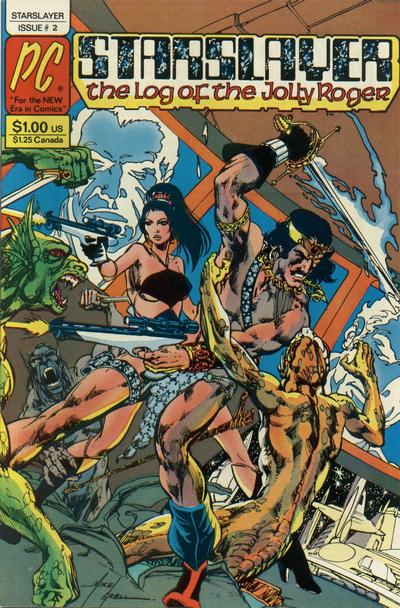
A topless barbarian dude is fighting off green skinned lizard like aliens with a flaming sword and a laser pistol. Next to him a dark haired woman is also firing a laser pistol

I actually didn’t know I had this until after I moved and started cataloguing my comics the other day — using the Grand Comics Database‘s free service to do so. One of those issues I picked up at a comic con or comic shop’s back issue bins sometime in the nineties. My first issue of this series was number four, picked up because I had been a Mike Grell fan ever since I saw Warlord reprinted in the Dutch Batman comics. That issue had a fan letter from none other than Bill Mantlo praising The Rocketeer, as well as a few others gushing about it.

The Rocketeer would run in issue two and three of Starslayer before it continued in Pacific Presents 1 and 2. For what was basically Stevens first feature, he hit a homerun. Never particularly prolific it would take years and several publishers before the story started in this issue would be completed. Nevertheless, it was popular enough to be made into a movie in 1991. What struck readers was not just Stevens’ incredible art, on a par with e.g Steve Rude, but the setting and how he mixed and matched famous real life people with equally famous pulp characters. The Rocketeer’s girlfriend is Bettie Page; the one after the rocket pack is Doc Savage. Back in 1982 this sort of thing was unheard of.

As for Starslayer, as Grell himself put it, it was intended as the exact opposite of Warlord: instead of a modern man flung into a barbarian world, it stars a barbarian transported to the far flung future, from his own Celtic era fighting Roman oppression to a time when the Sun has gone nova. It is his job, together with Tamara, the scientist who plucked him from his time, to prevent the total destruction of Earth and the Solar System.
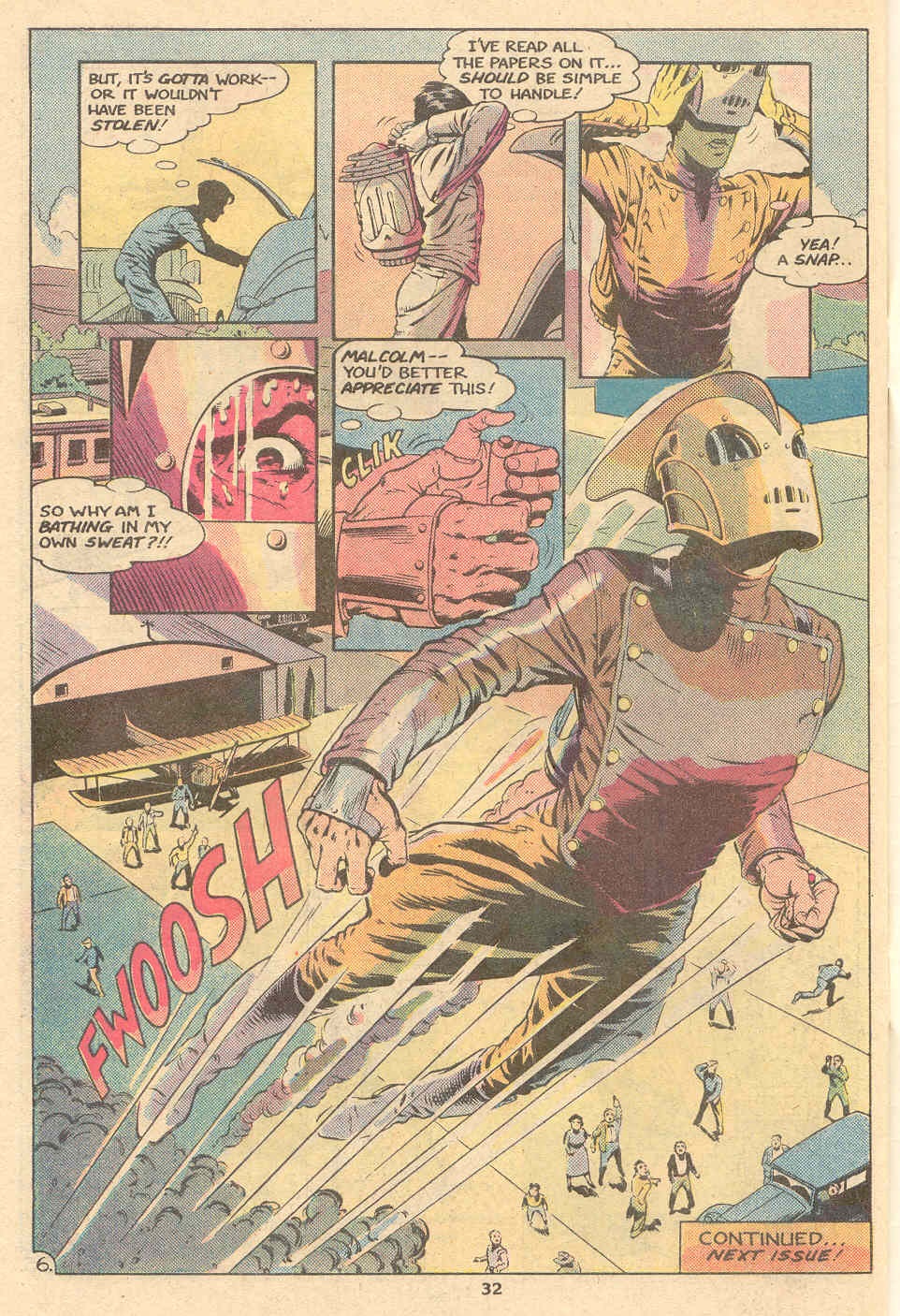
Final page of the first Rocketeer installment with the final panel showing the Rocketeer flying for the first time

The series lasted only six issues at Pacific Comics before Grell jumped ship to First. By the eight issue Grell had stopped doing the artwork for it; by the ninth he had handed over the writing to one John Ostrander. Ostrander, together with new artist Timothy Truman, would wrap up the story and take the series in a new direction. Ironically, just as with the Pacific Comics version, at First too Starslayer would have a backup feature overshadowing the main story, as with issue ten Ostrander & Truman’s Grimjack would start running. ultimately Starslayer lasted 28 issues for a total of 34 at First. Grell himself would come back and do a ‘directors cut’ of the first six issues in the nineties for Acclaim/Valiant.

Pacific Comics was one of the original independent publishers made possible by the creation of the direct market in the late seventies and early eighties. It was originally a distributor of comics to comic shops and saw its chance to publish it own series. Active from 1981 to 1984, it published various high profile creator owned titles. Apart from Grell, there was also Jack Kirby doing various superhero titles, Sergio Aragonés debuting Groo the Wanderer as well as Berni Wrightson, Bruce Jones and Arthur Suydam. For various reasons, mainly due with the collapse of the distribution sid, the company went bankrupt in 1984, most titles ending up at rival independents like Eclipse or First.